For most buyers seeking drones with camera, I’d start with the DJI Mini 5 Pro Fly More Combo with DJI RC 2, which pairs a 1-inch sensor with a dedicated controller for more capable aerial filming. The DJI Mini 4K Combo is a simpler 4K option, while screen-equipped controllers on several budget picks can make flight easier to follow without relying on a phone. The main tradeoffs are camera stability and image quality versus portability, ease of use, and how much control feedback you get. A 4K label alone does not tell you whether footage will look smooth, so camera stabilization and flight behavior matter too. Read on for the full breakdown and help matching a drone to your filming goals.

Get audio and creator gear delivered free with Prime
- Fast, free delivery on millions of items
- Prime Video, Amazon Music and more included
- Member-only deals all year
Complete the kit


Key Takeaways
The DJI Mini 5 Pro Fly More Combo is the strongest camera-first pick in this lineup, led by its 1-inch sensor; buyers should weigh its more capable feature set against the simpler Mini 4K options.
The DJI Mini 4K Combo adds a three-axis gimbal and a second battery, making it a more complete choice for stabilized 4K footage and longer outings than the single-battery Mini 4K.
The Mini 5 Pro Fly More Combo Plus is a premium alternative for buyers prioritizing a higher-capacity package, while the standard Mini 5 Pro remains the more straightforward way into the same camera family.
Several lower-cost picks use 1080P or 2K cameras and beginner flight aids. They suit practice and casual viewing better than buyers who want the image quality and stabilization of the DJI 4K models.
A built-in controller screen can reduce phone setup and make framing easier, but it does not by itself indicate better camera footage; compare the camera and stabilization separately.


| drones with camera | Weight | Camera | Flight time | Camera resolution |
|---|---|---|---|---|
| Drone with Camera and Built-in | — | 1080P HD, 80° adjustable lens | Up to 25 minutes | — |
| DJI Mini 5 Pro Fly More Combo | 249.9 g | 1-inch CMOS, 4K/60fps HDR | Up to 36 minutes | — |
| DJI Mini 4K Camera Drone Combo | 249 g | 4K UHD | — | — |
| DJI Mini 5 Pro Fly More Combo | 249.9 g | 1-inch CMOS, 4K/60fps HDR | Up to 52 minutes | — |
| DJI Mini 4K Drone with 4K UHD | Under 249 g | 4K UHD | — | — |
| Foldable Drone with 1080P HD C | — | — | — | 1080p HD |
| GPS Drone with 1080P Camera | 206 g | — | Up to 22 minutes | 1080p |
| Foldable Drone with 1080P Came | 4.2 ounces | — | Up to 25 minutes with two batteries | 1080p |
| 2K HD FPV Drone with Camera fo | Under 250g | — | — | 2K HD |
| Drone with Camera for Adults | Under 250g | — | — | 2K HD |
More Details on Our Top Picks
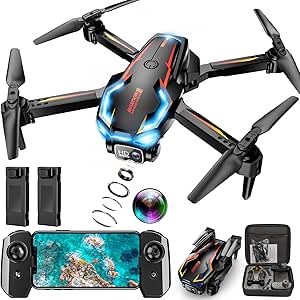
Drone with Camera and Built-in Screen on Controller
The PK01 is the clearest choice here for buyers who want to see the camera feed without mounting a phone: its controller has a built-in HD screen, while the DJI Mini 4K models rely on a compatible phone and app. Its 1080P adjustable camera and 25-minute flight time suit casual practice and nearby views, but they are a step down from the 4K footage and gimbal stabilization offered by the Mini 4K. Foldable construction, propeller guards, and a child lock make it more approachable for family use, and flight modes add variety. The tradeoff is that some functions use the app, and saving footage requires a separate SD card. I’d choose it for convenient, low-pressure flying rather than polished travel video.
Pros:- Built-in controller screen shows live footage without a phone
- Adjustable 1080P camera supports casual aerial viewing
- Propeller guards and child lock add safeguards for beginner use
- Foldable design and multiple flight modes make it versatile for practice
Cons:- 1080P footage lacks the resolution and stabilization of the DJI Mini 4K models
- An SD card is required for saving photos and video, and is not included
- Some advanced controls depend on app use and may take time to learn
Best for: Families and first-time pilots who want a live camera view on the controller without relying on a phone.
Not ideal for: Travel creators who need stabilized 4K footage, or pilots who want to record without buying a separate SD card.
- Camera:1080P HD, 80° adjustable lens
- Flight time:Up to 25 minutes
- Control modes:Remote control and app control
- Flight features:One-key takeoff and landing, headless mode, 360° flips, waypoint fly, gravity control, voice commands
- Safety features:Propeller guards, child lock, low-power alarm
- Design:Foldable
Our verdict“Choose the PK01 if a phone-free live view and beginner-friendly safeguards matter more than 4K image quality.”
DJI Mini 5 Pro Fly More Combo with DJI RC 2, 1-Inch CMOS
For buyers who put image quality and flight protection first, the DJI Mini 5 Pro Fly More Combo is the strongest camera-led pick in this group. Its 1-inch CMOS sensor and 4K/60fps HDR video offer more room for detailed, high-contrast footage than the DJI Mini 4K’s 4K camera, while omnidirectional sensing with LiDAR and vision sensors can help detect obstacles from more directions. The included DJI RC 2 and three batteries make it a more self-contained creator kit than the single-battery Mini 4K package. The tradeoffs are the higher feature complexity and the need to download DJI Fly outside Google Play on Android. Its stated weight is 249.9 g, so buyers should check the rules where they plan to fly rather than assume every location treats it alike.
Pros:- 1-inch CMOS sensor captures 4K/60fps HDR video
- Omnidirectional obstacle sensing combines LiDAR and vision sensors
- DJI RC 2 provides a dedicated controller, and the combo includes three batteries
- Foldable 249.9 g design is easier to pack than larger camera drones
Cons:- DJI Fly requires a manual download on Android rather than installation through Google Play
- Advanced camera and sensing features may be more than casual flyers need
- Local operating rules may apply; the stated weight is 249.9 g
Best for: Travel and outdoor video creators who want a compact drone with a higher-end sensor, obstacle sensing, and multiple batteries.
Not ideal for: Casual pilots who only need basic 4K footage, or Android users who prefer installing apps only through Google Play.
- Weight:249.9 g
- Camera:1-inch CMOS, 4K/60fps HDR
- Flight time:Up to 36 minutes
- Gimbal rotation:225°
- Obstacle sensing:Omnidirectional with LiDAR and vision sensors
- Controller:DJI RC 2
- Included accessories:Three batteries, spare propellers, charging hub, ND filters
Our verdict“Pick this combo for the most capable camera and sensing package here, provided you are comfortable with DJI’s app setup and local flight rules.”
DJI Mini 4K Camera Drone Combo, 4K UHD, 249g, 3-Axis Gimbal, 10km Transmission, Auto Return, 2 Batteries
The DJI Mini 4K Combo makes the strongest case for buyers who want stabilized 4K footage without moving up to the Mini 5 Pro’s more advanced sensor and obstacle sensing. Its 3-axis gimbal helps keep video steady as the drone moves, a meaningful advantage over the PK01’s adjustable 1080P camera when footage quality is the priority. Two batteries are included, with a stated combined flight time of 62 minutes, so a session need not end after one battery. The 10 km transmission figure is a specification, not a reason to fly beyond legal or safe limits. Compared with the single-battery DJI Mini 4K, this combo is better suited to longer outings; it still lacks the Mini 5 Pro’s 1-inch sensor and advanced sensing, and DJI Fly app setup may require a website download.
Pros:- 4K UHD camera paired with a 3-axis gimbal for steadier footage
- Two batteries provide up to 62 minutes of stated combined flight time
- 249 g design is compact for travel and everyday outings
- QuickShots and beginner-friendly controls simplify basic aerial clips
Cons:- Does not offer the Mini 5 Pro’s 1-inch sensor or omnidirectional obstacle sensing
- DJI Fly may need to be downloaded from DJI’s website on Android
- Long transmission range does not remove the need to follow safe flight limits
Best for: Newer pilots and hobby videographers who want a stabilized 4K camera and two batteries in one kit.
Not ideal for: Creators seeking a 1-inch sensor, HDR capture, or advanced obstacle sensing like the DJI Mini 5 Pro offers.
- Weight:249 g
- Camera:4K UHD
- Gimbal:3-axis
- Max video transmission:10 km
- Combined battery life:Up to 62 minutes with two batteries
- Wind resistance:Level 5
- Maximum altitude:Up to 4,000 meters
Our verdict“Choose this combo if stabilized 4K video and extra battery time matter more than the Mini 5 Pro’s higher-end camera and sensing features.”
DJI Mini 5 Pro Fly More Combo Plus with DJI RC 2, 4K Camera Drone
The Mini 5 Pro Fly More Combo Plus is the endurance-focused choice for creators who want the Mini 5 Pro camera and sensing package with a longer stated flight time. It shares the 1-inch CMOS, 4K/60fps HDR camera, 225° gimbal rotation, and omnidirectional LiDAR and vision sensing of the standard Mini 5 Pro combo, but lists up to 52 minutes of flight time and 42GB of internal storage. Against the standard combo’s stated 36 minutes, that extra airtime can mean fewer battery changes during a shoot. The DJI Mini 4K Combo remains a simpler 4K alternative, but it does not match the Pro’s camera sensor or obstacle sensing. This Plus kit still has the same app-download friction, and the listed 249.9 g weight makes checking local rules sensible.
Pros:- 1-inch CMOS sensor records 4K/60fps HDR video
- Up to 52 minutes of stated flight time supports longer sessions
- 42GB internal storage provides onboard space for footage
- Omnidirectional LiDAR and vision sensing help detect obstacles
Cons:- DJI Fly must be downloaded outside Google Play on Android
- Pro-level features may be unnecessary for basic recreational filming
- At 249.9 g, it is not safe to assume the same rules apply everywhere
Best for: Video creators planning longer outdoor shoots who want the Mini 5 Pro’s camera and sensing features with more stated airtime and internal storage.
Not ideal for: Occasional flyers who do not need the Pro camera and sensing suite, or buyers who want to avoid manual app installation and local-rule checks.
- Weight:249.9 g
- Camera:1-inch CMOS, 4K/60fps HDR
- Flight time:Up to 52 minutes
- Gimbal rotation:225°
- Obstacle sensing:Omnidirectional with LiDAR and vision sensors
- Storage:42GB internal
- Included accessories:DJI RC 2, three batteries, spare propellers, charging hub, ND filters
Our verdict“Choose the Plus combo over the standard Mini 5 Pro if longer stated flight time and onboard storage are priorities for your shoots.”
DJI Mini 4K Drone with 4K UHD Camera, Under 249g
The DJI Mini 4K is the most straightforward entry into 4K camera drones in this lineup: it pairs a sub-249 g design with a 3-axis gimbal, GPS Return to Home, and QuickShots that help beginners make composed clips without mastering every control. Compared with the two-battery DJI Mini 4K Combo, this version is a simpler starting package; battery choices can extend total flight time, but the listed maximum is 31 minutes per battery. It also cannot match the DJI Mini 5 Pro’s 1-inch sensor, HDR capture, or omnidirectional obstacle sensing. That keeps this model better suited to learning and everyday travel footage than demanding production work. Android buyers should also account for the DJI Fly app’s download process, and flight rules depend on location even for lightweight drones.
Pros:- 4K UHD camera with 3-axis gimbal stabilization
- Under-249 g weight makes it compact and easy to carry
- GPS Return to Home and stable hovering support beginner confidence
- QuickShots offer a simple route to more composed clips
Cons:- Maximum flight time is 31 minutes per battery
- Lacks the Mini 5 Pro’s 1-inch sensor and advanced obstacle sensing
- DJI Fly app installation may require a download from DJI’s website
Best for: First-time camera-drone buyers who want portable 4K footage, simple automated shots, and the option to add batteries.
Not ideal for: Experienced creators who need a larger sensor, HDR video, advanced obstacle sensing, or longer flight from a single battery.
- Weight:Under 249 g
- Camera:4K UHD
- Gimbal:3-axis
- Maximum flight time:Up to 31 minutes per battery
- Maximum transmission range:10 km
- Wind resistance:Level 5
- Battery options:1, 2, or 3 batteries; 62 to 93 minutes total flight time stated for multi-battery options
Our verdict“Pick this Mini 4K as a portable first camera drone if you want stabilized 4K video and can accept shorter flights per battery.”
Foldable Drone with 1080P HD Camera
I’d shortlist this foldable model for new pilots who want steady hovering and simple camera framing more than long-distance flights. Its adjustable 1080p camera and optical flow positioning help keep the drone settled while you learn basic movements, while headless mode and one-key return reduce some of the early control friction. Compared with the 2K HD FPV Drone (B0FXGPGYFP), this one gives up resolution and listed range but offers optical flow positioning, a useful aid when practicing closer to the ground. The tradeoff is a firm 200-foot maximum range, and the listing doesn’t specify battery life. I’d also budget for a separate microSD card, since one isn’t included. It suits casual practice and short trips, not distant or demanding aerial shoots.
Pros:- Adjustable 1080p camera supports changes to the shooting angle.
- Optical flow positioning helps steady the drone during hovering.
- Foldable, lightweight design is convenient for travel.
- Headless mode and one-key return offer simpler control options for beginners.
Cons:- Maximum listed range of 200 feet limits distance from the pilot.
- Battery life is not specified, making shoot planning harder.
- MicroSD card is not included for storing footage.
Best for: First-time flyers who want a portable drone for close-range practice, casual travel clips, and steadier hovering.
Not ideal for: Pilots planning long-range flights or extended filming sessions, since the stated range is 200 feet and battery duration is unspecified.
- Camera resolution:1080p HD
- Effective still resolution:12 MP
- Maximum range:200 feet
- Connectivity:2.4GHz Wi-Fi, RF
- Positioning:Optical flow positioning
- Battery type:Lithium-ion
- Control type:Remote control
- Age range:14 years and up
Our verdict“Choose this for close-range beginner practice with steadier hovering, but pick the 2K HD FPV Drone if camera resolution and listed range matter more.”
GPS Drone with 1080P Camera, 4.5″ FPV Screen, 5GHz Transmission
The built-in 4.5-inch FPV screen is the key distinction here: it gives outdoor flyers a dedicated viewing display rather than making a phone the center of the camera setup. The 1080p camera adds electronic image stabilization, and GPS-supported return features, follow mode, and orbit mode broaden its use beyond basic practice. Compared with the Foldable Drone with 1080P HD Camera (B0H7X72LF7), this model lists up to 22 minutes of flight and adds a screen-oriented control setup, while the other drone highlights optical flow positioning. Its 5GHz transmission and brushless motor are also listed, though the product data doesn’t state a maximum range. Storage is capped at 32GB, and a microSD card isn’t included. I’d favor it for casual outdoor filming, not buyers seeking higher-resolution footage or phone-free control in every respect.
Pros:- 4.5-inch screen supports live FPV viewing without relying solely on a phone display.
- Electronic image stabilization is designed to reduce visible camera shake.
- Lists up to 22 minutes of flight time.
- GPS-related return, follow, and orbit modes add filming options.
Cons:- MicroSD card is not included, and supported card capacity is limited to 32GB.
- The product data does not provide a maximum flight or transmission range.
- 1080p resolution is less suited to buyers seeking more detail than the 2K models in this roundup.
Best for: Outdoor beginners who want a dedicated FPV screen, GPS-assisted flight modes, and a stated flight duration for casual filming.
Not ideal for: Buyers who need 4K or 2K footage, large-capacity onboard storage, or a clearly stated long transmission range.
- Camera resolution:1080p
- Effective still resolution:8.85 MP
- FPV transmission:5GHz
- Display:4.5-inch FPV screen
- Flight time:Up to 22 minutes
- Battery capacity:2200mAh
- Weight:206 g
- MicroSD support:Up to 32GB
Our verdict“Pick this for screen-based outdoor FPV and GPS-assisted modes, but choose a higher-resolution model if detailed footage is your priority.”
Foldable Drone with 1080P Camera & Screen Remote Controller for Beginners
I’d give this model a narrow role: it pairs a built-in LCD remote with a foldable body and two batteries, so the live camera view doesn’t depend on a phone screen. Optical flow positioning and altitude hold are beginner-friendly aids, and the listing claims up to 25 minutes of flight across the included batteries. Against the GPS Drone with 1080P Camera (B0FQ5XGTC8), this one also offers a screen-based viewing setup, while the GPS model lists EIS, GPS flight modes, and a 4.5-inch display. The major concern is the stated 2-foot maximum range; taken literally, that leaves almost no room to fly or frame a useful aerial shot. The 2MP effective still resolution also makes this less appealing for image detail. I’d verify the range before buying it for camera use.
Pros:- Built-in LCD remote provides a dedicated live-view display.
- Optical flow positioning and altitude hold support steadier beginner flight.
- Includes two batteries with up to 25 minutes of claimed combined flight time.
- Foldable design and carry case support transport.
Cons:- The stated maximum control range is only 2 feet, severely limiting camera use if accurate.
- Effective still resolution is listed as 2 MP.
- Some advanced features require app control, adding setup complexity.
Best for: Beginners who want a remote with an integrated viewing screen and plan to fly only at very close range.
Not ideal for: Anyone expecting ordinary outdoor flight distances or useful aerial framing, given the listed 2-foot maximum range.
- Camera resolution:1080p
- Effective still resolution:2 MP
- Maximum range:2 feet
- Display:Built-in LCD screen on remote
- Flight time:Up to 25 minutes with two batteries
- Positioning:Optical flow positioning
- Weight:4.2 ounces
- Connectivity:Wi-Fi
Our verdict“Consider it only if the integrated screen is your priority and you can confirm the listed 2-foot range is accurate.”
2K HD FPV Drone with Camera for Adults – Foldable & Portable, 3 Speed Modes, One-Key Takeoff/Landing, Altitude Hold, Headless Mode, 2 Batteries, Gift for Beginners and Teens
This is the stronger fit for casual pilots who want a step up from 1080p without moving to a more advanced camera drone. Its 2K camera, adjustable angle, and listed 984-foot maximum range make it more appealing for broader outdoor framing than the Foldable Drone with 1080P HD Camera (B0H7X72LF7), whose listed range is 200 feet. Two batteries provide a stated 20 minutes of total flight time, and the foldable, under-250g design is convenient to carry. Those figures make this a travel-friendly option, though the data doesn’t describe image stabilization or GPS features. I’d treat it as a beginner and casual-use pick, not a substitute for the DJI Mini models elsewhere in the roundup, which list more advanced camera hardware. Its flight time may also feel short when you’re composing multiple shots.
Pros:- 2K camera resolution exceeds the 1080p models in this batch.
- Adjustable camera angle helps reframe shots in flight.
- Listed maximum range of 984 feet gives more room than the 200-foot 1080p foldable model.
- Foldable design and weight under 250g support portability.
Cons:- Two batteries provide 20 minutes of stated total flight time.
- The product data does not specify GPS or image stabilization.
- Positioned for beginner and casual use rather than advanced filming.
Best for: Teens and casual flyers who want foldable portability, 2K footage, and more listed range than the basic 1080p beginner models.
Not ideal for: Experienced aerial videographers who need advanced stabilization, pro-level camera controls, or long filming sessions.
- Camera resolution:2K HD
- Effective still resolution:12 MP
- Maximum range:984 feet
- Battery life:20 minutes with two batteries
- Connectivity:Wi-Fi
- Weight:Under 250g
- Material:Plastic
- Camera angle:Adjustable
Our verdict“Choose this for portable 2K casual footage and a longer stated range, but look to a DJI Mini model for more advanced camera work.”
Drone with Camera for Adults, 2K HD FPV Drones with Altitude Hold, One-Key Takeoff/Landing, Speed Adjustment, Headless Mode, 2 Batteries, Beginner Toy Gift
For a beginner weighing flight time against camera detail, this mini drone’s clearest advantage is its stated approximately 26 minutes across two batteries—the longest combined duration among these five listings. Its 2K camera, adjustable angle, optical flow positioning, and altitude hold make it a more capable practice camera than the 1080p Foldable Drone (B0H7X72LF7), though the latter lists a 12MP still resolution versus 2.2MP here. One-key takeoff and landing, speed adjustment, and headless mode keep the controls approachable, while the folded size is compact for carrying. The tradeoff is a feature set aimed at entry-level flying, with no listed maximum range and Wi-Fi needed for camera streaming. I’d pick it for repeated short practice flights, not for pilots who need detailed stills, advanced flight tools, or dependable long-distance framing.
Pros:- Approximately 26 minutes of stated battery life across two batteries.
- 2K camera with adjustable angles supports flexible framing.
- Optical flow positioning and altitude hold aid stable practice.
- Compact folded size of 5 x 3 x 2 inches supports easy packing.
Cons:- Effective still resolution is listed as 2.2 MP, below the 12MP figure for the 1080p Foldable Drone.
- No maximum control range is provided.
- Camera streaming requires a Wi-Fi connection, and advanced features are limited.
Best for: New pilots who want a compact 2K camera drone and more combined practice time from two batteries.
Not ideal for: Photographers who prioritize high-resolution still images, long-range control, or advanced filming features.
- Camera resolution:2K HD
- Effective still resolution:2.2 MP
- Video format:MP4
- Battery life:Approximately 26 minutes
- Weight:Under 250g
- Folded size:5 x 3 x 2 inches
- Connectivity:Wi-Fi
- Control type:Remote control
Our verdict“Choose this for beginner practice with longer combined flight time, but skip it if still-image detail or advanced camera controls are priorities.”

How We Picked
I compared these 10 camera drones by the parts of ownership that shape the footage and the flying experience: camera resolution and sensor details, stabilization, transmission and controller setup, battery configuration, portability, and beginner aids. Camera claims matter most when the drone can also keep the view steady and let the pilot frame shots reliably. I treated included batteries and a dedicated or built-in screen as practical benefits, not substitutes for camera capability.
The ranking favors models that offer a stronger combination of usable image quality, stable footage, and flight control. That puts the DJI Mini 5 Pro options and the gimbal-equipped Mini 4K combo ahead of basic 1080P and 2K foldable models for buyers focused on filming. The less expensive-featured beginner drones still have a place for practice and casual use, but their lower stated camera resolution and more limited filming focus make them less suitable as serious aerial cameras. Where product names give limited detail, I avoid assuming unlisted performance or capabilities.
| drones with camera | Flight time |
|---|---|
| Drone with Camera and Built-in | Up to 25 minutes |
| DJI Mini 5 Pro Fly More Combo | Up to 36 minutes |
| DJI Mini 4K Camera Drone Combo | — |
| DJI Mini 5 Pro Fly More Combo | Up to 52 minutes |
| DJI Mini 4K Drone with 4K UHD | — |
| Foldable Drone with 1080P HD C | — |
| GPS Drone with 1080P Camera | Up to 22 minutes |
| Foldable Drone with 1080P Came | Up to 25 minutes with two batteries |
| 2K HD FPV Drone with Camera fo | — |
| Drone with Camera for Adults | — |
Factors to Consider When Choosing Drones With Camera
Choosing among drones with camera starts with the footage you want, but the camera is only part of the decision. I’d also match controller setup, battery needs, portability, and flying support to where and how often you plan to fly.
Match Camera Quality to the Footage You Need
Start by deciding where your footage will be viewed: a phone screen, a large monitor, or a cropped social video. Higher resolution can preserve detail and give you more room to crop, but it cannot compensate for shaky footage or poor framing. Look for stabilization information alongside resolution, especially if you plan to film moving subjects or fly in breezy conditions. A three-axis gimbal, such as the one listed for the Mini 4K Combo, addresses camera movement more directly than a resolution figure alone. Avoid paying for a headline resolution if the listing does not explain how the camera is stabilized. For casual practice, a basic 1080P or 2K camera may be enough; for polished clips, camera and stabilization specifications deserve priority.
Choose a Controller That Fits Your Flying Habits
A controller screen can show the live camera view without requiring a phone, which may simplify setup and reduce interruptions from calls or notifications. A phone-based display can be convenient if you already carry a compatible device, but check how the connection works and what the package includes. Screen size and transmission claims are not the whole story: sunlight visibility, connection reliability, and how easily you can adjust camera framing also affect the flight. A built-in display does not automatically mean stronger image quality, so compare it separately from the camera. If you frequently film alone, a clear live view can matter more than a small difference in advertised resolution. If you mainly fly nearby for practice, a simpler controller may be sufficient.
Plan for Battery Time, Not Just Battery Count
Extra batteries let you spend more of an outing flying instead of waiting to recharge, but battery count alone does not reveal how long each flight lasts. Check the stated flight time, charging method, and whether batteries are included in the exact bundle you plan to buy. Wind, temperature, frequent acceleration, and camera use can all reduce practical flight time from a maker’s estimate. Combo packages can suit trips where charging access is limited, while a lighter setup may be easier to carry for brief sessions. A common mistake is to buy a drone with a strong camera but too little power for the planned shoot. For travel or event filming, plan spare batteries and a safe landing buffer into each flight.
Balance Portability With Wind and Flight Demands
Foldable designs are easier to pack, but small size does not mean every model handles outdoor conditions equally well. A light drone is convenient for travel and may fit more easily into a day bag; it can also be more affected by gusts than a larger, heavier aircraft. Consider where you will fly most: sheltered parks and open, windy coastlines place different demands on a drone. A compact aircraft can still be the better choice if you value portability and can choose calmer conditions. Do not treat a listed transmission distance as a promise of safe or reliable flight at that distance. Keep the aircraft within a range where you can maintain control and follow local rules.
Treat Beginner Modes as Assistance, Not a Substitute for Practice
One-key takeoff and landing, altitude hold, headless mode, and speed settings can make early flights less intimidating. They do not remove the need to learn orientation, braking, and how the drone responds when the controls are released. Beginners should practice in a wide, open space and start at a slower setting before attempting camera moves near people or obstacles. GPS features and return functions can help, but buyers should learn how these functions behave and set a suitable home point before flight. If a drone is mainly for learning, choose simple controls and clear live video over advanced camera features you will not use. For a beginner who also wants dependable filming, stronger stabilization can make practice footage more rewarding.
Check the Rules and Support Before Buying
Weight can affect which rules apply where you fly, but a sub-249g label does not mean a drone is free from every restriction. Confirm current local requirements for registration, operator competency, airspace, and privacy before taking off. Also check what the bundle includes: spare propellers, a charging hub, batteries, and a carrying case can change how ready the drone is for regular use. Review the maker’s repair process and availability of replacement parts, since propeller damage is a common cost of learning. If the product listing is vague about warranty, app support, or compatible accessories, treat that uncertainty as part of the buying decision. A camera drone is a better fit when the support and rules around it match your plans, not just when its feature list looks strong.
Frequently Asked Questions
Is a 4K camera worth choosing over a 1080P or 2K camera?
Choose 4K if you expect to crop footage, display it on a larger screen, or keep files that retain more detail for later editing. For casual clips viewed on a phone, 1080P or 2K may be adequate, especially if the drone is primarily for learning. Stabilization can matter as much as resolution: smooth, steady footage may look more usable than higher-resolution footage with visible shake. In this lineup, the Mini 4K models offer a clearer step toward dedicated aerial filming than the basic 1080P and 2K options. Compare the full camera system rather than choosing from the resolution label alone.
Should I choose the Mini 5 Pro or the Mini 4K for filming?
The Mini 5 Pro is the better direction if you want a more camera-focused option, with the listed 1-inch sensor as its main distinction. The Mini 4K is a more straightforward choice for buyers who want 4K recording and a three-axis gimbal without needing the Mini 5 Pro package. The Mini 4K Combo also includes two batteries, which can be useful for longer outings. If image capability is your priority, compare the Mini 5 Pro bundles; if a simpler 4K setup and extra battery matter more, look closely at the Mini 4K Combo. Check the exact bundle contents before choosing between versions.
Does a controller with a built-in screen make a drone easier to use?
It can simplify setup because you do not need to mount and connect a separate phone to see the live view. That is useful when you want a ready-to-fly controller or prefer keeping your phone free. A screen does not automatically improve camera quality, flight stability, or transmission reliability, so those details still need separate attention. If you already have a compatible phone and are comfortable using it, a built-in display may matter less. Compare screen visibility and the camera system as separate parts of the purchase.
Are 1080P and 2K foldable drones suitable for a first camera drone?
They can suit a beginner who wants to practice basic controls and capture casual clips without prioritizing highly detailed footage. Features such as speed modes, altitude hold, and one-key takeoff can make early flights less demanding. The tradeoff is that these models are not the strongest picks here for camera quality compared with the DJI 4K options. Before buying, check whether the live-view connection, replacement parts, and battery details are clear. If you want your first drone to stay useful as your filming skills grow, a stabilized 4K model may be a better long-term fit.
What should I check before flying a drone advertised as under 249g?
Confirm the drone’s actual takeoff weight in the configuration you will fly, including any accessories or batteries that affect it. Weight thresholds can change which rules apply, but they do not remove airspace restrictions, privacy responsibilities, or other local requirements. Check current aviation guidance for your location before the first flight, since rules can differ by country and change over time. Also learn the drone’s return-to-home behavior and keep it within a range you can control safely. Treat the weight figure as one planning detail, not permission to fly anywhere.
Conclusion
For the strongest all-around camera capability in this group, I’d choose the DJI Mini 5 Pro Fly More Combo with DJI RC 2; the Mini 5 Pro Fly More Combo Plus is the premium pick for buyers who prefer its higher-capacity package. The DJI Mini 4K Combo is my value choice for stabilized 4K footage with two batteries, while the single-battery Mini 4K is a simpler option if you want that camera class without the combo setup. For beginners focused on basic flying and casual clips, the foldable 1080P and 2K models offer approachable flight aids, though their camera claims are more modest. If a screen on the controller is your main need, compare the screen-equipped picks, but do not let the display outweigh camera stabilization. Choose according to the footage and flight experience you actually want: the best fit depends on whether image quality, ease of learning, extra batteries, or a self-contained controller matters most.
Halloween Picks
halloween
As an affiliate, we earn on qualifying purchases.