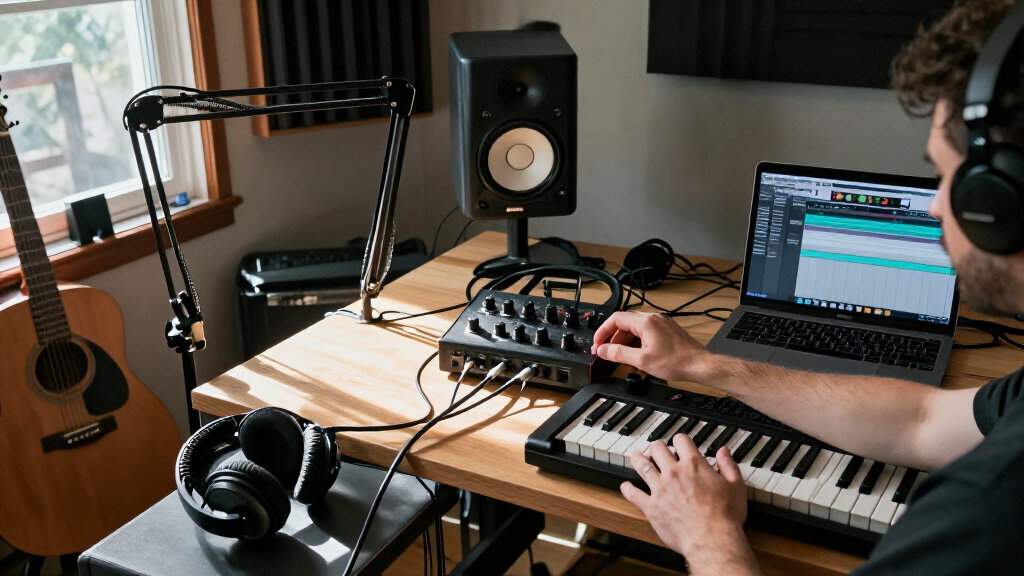

This checklist is for anyone putting together a home recording setup, whether you are starting with a few core pieces or filling gaps in a room you already use. The picks cover recording, monitoring, microphone placement, and room treatment.

Get audio and creator gear delivered free with Prime
- Fast, free delivery on millions of items
- Prime Video, Amazon Music and more included
- Member-only deals all year
Each section focuses on one essential equipment slot and names a product pick. The notes explain what to consider when choosing that type of gear, including how it may fit your room, workflow, and other equipment.
Use the checklist to identify what you need first, then check the connections, fit, and placement details before buying. Treat each pick as a starting point: your recording habits and available space should guide the final choice.
Audio Interface
An audio interface is a central part of a recording setup: it connects the gear you use to record with the computer-based workflow you plan to use. Before choosing one, list the sources you expect to record and the connections your existing equipment requires. A setup built around one microphone has different needs from one that regularly records several sources. Confirm that the interface’s included connections and controls suit your intended use rather than assuming the product name tells the whole story.
A common buying mistake is choosing an interface without checking computer compatibility and cable needs. Review the ports on your computer, the cables you already own, and any software or accessories you expect to use. Also consider where the interface will sit: controls should be easy to reach, and cables should have room to connect without being bent or pulled. The Focusrite Scarlett 2i2 Studio 4th Gen USB-C Audio Interface Bundle is the pick for this slot. Check exactly what the bundle includes and whether its components match your recording plans. Leave room in your decision for future sources, but avoid paying attention to capacity you are unlikely to use.
What to look for:
- Connections that match your computer and recording equipment
- Enough inputs for the sources you plan to record
- Controls that are accessible where the interface will sit
- Included bundle items that suit your workflow
- Cable routing that avoids strain and clutter
Focusrite Scarlett 2i2 Studio 4th Gen USB-C Audio Interface Bundle
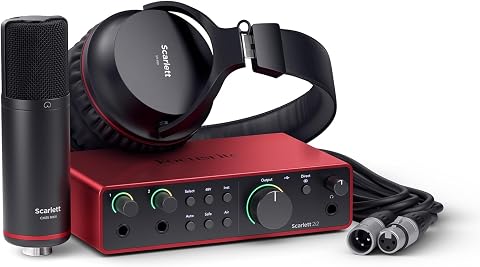
This recording bundle includes a two-channel USB audio interface, CM25 MkIII condenser microphone, SH-450 headphones, and recording software. The interface features a 120 dB dynamic range, 192 kHz maximum sample rate, Auto Gain, Clip Safe, and Air mode for vocals and guitars.
Pros:
- Includes microphone, headphones, and recording software
- 120 dB dynamic range and 192 kHz maximum sample rate
- Auto Gain and Clip Safe help manage recording levels
- Air mode adds presence to vocals and guitars
Cons:
- Availability can vary
Best for: A home setup centered on an audio interface bundle
Not ideal for: Anyone who has not checked their ports and source needs
Bottom line: Choose the Focusrite Scarlett 2i2 Studio 4th Gen USB-C Audio Interface Bundle after confirming its connections and included components fit your setup.
Studio Monitors
Studio monitors give you a way to listen to your work through speakers, so the room and listening position matter as much as the product choice. Think about where the speakers can sit, how far apart they can be, and whether you can face them from a consistent position. A monitor that is awkwardly placed may be harder to use as part of a dependable listening routine. Plan the layout before purchasing so the speakers and your desk can work together.
One common mistake is treating monitors as though they can be positioned anywhere without considering space and connections. Check the available surface or stands, the distance from your listening seat, and the connections needed to link the speakers to your equipment. Leave enough room for cables and make sure the placement does not interfere with everyday use of the room. The PreSonus Eris E7 XT 2-Way Active Studio Monitor is the pick for this checklist slot. Confirm whether your setup calls for one monitor or a pair, and check how the product is sold before planning the arrangement. Decide where you will listen and work before deciding where the monitors belong.
What to look for:
- A placement plan that fits your desk and room
- A listening position you can use consistently
- Connections compatible with your audio setup
- Suitable surfaces or stands for the intended locations
- Whether you need one monitor or a pair
PreSonus Eris E7 XT 2-Way Active Studio Monitor

The PreSonus Eris E7 XT is a 2-way active studio monitor featuring a 6.55-inch woven composite low-frequency driver and a 1.25-inch silk-dome high-frequency transducer for clear, accurate sound. It includes acoustic tuning controls and an innovative waveguide for wide imaging, making it suitable for professional mixing and music production.
Pros:
- Wide sweet spot and solid imaging due to innovative waveguide
- Accurate sound reproduction suitable for mixing
- Includes professional music production software
Cons:
- May require acoustic treatment for optimal performance
- Price not specified, potentially expensive for casual users
Best for: Creators planning a dedicated speaker listening position
Not ideal for: Anyone without suitable space or a placement plan
Bottom line: Choose the PreSonus Eris E7 XT 2-Way Active Studio Monitor once you have checked placement, connections, and whether you need one or two.
Condenser Microphone
A condenser microphone is a key choice when your recording plans depend on capturing sound with a microphone. Start by considering what you plan to record, how you will position the mic, and what other equipment your signal path requires. Think through the physical setup as well as the recording workflow: the microphone needs a stable place, a compatible connection, and enough clearance for the person or source being recorded. Your intended use should lead the decision.
A common buying mistake is selecting a microphone before checking the rest of the setup. Confirm that your interface and cables can accommodate it, and consider whether your room and recording position suit the way you plan to work. Check what mounting accessories are included, since you may need additional support or placement hardware. The Neumann TLM 102 Large-Diaphragm Condenser Microphone – Nickel is the pick in this slot. Verify the exact product configuration and what else you need to connect and position it. Leave practical room around the mic for comfortable use, and consider how you will store or reposition it between sessions. A good checklist starts with the complete signal path, not the microphone alone.
What to look for:
- A microphone suited to the sources you intend to record
- Compatibility with your interface and cables
- A stable mounting plan and adequate clearance
- Included accessories and any additional support needed
- A practical storage and repositioning plan
Neumann TLM 102 Large-Diaphragm Condenser Microphone – Nickel
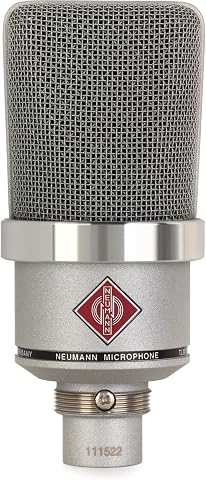
The Neumann TLM 102 is a compact large-diaphragm condenser microphone designed for studio, home recording, and broadcasting. It features a cardioid pattern, high SPL handling, and a slight high-frequency boost for vocal presence, delivering clear, detailed sound with minimal coloration.
Pros:
- High SPL handling allows recording of loud sources like drums and amps
- Compact design suitable for various studio setups
- Excellent vocal presence with a slight high-frequency boost
- Minimal coloration for clear, natural sound
Cons:
- Requires phantom power for operation
- Premium price may be a barrier for some users
Best for: Recordists whose plans call for a condenser microphone
Not ideal for: Anyone who has not mapped the full signal path
Bottom line: Choose the Neumann TLM 102 Large-Diaphragm Condenser Microphone – Nickel after confirming your interface, mounting, and accessory needs.
Microphone Boom Arm
A boom arm helps make microphone placement part of a repeatable recording setup. The important questions are where it can attach, how you want to position the microphone, and whether the arm can move through the space your sessions require. Think about the desk or other surface that will support it, the reach needed to bring the mic into position, and where it can move when not in use. Mapping those positions ahead of time helps avoid an awkward fit.
A frequent buying mistake is checking the arm without checking the mounting surface and microphone setup. Confirm the attachment method works with your furniture and that the intended mic and any holder can be used together. Consider how much desk space the mount occupies, whether the arm can be moved without obstructing a screen or other equipment, and whether cables can follow the arm neatly. The RØDE PSA1+ Professional Studio Boom Arm with Spring Damping, Black is the pick for this slot. Verify product compatibility and the items included before relying on it as a complete mounting solution. Place the arm where you can reach it comfortably while keeping the microphone clear of your usual workspace.
What to look for:
- A mounting method compatible with your desk or surface
- Reach that suits your recording position
- Compatibility with your microphone and holder
- A movement path clear of screens and other equipment
- A tidy route for the microphone cable
RØDE PSA1+ Professional Studio Boom Arm with Spring Damping, Black

The RØDE PSA1+ is a professional studio boom arm with internal spring damping for quiet, smooth adjustments during recording. It clamps to desks up to 70mm thick and supports microphones from 0.25kg to 1.2kg, including shock mounts.
Pros:
- Internal spring damping helps reduce creaks and handling noise
- Supports a useful range of microphone weights, including shock mounts
- Integrated cable management keeps XLR cables hidden
- 360-degree rotation provides flexible positioning
Cons:
- Desk clamp may not fit very thin or very thick surfaces
- Load capacity may not support unusually heavy microphone setups
Best for: Recordists who want a planned, movable mic position
Not ideal for: Anyone without a compatible mounting surface
Bottom line: Choose the RØDE PSA1+ Professional Studio Boom Arm with Spring Damping, Black after checking its mount, reach, and microphone compatibility.
Studio Headphones
Headphones give you another way to work through a recording session, so consider how and where you will use them. Think about whether you need to listen while recording, review takes, or work in a shared space where speakers are not convenient. Fit matters during longer sessions: consider the shape of the earcups, the feel of the headband, and whether you can wear the headphones comfortably. If possible, try them on before settling on a choice.
A common buying mistake is selecting headphones without checking design, comfort, and connection needs. The Sennheiser HD 660S2 Open-Back Audiophile Headphones is the pick for this slot; its open-back designation is part of the product name, so consider whether that style fits the room and situation where you plan to listen. Check the connection and any adapter requirements against your equipment. Also consider who else may be nearby and whether your listening routine calls for speakers, headphones, or both. Keep the cable route in mind so it does not snag on your desk or chair. Choose headphones you can use comfortably and consistently within your actual recording space.
What to look for:
- A fit you can wear comfortably during your sessions
- A design suited to your listening environment
- Connections that work with your equipment
- Cable length and routing suited to your workspace
- A role for headphones alongside your monitor setup
Sennheiser HD 660S2 Open-Back Audiophile Headphones

The Sennheiser HD 660S2 headphones deliver high-fidelity, natural sound with a spacious soundstage, making them ideal for immersive listening, gaming, and professional use. They feature detailed highs, deep bass, and a comfortable open-back design for extended wear.
Pros:
- Exceptional sound quality with detailed highs and deep bass
- Comfortable open-back design suitable for long listening sessions
- Premium build quality with durable materials
- Ideal for audiophiles, gamers, and professionals
Cons:
- Wired connection may limit mobility
- Open-back design can leak sound and let in external noise
- Higher price point may not suit casual users
Best for: Creators who want headphones in their listening setup
Not ideal for: Anyone whose room or workflow does not suit open-back headphones
Bottom line: Choose the Sennheiser HD 660S2 Open-Back Audiophile Headphones after checking comfort, connection needs, and whether the design suits your space.
Acoustic Panels
Acoustic panels are a room-treatment consideration for creators planning how their recording space will be used. Start by looking at the room and intended placement: note the available wall area, the surfaces near your recording position, and any limits on mounting or rearranging the space. A plan for where panels might go makes it easier to decide how many you need and whether their dimensions fit. Think about the room as a whole rather than choosing panels before measuring.
A common buying mistake is assuming a panel will suit a space without checking its dimensions, mounting, and finish. The ATS Acoustics Sound Absorbing Acoustic Panel 24" x 24" x 4" Beveled Ed is the pick listed here; compare the stated dimensions with the wall area you can use and check how the panels are intended to be installed. Consider whether the finish works in the room and whether the placement leaves access to doors, outlets, and equipment. Verify the complete product name and configuration when shopping, since the supplied name ends with “Beveled Ed.” Plan the layout before ordering so each panel has a clear, practical destination.
What to look for:
- Panel dimensions that fit the available wall area
- A mounting approach suited to the room
- Placement that keeps doors, outlets, and equipment accessible
- A finish that works with the room
- The exact product configuration and complete listing
ATS Acoustics Sound Absorbing Acoustic Panel 24" x 24" x 4" Beveled Edge (Ivory)

These acoustic panels are designed to improve sound clarity by effectively controlling reverb and echo. Made with a mineral wool core and wrapped in jute burlap fabric, they are suitable for various spaces like studios, offices, and home theaters, offering easy installation and durable construction.
Pros:
- Effective sound absorption with NRC rating of 1.15
- Easy to install with included hardware and template
- Durable, furniture-grade quality with attractive burlap fabric
- Suitable for various residential and commercial spaces
Cons:
- Limited color options (Ivory only)
- May require multiple panels for larger rooms
- Heavy weight (8 pounds) may need sturdy mounting
Best for: Creators planning panel placement in a recording space
Not ideal for: Anyone who has not measured available wall area
Bottom line: Choose the ATS Acoustics Sound Absorbing Acoustic Panel 24" x 24" x 4" Beveled Ed after measuring the room and checking its mounting needs.
Build your checklist in a budget-first order by listing the recording tasks you need to support, then prioritize the equipment that removes the biggest workflow gap. Check what you already own, confirm connections and placement, and add items in stages so every purchase has a clear role in your setup.
A home studio can come together one considered choice at a time. Use these picks to focus your research, compare them with your room and recording plans, and make a setup that feels practical to use. Start with the essentials you will reach for most, then refine the space as your needs become clearer.
Columbus Day / Indigenous Peoples' Day Picks
long weekend sales
As an affiliate, we earn on qualifying purchases.