
To help ideas stick better, try using visual and mind mapping techniques, which turn linear info into colorful webs that show relationships between concepts. The Cornell Method is also effective, encouraging active engagement and review through structured sections for notes, cues, and summaries. Combining these methods can boost retention and understanding. If you keep exploring different approaches, you’ll discover ways to make your notes even more memorable and tailored to your learning style.

Get audio and creator gear delivered free — and shop member deals
- Fast, free delivery on millions of items
- Access to Prime Big Deal Days deals on October 6–7
- Prime Video, Amazon Music and more included
Key Takeaways
- Use visual techniques like mind maps and diagrams to create interconnected, memorable representations of ideas.
- Incorporate colors, symbols, and sketches to reinforce key concepts and enhance visual memory.
- Apply structured methods like the Cornell Technique to promote active engagement and easier review.
- Combine multiple note-taking styles to engage different learning pathways and strengthen retention.
- Regularly review and summarize notes to reinforce understanding and solidify long-term memory.
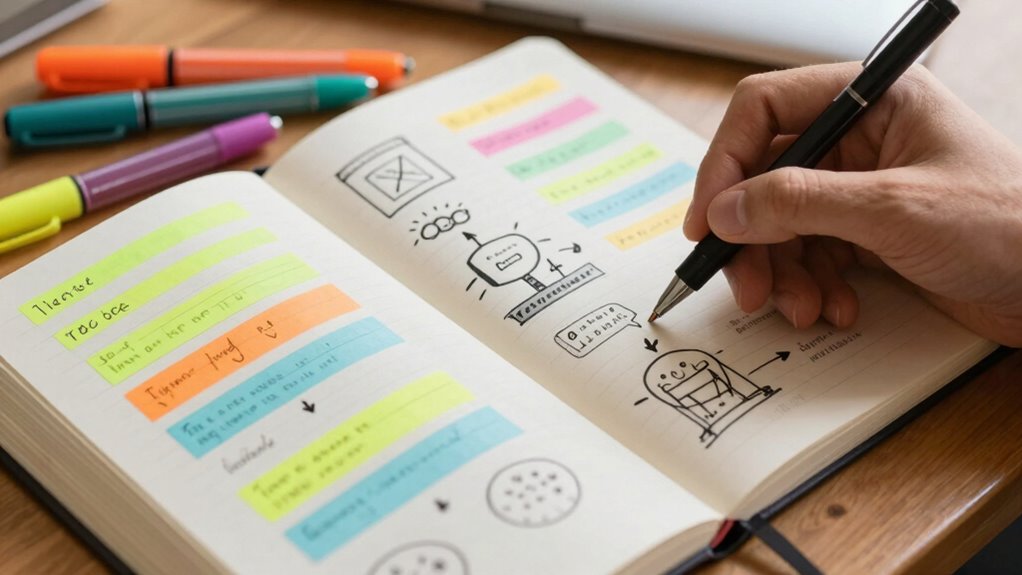
Taking effective notes is essential for turning fleeting ideas into lasting knowledge. When you’re in a lecture or reading a book, capturing information in a way that helps your brain process and remember it is vital. One powerful method is using mind mapping and visual notes. These approaches turn linear information into a colorful, interconnected web that engages your visual and spatial reasoning. Instead of writing down everything verbatim, you create diagrams that highlight relationships between concepts, making complex ideas easier to grasp and recall. Visual notes, in particular, combine sketches, symbols, and colors to emphasize key points, making your notes more engaging and memorable. When you see a diagram or a mind map, your brain quickly recognizes patterns and connections, reinforcing learning and retrieval.
Another effective technique is the Cornell Method, which divides your page into sections for notes, cues, and summaries. This structure encourages active engagement during note-taking and helps you review more efficiently. However, if you’re aiming to boost your understanding and retention, integrating mind mapping into your note-taking can be especially advantageous. For example, after a lecture, you might draw a central idea in the middle of your page and branch out with related subtopics, examples, and questions. This method makes it easier to see how ideas connect, which is often lost in traditional linear notes. It also allows you to add visuals—like arrows, icons, or sketches—that further reinforce the material.
Using visual notes isn’t just about making your notes colorful; it’s about transforming abstract information into concrete visuals that your brain can latch onto. When you incorporate images or symbols next to your written content, you create multiple pathways for your memory to access the information later. This multisensory approach helps ideas stick because you’re engaging more of your brain in the learning process. Additionally, employing visual note-taking techniques can make the review process more efficient by highlighting key concepts at a glance. Incorporating visual learning strategies into your notes can also help accommodate different learning styles, making your study sessions more effective. Moreover, experimenting with various note-taking styles can help you discover which methods best align with your cognitive strengths, further enhancing retention.
Finally, don’t shy away from experimenting with different note-taking styles. Some people find that combining methods—like creating a mind map with visual notes for complex topics—maximizes retention. The key is to find what works for you and make it a habit. When you take notes that are visually appealing and conceptually organized, you turn passive recording into active learning, making ideas stick more effectively and lasting longer in your memory.
Frequently Asked Questions
Which Note-Taking Method Works Best for Visual Learners?
As a visual learner, mind mapping works best for you because it helps organize ideas visually and shows relationships clearly. Incorporate color coding into your mind maps to differentiate concepts and make key points stand out. This combination keeps information engaging and easier to recall. Using colorful, diagram-based notes taps into your visual strengths, making study sessions more effective and helping ideas stick better in your memory.
How Can I Adapt Note-Taking for Auditory Learners?
Imagine your notes transforming into a symphony for your ears — that’s how you adapt for auditory learners. You should practice mindful listening during lectures, focusing fully on spoken words. Record key points and listen to auditory summaries repeatedly. This way, your notes become a vibrant melody, making ideas stick effortlessly. Embrace sound-rich methods, and you’ll find information resonating deeply, turning learning into an immersive, unforgettable experience.
Are Digital Notes More Effective Than Handwritten Notes?
Digital notes can be more effective because they allow for easy digital annotation, which helps you highlight key ideas and organize information efficiently. However, handwritten summaries often boost memory retention through the physical act of writing, making ideas stick better. You might find that combining digital annotation for detailed review and handwritten summaries for reinforcement offers the best of both worlds, enhancing your overall note-taking effectiveness.
How Can I Review Notes Effectively to Retain Information?
Your memory is a treasure chest waiting to be opened. To review notes effectively, develop strong study habits like regularly revisiting your material and summarizing key points. Use memory techniques such as mnemonics or visualization to reinforce learning. Actively recall information rather than passively rereading. Spaced repetition and self-testing are powerful tools that turn fleeting knowledge into long-lasting understanding, helping ideas stick like glue in your mind.
What Tools or Apps Enhance Note-Taking and Memory Retention?
You can enhance your note-taking and memory retention with tools like Evernote or Notion, which support digital organization for quick access and easy updates. Incorporate memory techniques like spaced repetition and visual mnemonics within these apps to reinforce learning. These tools help you organize notes systematically, making it easier to review and retain information over time. Using them actively boosts your ability to remember and apply what you’ve learned.
Conclusion
By mastering these note-taking methods, you turn your notes into a sturdy bridge connecting ideas and memories. Think of your notes as seeds—plant them wisely, and with consistent care, they’ll grow into a lush forest of understanding. When you choose techniques like Cornell or mind mapping, you’re giving your brain a toolkit to keep ideas alive and thriving. So, embrace these methods, and watch your knowledge blossom into a vibrant, unstoppable garden.
Evergreen bestsellers Picks
bestsellers
As an affiliate, we earn on qualifying purchases.