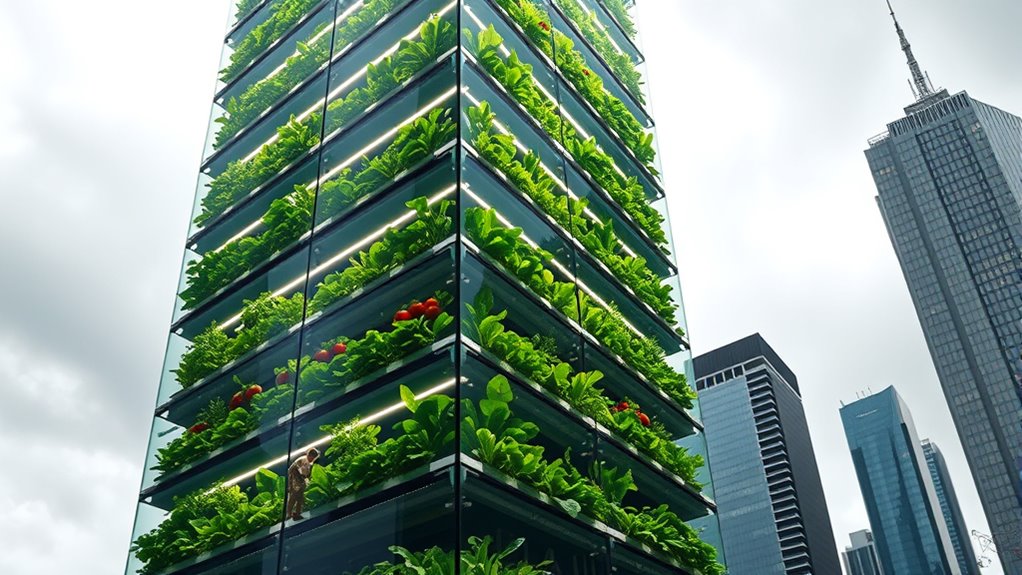

Vertical farming allows you to grow fresh food within city limits, using minimal space and no farmland. It takes advantage of advanced technologies like LED lighting, hydroponics, and climate controls to produce crops year-round. This method reduces transportation and water use, lowers emissions, and creates local jobs. By transforming unused spaces into farms, cities become more sustainable and resilient. Keep exploring to discover how this innovative approach is shaping the future of urban agriculture.

Get audio and creator gear delivered free with Prime
- Fast, free delivery on millions of items
- Prime Video, Amazon Music and more included
- Member-only deals all year
Key Takeaways
- Vertical farming maximizes urban space, enabling year-round crop production without traditional farmland.
- It utilizes technologies like LED lighting and hydroponics to grow food efficiently indoors.
- Controlled environments reduce pesticide use and resource consumption, supporting sustainable urban agriculture.
- Localized vertical farms lower transportation costs and emissions, enhancing food security in cities.
- Innovations in vertical farming promote scalable, resilient solutions for feeding growing urban populations.
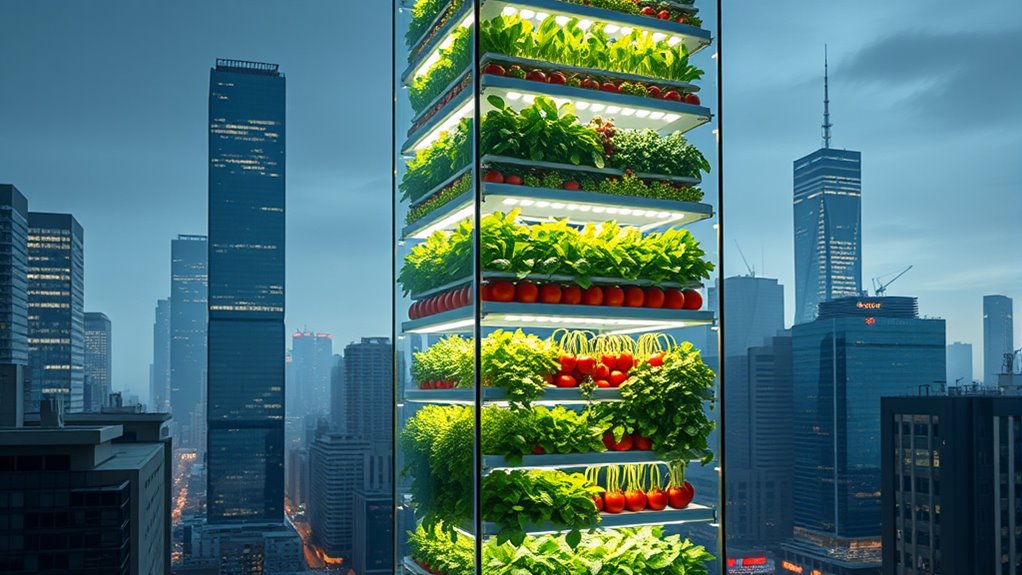
Have you ever wondered how we can grow more food in less space? As cities expand and farmland becomes scarcer, traditional agriculture faces growing challenges. That’s where vertical farming steps in as a game-changer, offering a new way to produce fresh produce right where people live. By stacking crops vertically in controlled environments, you can maximize urban sustainability, reducing the need to transport food over long distances and cutting down on carbon emissions. This innovative agriculture method enables you to grow larger yields in a fraction of the space required by conventional farms, making it an ideal solution for densely populated areas.
Vertical farming maximizes urban space by growing more food in smaller areas with controlled environments.
In vertical farms, you’re not limited to the constraints of outdoor land. Instead, you harness the power of technology—LED lighting, hydroponics, aeroponics, and climate control systems—to create prime growing conditions regardless of weather or season. This means you can produce food year-round, ensuring a reliable supply of fresh vegetables, herbs, and even small fruits. With this approach, you play a part in urban sustainability by reducing dependence on rural farmland and decreasing food waste, since products can be harvested at peak freshness and delivered quickly to local markets. You’re effectively transforming unused or underutilized spaces like rooftops, abandoned buildings, and vacant lots into productive farms.
This innovative agriculture doesn’t just benefit the environment; it also supports local economies. By growing food within city limits, you cut transportation costs and create new job opportunities in urban areas. Plus, vertical farms often use considerably less water than traditional farms, thanks to closed-loop systems that recycle nutrients and minimize waste. As a result, you’re participating in a sustainable cycle that conserves crucial resources while feeding more people efficiently. Furthermore, vertical farming reduces the need for pesticides and herbicides, because the controlled environments limit pests and diseases, making the produce healthier and safer.
You may be surprised to learn that vertical farming can also adapt to various scales. Whether you’re running a small community project or a large commercial operation, you’re harnessing innovative agriculture to meet local food demands without sacrificing land or environmental health. Additionally, as the industry advances, innovations like sustainable materials and energy-efficient systems are further enhancing the environmental benefits of vertical farming. As cities continue to grow, vertical farming offers a practical, scalable solution that aligns with your desire for urban sustainability and food security. By embracing this technology-driven approach, you’re helping shape resilient urban ecosystems, ensuring fresh, nutritious food is always within reach—without relying on farmland that’s miles away.
LED grow lights for indoor farming
As an affiliate, we earn on qualifying purchases.
As an affiliate, we earn on qualifying purchases.
Frequently Asked Questions
What Are the Initial Costs of Setting up a Vertical Farm?
You’ll find that setting up a vertical farm involves significant initial costs, including investing in advanced technological innovations like LED lighting, climate control systems, and hydroponic or aeroponic setups. An economic analysis shows these expenses can be high upfront but lead to long-term savings and sustainability. Your investment depends on factors like farm size, location, and technology choices, but expect startup costs to range from hundreds of thousands to millions of dollars.
How Does Vertical Farming Impact Local Ecosystems?
Your curiosity about how vertical farming impacts local ecosystems is essential. It’s like planting a seed of change that could reshape urban biodiversity and ecosystem balance. Vertical farms reduce land use, minimizing habitat disruption and pollution. They also lower water consumption and pesticide use, helping preserve native species. Overall, vertical farming supports healthier ecosystems, making cities greener and more sustainable, and you become an active part of this positive transformation.
What Crops Are Most Suitable for Vertical Farming?
You should consider crop varieties that thrive in controlled environments, such as leafy greens, herbs, and strawberries, as they grow efficiently indoors. Using suitable growing mediums like hydroponic or aeroponic systems, you can optimize growth and yield. These crops are ideal because they require less space, grow quickly, and adapt well to vertical farming setups, making them perfect choices for maximizing productivity in limited space.
How Energy-Efficient Is Vertical Farming Compared to Traditional Methods?
You might wonder about energy efficiency in farming methods. Vertical farming generally uses less energy than traditional farming because it reduces transportation and land use. Its energy consumption depends on factors like lighting and climate control, but innovative LED lights and automation improve sustainability metrics. Overall, vertical farming can be more sustainable, especially in urban areas, by conserving resources and lowering environmental impact.
What Are the Biggest Challenges Facing Vertical Farm Scalability?
You might find that scaling vertical farms faces major hurdles like urban integration and technology adoption. Integrating these farms into city landscapes requires careful planning and infrastructure updates, which can be costly and complex. Additionally, adopting advanced technology demands significant investment and expertise. These challenges slow down widespread implementation, making it harder for vertical farms to grow beyond pilot projects and become a mainstream solution for urban food production.
As an affiliate, we earn on qualifying purchases.
Conclusion
Vertical farming offers a sustainable way to feed our growing cities without needing traditional farmland. By growing crops vertically in controlled environments, you can enjoy fresh produce year-round and reduce your ecological footprint. Isn’t it time we embraced innovative solutions to nourish our urban populations? As you consider the future, remember that small changes in farming methods can lead to big impacts on our planet’s health. Will you be part of the movement toward smarter, greener cities?
climate control systems for indoor farms
As an affiliate, we earn on qualifying purchases.
As an affiliate, we earn on qualifying purchases.
small-scale vertical farming equipment
As an affiliate, we earn on qualifying purchases.
As an affiliate, we earn on qualifying purchases.
Halloween Picks
halloween
As an affiliate, we earn on qualifying purchases.