
Choosing the right music production MIDI controller can significantly enhance your workflow and creative potential. The best overall pick, the Akai Professional MPK Mini MK3, offers a balanced mix of portability, features, and affordability. For those seeking premium build quality and extensive control, the 72-Key Modular MIDI Controller Bundle stands out. Meanwhile, beginners might prefer compact, easy-to-use options like the Donner DMK25 Pro. However, tradeoffs exist: more features often mean higher cost or complexity, while simpler models may lack advanced control. Keep reading for a detailed breakdown to find the perfect fit for your music production needs.

Get audio and creator gear delivered free with Prime
- Fast, free delivery on millions of items
- Prime Video, Amazon Music and more included
- Member-only deals all year
Complete the kit


Key Takeaways
- The top-ranked controllers balance portability with comprehensive control features, making them versatile for different production setups.
- Price often correlates with feature set; premium models offer more customization and build quality, but may be overkill for casual users.
- Size matters: smaller controllers excel for mobile setups, but larger ones provide better tactile control for complex projects.
- Ease of use varies significantly—controllers with intuitive layouts and learning resources benefit beginners more.
- Compatibility with DAWs and software integrations is a critical factor that influences workflow efficiency across all levels.


| music production MIDI controller | Number of Keys | Connectivity |
|---|---|---|
| M-VAVE 37-Key MIDI Keyboard Co | 37 | — |
| Donner DMK25 Pro MIDI Keyboard | 25 | USB-C |
| Akai Professional MPK Mini Plu | 37 | USB, CV/Gate, MIDI I/O |
| Akai Professional MPK Mini MK3 | 25 | USB |
| 49 Key USB MIDI Keyboard Contr | 49 | USB |
| Arturia MiniLab 3 Universal MI | — | — |
| DaierTek 25-Key Portable Bluet | 25 | Bluetooth, USB |
| 72-Key Modular MIDI Keyboard C | 72 (expandable to 108) | Bluetooth MIDI, USB-C, NFC |
| Donner Mini MIDI Keyboard N-25 | 25 | USB-MIDI |
| Akai Professional APC Mini MK2 | — | USB powered, plug-and-play |
| 36-Key Portable MIDI Keyboard | 36 (expandable up to 108) | Bluetooth, USB-C, NFC |
More Details on Our Top Picks
M-VAVE 37-Key MIDI Keyboard Controller with 16 Backlit Drum Pads
This controller shines for musicians who need a portable, wireless solution that combines keys and drum pads in a compact form. Unlike the Akai MPK Mini Plus, which emphasizes extensive connectivity and software, the M-VAVE offers a built-in sound source and wireless operation, making it ideal for live performances without a laptop. The tradeoff is its limited 37 keys, which might not satisfy pianists needing full-range keyboards. Its backlit pads and expandable controls add versatility for on-the-fly sound design, but the complexity can be daunting for beginners. This device is best suited for performers who prioritize mobility and integrated sound over a traditional keyboard experience.
Pros:- Compact, lightweight design for easy transport
- Wireless operation with built-in battery for flexible setup
- Multiple control knobs and expandable pads for sound control
- Includes 128 sound timbres for standalone use
Cons:- Expandable features may require additional purchases
- Limited to 37 keys, restricting performance range
- Complex controls may challenge beginners
Best for: Musicians seeking a wireless, portable MIDI controller for live performances or mobile studio setups.
Not ideal for: Pianists or producers needing a full 88-key experience or extensive built-in sounds for studio work.
- Number of Keys:37
- Backlit Drum Pads:16
- Sound Timbres:128
- Display Size:1.54 inches
- Battery:Built-in
Our verdict“This is a smart choice for performers who need a portable, all-in-one MIDI controller with sound onboard.”
Donner DMK25 Pro MIDI Keyboard Controller, 25 Mini Key Portable USB-C MIDI Keyboard with 8 Drum Pads, OLED Display, Touch Bar, Software & Courses
The Donner DMK25 Pro stands out for its compact size combined with comprehensive features, including a high-definition OLED display and a customizable touch bar. Compared to the Akai MPK Mini MK3, which emphasizes built-in sounds and arpeggiator, the DMK25 focuses on software control and educational content, making it excellent for newcomers who want guided learning. Its limited 25 keys mean it’s less suited for melodic performance, but the inclusion of software and courses compensates for that gap. The learning curve can be steep for absolute beginners unfamiliar with MIDI, but its portability and educational value make it a compelling starter option.
Pros:- Compact, lightweight design for easy carrying
- Includes 40 music production courses and software
- High-definition OLED display for precise control feedback
- Customizable control wheels for creative flexibility
Cons:- Requires connection to a device to produce sound, no built-in sound
- Learning curve for users unfamiliar with MIDI workflows
- Limited to MIDI control, not a standalone instrument
Best for: Beginners or students who want an affordable, portable MIDI controller with integrated learning tools.
Not ideal for: Advanced producers or keyboardists needing full range and deep hardware controls for complex performances.
- Number of Keys:25
- Connectivity:USB-C
- Drum Pads:8
- Display:High-definition OLED
- Control Wheels:4
- Included Courses:40
Our verdict“Ideal for beginners seeking a portable MIDI controller with strong educational support and software integration.”
Akai Professional MPK Mini Plus 37-Key USB MIDI Keyboard Controller
The MPK Mini Plus caters to producers and performers who need a full octave of keys combined with advanced connectivity, including CV/Gate and MIDI I/O, unlike the smaller MPK Mini MK3. Its 37 keys provide a more playable range for melodies and chords, making it suitable for melodic genres and harmonic arrangements. The inclusion of a built-in 64-step sequencer and RGB MPC pads elevates its creative potential, especially for beatmakers and electronic musicians. However, its extensive features can overwhelm beginners unfamiliar with DAWs or MIDI setups. This pick makes the most sense for intermediate to advanced users who want a portable, flexible controller with a professional feature set.
Pros:- Full 3-octave keybed for melodic play
- Multiple connectivity options including CV/Gate and MIDI I/O
- Includes professional software and sample library
- Built-in 64-step sequencer for creative sequencing
Cons:- May be complex for users new to MIDI workflows
- Requires familiarity with DAWs for full use
- Portability is somewhat compromised by its extensive features
Best for: Producers and performers needing a versatile, feature-rich MIDI controller for melodic and beat-making tasks.
Not ideal for: Complete beginners or users primarily focused on simple, plug-and-play control without deep feature requirements.
- Number of Keys:37
- Octaves:3
- Connectivity:USB, CV/Gate, MIDI I/O
- Sequencer:64-step
- Pads:8 RGB MPC
- Included Software:MPC Beats
Our verdict“Best suited for experienced producers needing a comprehensive, portable MIDI controller with advanced connectivity and sequencing capabilities.”
Akai Professional MPK Mini MK3 25-Key USB MIDI Keyboard Controller
The MPK Mini MK3 emphasizes portability with its 25 mini keys and MPC-style pads, making it ideal for studio musicians who require a lightweight, easy-to-transport controller. Its NKS support allows seamless integration with Native Instruments plugins, and the bundled sounds and MPC Beats software add immediate production value. In comparison to the MPK Mini Plus, it offers fewer keys and connectivity options but remains a solid choice for simple studio setups or mobile music making. Some users may find its limited key range restrictive for melodic tasks, and the small keys can be less comfortable for extended playing.
Pros:- Compact and highly portable design
- Supports NKS for plug-and-play with Native Instruments
- Includes a large sound library and virtual instrument support
- MPC-style pads for beat making
Cons:- Limited to 25 mini keys, restricting melodic play
- Requires software to unlock full potential
- Small keys may be less comfortable for long sessions
Best for: Studio musicians and producers needing a compact, NKS-compatible controller for quick setup and beat production.
Not ideal for: Performers or composers requiring full-range keyboards or extensive connectivity for complex live setups.
- Number of Keys:25
- Key Type:Mini velocity-sensitive
- Pads:8 MPC-style
- NKS Support:Yes
- Included Content:1500+ sounds, virtual instruments
- Connectivity:USB
Our verdict“A perfect fit for producers who prioritize portability and NKS integration over full-range performance.”
49 Key USB MIDI Keyboard Controller with OLED Display, 8 Drum Pads, DAW Integration for Music Production, Black
This controller balances a full 49-key range with advanced DAW features, including an OLED display that offers real-time feedback, making it suitable for producers who need expressive control and seamless integration. Compared to the smaller 25-key models, the 49 keys provide a comfortable playing experience for melodies, chords, and harmonic arrangements. Its dedicated drum pads and auto-accompaniment tools enhance creative versatility. However, it isn’t as compact as the 25-key options, which might be a drawback for mobile setups. The OLED display and auto features make it particularly appealing for studio users who want clear visual feedback during production.
Pros:- Full-size keys with expressive touch
- OLED display for instant feedback and control
- Includes 8 velocity-sensitive drum pads
- Excellent DAW integration and auto-accompaniment features
Cons:- iOS adapters sold separately, limiting quick mobile use
- Limited to 49 keys, which may not suit advanced pianists
- Larger footprint may reduce portability
Best for: Producers and composers who need a full-size keyboard with integrated DAW controls and real-time feedback.
Not ideal for: Travelers or performers needing ultra-portable controllers, due to its larger size and weight.
- Number of Keys:49
- Display:OLED
- Drum Pads:8
- Connectivity:USB
- Includes:Sustain pedal port
Our verdict“An excellent choice for producers who prioritize full-range keys combined with visual feedback and DAW integration.”
Arturia MiniLab 3 Universal MIDI Controller, White
The Arturia MiniLab 3 stands out for its balance of portability and control, offering velocity-sensitive keys, 8 drum pads, and 4 faders that make it suitable for musicians who need a versatile controller in a compact form. Compared with larger options like the 72-Key Modular MIDI Controller, it sacrifices expandability but gains in ease of transport. Its simple design means limited info on software compatibility, which could be a drawback for users needing seamless integration. This controller is ideal for musicians seeking an intuitive, portable device for basic control and on-the-go production. Its main tradeoff is fewer controls and features compared to larger, more feature-rich controllers.- Compact and portable design
- Velocity-sensitive keys for expressive playing
- Multiple control options for instruments and tracks
- Limited info on software compatibility
- No additional features beyond basic controls
Pros:- Compact and portable design
- Intuitive control with velocity-sensitive keys
- Multiple control options for instruments and tracks
Cons:- Limited information on software compatibility
- No advanced features or expandability
Best for: Musicians who need a portable, straightforward MIDI controller for basic production and live performance
Not ideal for: Producers requiring extensive controls, advanced features, or integration with complex DAWs
- Color:White
- Number of Pads:8
- Number of Faders:4
- Velocity-sensitive keys:Yes
Our verdict“This controller makes the most sense for mobile musicians and beginners focused on simple, reliable control.”
DaierTek 25-Key Portable Bluetooth & USB MIDI Keyboard Controller
The DaierTek 25-Key Controller excels in portability and wireless convenience, featuring Bluetooth and USB connectivity, 8 RGB backlit pads, and 8 assignable knobs—making it ideal for musicians who prioritize mobility. Unlike the Donner N-25, which is more beginner-friendly with included courses, this model emphasizes versatility and system compatibility, supporting Windows, Mac, Android, and iOS. Its 25 keys may limit complex compositions, and Bluetooth setup could challenge less tech-savvy users. This pick is best for experienced producers and performers who need a portable, wireless controller that adapts to multiple devices. The tradeoff is a smaller key range and potentially complex setup for some users.- Wireless Bluetooth connectivity with long battery life
- Highly sensitive keys with zero delay response
- Compatible with multiple operating systems and DAWs
- Limited to 25 keys, restricting complex playing
- No built-in sound or speakers
Pros:- Portable and lightweight design
- Wireless Bluetooth connectivity with long battery life
- Highly sensitive keys with zero delay response
Cons:- Limited to 25 keys, restricting complex compositions
- Bluetooth setup may be complex for some users
Best for: Experienced musicians and producers needing a portable, wireless MIDI controller for flexible use across multiple platforms
Not ideal for: Beginners or those needing a larger keyboard for complex arrangements, due to limited keys and potential setup complexity
- Number of Keys:25
- Backlit Pads:8 RGB backlit pads
- Assignable Knobs:8
- Battery Capacity:2000 mAh
- Battery Life:Up to 16 hours
- Connectivity:Bluetooth, USB
Our verdict“This controller suits mobile producers seeking wireless flexibility and multi-device compatibility in a compact form.”
72-Key Modular MIDI Keyboard Controller Bundle with RGB Light-Up Keys
The 72-Key Modular MIDI Controller offers unparalleled expandability, allowing users to connect two 36-key modules into a full 72-key setup, with optional expansion up to 108 keys. Its RGB light-up keys provide visual feedback, aiding in learning and live performance, making it ideal for more advanced or mobile producers needing a flexible setup. Compared to the Donner N-25, this system offers more control and a broader range, but it requires additional modules for full expansion and lacks built-in controls like knobs or faders. Its omission of octave shifting may hinder quick range adjustments. This product is best suited for serious producers or performers who want a modular, adaptable keyboard system. The main tradeoff involves complexity and potential cost for expansion.- Modular design allows for flexible expansion up to 108 keys
- RGB keys provide excellent visual feedback
- Supports multiple connectivity options including Bluetooth, USB-C, and NFC
- No octave shifting feature included
- Requires additional modules for full 108-key setup
Pros:- Modular design for flexible expansion
- RGB light-up keys for visual feedback
- Multiple connectivity options including Bluetooth and NFC
Cons:- No octave shifting included
- Requires additional modules for maximum size
Best for: Professional producers or mobile musicians who want a scalable, visually-rich MIDI keyboard setup
Not ideal for: Casual users or beginners who may find the system complexity and cost prohibitive
- Number of Keys:72 (expandable to 108)
- Modules Included:2 x 36-key modules
- Connectivity:Bluetooth MIDI, USB-C, NFC
- Lighting:RGB light-up keys
- Compatibility:Mac, Windows, iOS, Android, DAWs
- Additional Features:Carry case, expandable system, customizable MIDI mapping
Our verdict“This controller is perfect for experienced users aiming to build a tailored, expandable MIDI keyboard system.”
Donner Mini MIDI Keyboard N-25, 25-Key Velocity-Sensitive Controller with Light-Up Buttons and Teaching Courses
The Donner N-25 emphasizes ease of use and learning, featuring 25 velocity-sensitive keys, light-up buttons, and 40 teaching courses to support new users. Its compact size makes it perfect for students or beginners who want an accessible entry point into music production. Compared with the DaierTek controller, which offers wireless connectivity, the Donner N-25’s wired USB-MIDI is simpler for those new to setup. However, its limited key range constrains complex compositions, and it relies on compatible DAWs for sound. This controller is best for beginners or educators seeking a straightforward, educational MIDI device. The key limitation is its small size, which may restrict advanced playing.- Compact, portable design ideal for beginners
- Includes 40 teaching courses to support learning
- User-friendly with programmable banks and essential controls
- Limited to 25 keys, restricting complex arrangements
- Requires compatible DAW for music output
Pros:- Compact and portable design
- Includes educational courses and user-friendly controls
- Velocity-sensitive keys for expressive playing
Cons:- Limited to 25 keys, restricting complex music creation
- Dependent on DAW software for sound output
Best for: Beginners and educators seeking an easy-to-use MIDI keyboard with learning support
Not ideal for: Advanced producers or performers needing a larger range for complex compositions
- Number of Keys:25
- Key Type:Velocity-sensitive
- Compatibility:Mac, iOS, PC, iPhone, iPad
- Connectivity:USB-MIDI
- Additional Features:Light-up buttons, pitch-bend wheel, 40 teaching courses
Our verdict“This controller makes the most sense for students and beginners prioritizing ease of learning over range size.”
Akai Professional APC Mini MK2 USB MIDI Pad Controller
The AKAI APC Mini MK2 is tailored for Ableton Live, with an 8×8 RGB pad matrix designed for clip launching and visual feedback. Its 9 assignable faders provide quick control over parameters, making it ideal for live performances and Ableton workflows. In comparison to the Arturia MiniLab 3, which offers more keys and faders, the APC Mini prioritizes clip-based control and visual feedback, but is less suited for detailed instrument control. Its limited DAW compatibility means users outside Ableton may find it less effective. This controller is best for Ableton Live performers and electronic musicians focusing on clip launching and session control. The main compromise is reduced control versatility for other DAWs.- Compact, portable design ideal for live sets
- Intuitive RGB pad matrix with visual feedback
- Includes Ableton Live Lite and virtual instruments
- Limited to Ableton Live integration
- Fewer faders than larger control surfaces
Pros:- Compact and portable for studio and stage
- RGB pad matrix with visual feedback
- Includes Ableton Live Lite and virtual instruments
Cons:- Limited to Ableton Live compatibility
- Fewer faders than larger controllers
Best for: Electronic musicians and live performers using Ableton Live who need quick clip launching and visual cues
Not ideal for: Producers working with other DAWs or requiring extensive instrument controls and faders
- Pad Matrix:8×8 RGB pads
- Faders:9 (8 assignable + 1 master)
- Connectivity:USB powered, plug-and-play
- Included Software:Ableton Live Lite, Hybrid 3, Mini Grand, Velvet
Our verdict“This pick is ideal for Ableton Live performers seeking a streamlined, clip-focused control surface for live and studio use.”
36-Key Portable MIDI Keyboard Controller with RGB Light-Up Keys, Expandable up to 108 Keys, Bluetooth & USB-C, DAW Compatible
This compact MIDI controller offers an excellent blend of portability and expandability, making it ideal for musicians who need a versatile device on the go. Unlike the Akai MPK Mini MK3, which has fixed keys, this model’s modular design allows users to expand up to 108 keys, accommodating more complex arrangements without sacrificing portability. The RGB light-up keys provide real-time visual cues—something the Arturia MiniLab 3 lacks—improving workflow clarity during live performances or practice sessions. Its connectivity options cover Bluetooth, USB-C, and NFC, offering seamless integration across devices, unlike some controllers that rely solely on USB. However, the initial 36 keys may be limiting for advanced compositions, and the modular setup can be tricky to assemble for beginners, requiring patience and some technical familiarity. Overall, this pick makes the most sense for mobile producers who prioritize flexibility and visual feedback but are prepared for some setup complexity.
Pros:- Compact, lightweight, and highly portable for mobile music creation
- RGB light-up keys provide clear visual cues without additional software
- Expandable modular design up to 108 keys accommodates larger setups
- Multiple connectivity options including Bluetooth, USB-C, and NFC
Cons:- Limited to 36 keys initially, which might be restrictive for complex productions
- Modular assembly can be complex and intimidating for new users
- Requires compatible devices for full feature set, which could limit flexibility
Best for: Musicians and producers who need a portable, expandable controller with visual feedback for live sessions or mobile workflows.
Not ideal for: Studio-based producers requiring a full-sized keyboard with immediate, out-of-the-box functionality for complex arrangements, as the initial 36-key limit may hinder workflow.
- Number of Keys:36 (expandable up to 108)
- Connectivity:Bluetooth, USB-C, NFC
- Lighting:RGB light-up keys
- Compatibility:Mac, Windows, iOS, Android
- Design:Modular, magnetic connection system
- Size:Compact portable form factor
Our verdict“This controller suits mobile producers who value flexibility and visual feedback, accepting some setup complexity for a customizable experience.”
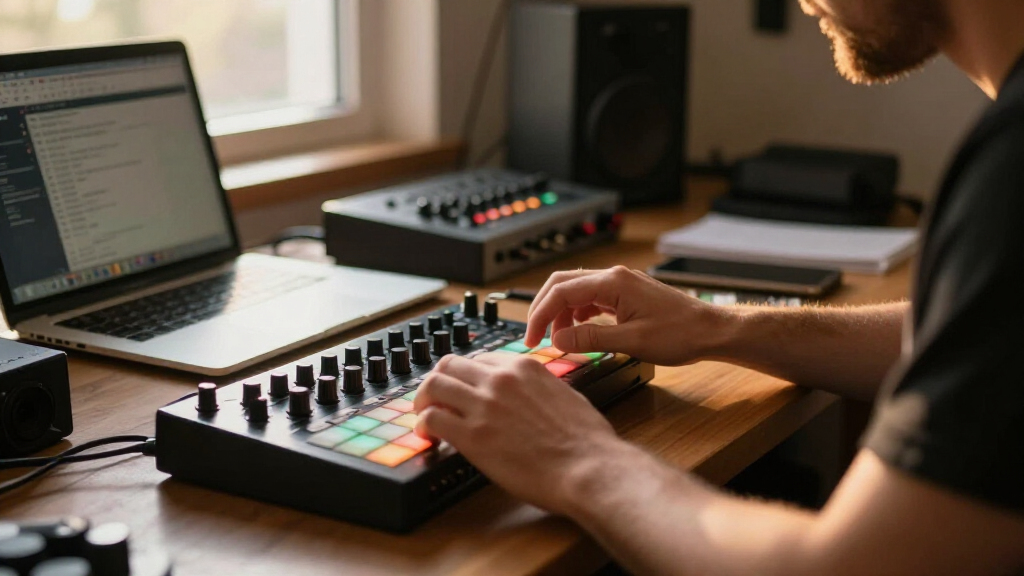
How We Picked
The products in this roundup were evaluated based on key criteria including build quality, control options, usability, compatibility, and value for money. We prioritized controllers that offer a good balance of features suited to both beginner and professional producers. Additional factors such as portability, software bundle quality, and expandability were also considered. The ranking reflects a combination of versatility, user-friendliness, and overall performance, ensuring that each option serves a distinct user need or budget range.Factors to Consider When Choosing Music Production MIDI Controllers
Selecting the right MIDI controller depends on several critical factors beyond basic features. Understanding your workflow, budget, and production environment can help you choose a model that enhances your creativity rather than complicates it. This guide covers key considerations to keep in mind, helping you avoid common pitfalls and make a more informed purchase.Size and Portability
Size impacts both portability and usability. Compact controllers are ideal for producers who need mobility or limited desk space, but they often sacrifice some controls or keys. Larger models provide more tactile control and a wider range of features, which can improve workflow in a dedicated studio setting. Consider where you’ll use the controller most and how much space you have to ensure it fits your setup comfortably.
Number of Keys and Key Action
The number of keys influences your playing range and the complexity of your compositions. Smaller controllers with 25-37 keys are suitable for quick sketches or mobile setups, but they may limit live performance options. Full-sized 49 or 61-key controllers better serve musicians needing extensive range and more realistic playing experience. Also, evaluate the key action—weighted keys offer a more piano-like feel, while synth-style keys are lighter and more responsive for rapid performances.
Control Features and Pads
Beyond keys, consider the control surface—pads, knobs, sliders, and transport controls. These expand your expressive options and streamline editing. For example, drum pads can facilitate beat making, while assignable knobs allow real-time parameter tweaking. Beware of controllers with overly complex controls that might require a steep learning curve if you’re just starting out. Prioritize intuitive layouts that match your production style.
Compatibility and Software Integration
Check that the controller seamlessly integrates with your DAW and preferred plugins. Some models come with bundled software or presets optimized for specific platforms, saving setup time. Compatibility issues can hinder your workflow, especially if you use uncommon or older software. Make sure the controller supports your OS and offers class-compliant operation if you plan to use it across different devices.
Build Quality and Expandability
Investing in a robust build ensures longevity, especially if you travel or perform live. Metal and high-quality plastic construction tend to last longer and feel better under your fingers. Additionally, controllers with expandability options—such as additional modules or MIDI outs—offer future-proofing for evolving workflows. However, higher build quality and expandability usually come with increased cost, so balance this with your current needs.
Frequently Asked Questions
Can I use a MIDI controller without a DAW?
Yes, many MIDI controllers can operate independently of a DAW, especially those with onboard controls or built-in sound modules. These standalone options allow you to play instruments or trigger samples without connecting to software. However, most controllers are designed to work with DAWs for full editing and recording capabilities. Ensure your chosen controller supports standalone operation if this is a priority.
Is it better to buy a smaller or larger MIDI controller?
The decision depends on your workflow and space constraints. Smaller controllers are portable and sufficient for basic tasks or mobile production, but they might limit expressiveness. Larger controllers with more keys and control options support complex compositions and live performances but require more space. Balance your needs for portability against the demands of your music projects.
Are weighted keys necessary for music production?
Weighted keys are more common on digital pianos and benefit players focusing on realistic piano playing. For MIDI controllers aimed at electronic music, synth-style keys are often preferred for their lighter touch and faster response. Your choice should align with your playing style and the type of music you produce, rather than a general rule.
What features should a beginner look for in a MIDI controller?
Beginners should prioritize controllers with intuitive layouts, good build quality, and bundled software to start learning easily. Compact models with basic control options reduce complexity, while models with tutorials or predefined mappings help speed up the learning process. Avoid overly complex controllers with many features that might overwhelm new users.
How important is DAW compatibility when choosing a MIDI controller?
DAW compatibility is vital because it ensures seamless integration, reducing setup time and technical issues. Most controllers support major DAWs like Ableton Live, Logic, and FL Studio, but some may have limited or no support for niche software. Confirm support for your preferred DAW before purchasing to guarantee a smooth workflow.
Conclusion
For users seeking the best overall experience, the Akai Professional MPK Mini MK3 offers a versatile balance of features and portability at a reasonable price. Those on a tighter budget or new to music production should consider the Donner DMK25 Pro for its simplicity and value. Professionals or serious hobbyists aiming for maximum control and expandability will find the 72-Key Modular MIDI Controller Bundle worth the investment. Beginners should focus on models with intuitive controls and software bundles, while advanced users might prioritize build quality and extensive control features. Ultimately, your choice hinges on your workflow, space, and production goals.
Fall Picks
fall essentials
As an affiliate, we earn on qualifying purchases.