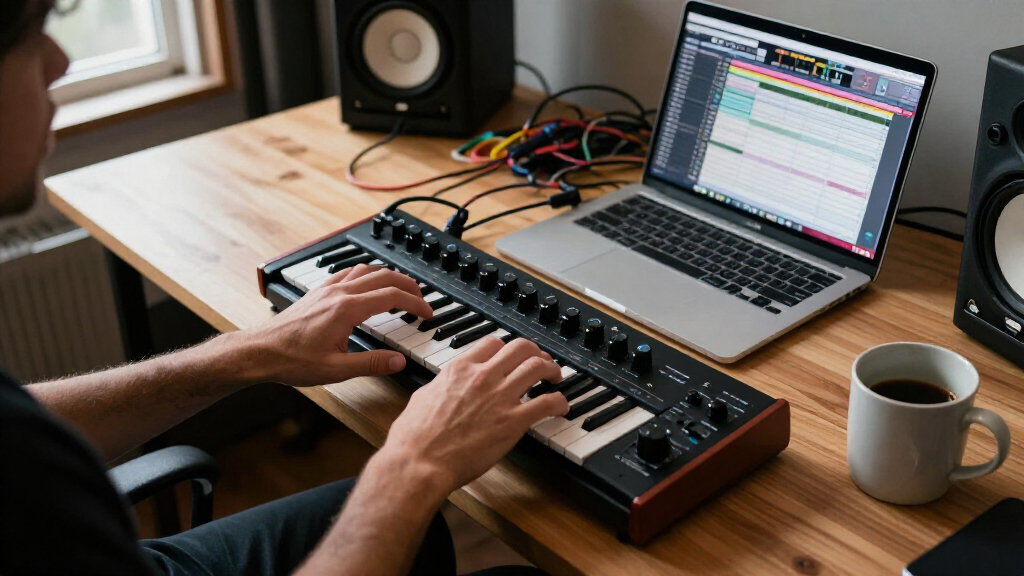
For most producers seeking a compact synthesizer for music production, I’d start with the Korg microKORG S: its keyboard, sound-shaping controls, vocoder, and speakers make it a capable standalone instrument. The Behringer PRO-800 is a stronger fit for hands-on polyphonic analog playing, while the Roland AIRA Compact J-6 favors quick chord-based songwriting in a small setup. The main tradeoff is between a self-contained instrument and a focused module or controller that depends more on your other gear. Portability, key feel, sound design depth, and integration all matter more than size alone. Read on for the full breakdown and a guide to choosing the right role for your setup.

Get audio and creator gear delivered free with Prime
- Fast, free delivery on millions of items
- Prime Video, Amazon Music and more included
- Member-only deals all year
Complete the kit


Key Takeaways
- The microKORG S is the most self-contained pick: its keyboard, built-in speakers, and vocoder reduce the need for extra gear, though its modeling-synth approach differs from the PRO-800’s analog voice architecture.
- The PRO-800 prioritizes playable polyphony over grab-and-go convenience: it suits producers who want a dedicated analog instrument, while several smaller options favor portability or preset-led workflows.
- The J-6 is a songwriting tool as much as a synth: its chord-focused design can speed up arrangement ideas, but it offers a different kind of hands-on control than a traditional keyboard synth.
- The M-VAVE FM-1 stands out for portable FM production: its battery power, sequencer, effects, and Bluetooth MIDI make it unusually self-contained for a small digital instrument.
- Not every item in the lineup is a standalone synthesizer: the MPK Mini Play MK3 is primarily a MIDI controller with onboard sounds, so buyers should distinguish it from dedicated sound-design instruments.
| Korg microKORG S Compact Analog Modeling Synthesizer |  | Best All-in-One for Portable Performance | Synthesis: Analog modeling | Oscillators: Dual-oscillator engine | Vocoder: 8-band with formant shifting | VIEW LATEST PRICE | See Our Full Breakdown |
| Stylophone The Original Pocket Electronic Synthesizer |  | Best for Instant Pocket-Sized Ideas | Playing surface: Touch-sensitive metal surface played with connected stylus | Range: Three octaves | Effect: Optional vibrato | VIEW LATEST PRICE | See Our Full Breakdown |
| M-VAVE FM-1 Orange 6-Operator FM Synthesizer |  | Best Value for a Portable Production Toolkit | Synthesis: Six-operator FM with 32 algorithms | Polyphony: Up to 12 voices | Presets: 128 factory presets | VIEW LATEST PRICE | See Our Full Breakdown |
| Behringer PRO-800 Classic Analog 8-Voice Polyphonic Synthesizer |  | Best for Analog Polyphonic Studio Parts | Synthesis: Analog signal path with VCO, VCF, and VCA | Voices: Eight-voice polyphony | Oscillators: Two VCOs per voice | VIEW LATEST PRICE | See Our Full Breakdown |
| Behringer AKS MINI Synthesizer |  | Best for Experimental Analog Textures | Circuit inspiration: EMS Synthi AKS | Oscillator circuitry: VCO circuitry | Filter: AKS-inspired filter | VIEW LATEST PRICE | See Our Full Breakdown |
| Roland n/vision Portable Boutique Wavetable Synthesizer |  | Best for Evolving Wavetable Textures | Synthesis: Wavetable | Polyphony: Up to 56 voices | Multitimbrality: Two-part | VIEW LATEST PRICE | See Our Full Breakdown |
| Akai Professional MPK Mini Play MK3 25-Key USB MIDI Keyboard Controller |  | Best for Portable Beatmaking | Keys: 25 velocity-sensitive mini keys | Pads: 8 velocity-sensitive, backlit MPC pads | Controls: 4 assignable rotary encoder knobs | VIEW LATEST PRICE | See Our Full Breakdown |
| Roland AIRA Compact J-6 CHORD SYNTH Portable Song Creation Machine |  | Best for Chord-Driven Songwriting | Sound engine: Four-voice JUNO-60 synth engine using Analog Circuit Behavior technology | Chord library: 100 chord sets | User patterns: 64 | VIEW LATEST PRICE | See Our Full Breakdown |
| Behringer UB-Xa MINI Synthesizer |  | Best for Compact Analog Character | Synthesis: Analog | Oscillators: 3 VCOs | Waveforms: Saw, rectangular wave, and PWM | VIEW LATEST PRICE | See Our Full Breakdown |
| compact synthesizers for music production | Synthesis |
|---|---|
| Korg microKORG S Compact Analo | Analog modeling |
| Stylophone The Original Pocket | — |
| M-VAVE FM-1 Orange 6-Operator | Six-operator FM with 32 algorithms |
| Behringer PRO-800 Classic Anal | Analog signal path with VCO, VCF, and VCA |
| Behringer AKS MINI Synthesizer | — |
| Roland n/vision Portable Bouti | Wavetable |
| Akai Professional MPK Mini Pla | — |
| Roland AIRA Compact J-6 CHORD | — |
| Behringer UB-Xa MINI Synthesiz | Analog |
More Details on Our Top Picks
Korg microKORG S Compact Analog Modeling Synthesizer
The Korg microKORG S earns this spot by combining a flexible modeling synth, an 8-band vocoder, and its own stereo speaker system in one portable instrument. That built-in sound makes it more self-contained than the Behringer PRO-800, which is aimed at studio use and does not offer the same speaker-based portability. The microKORG S also runs on six AA batteries, so it can work for writing away from a desk or for a small informal performance. Its 64 additional program slots give sound designers room to save more patches. The tradeoff is the mini-key layout, which is less comfortable for extended two-handed playing, and its modeling approach differs from the PRO-800’s all-analog signal path. Choose it for versatility and mobility, not for full-size keyboard feel.
Pros:- Built-in stereo speaker system with woofer allows immediate playback without external monitors.
- Eight-band vocoder and included mini mic support vocal processing.
- Battery operation supports portable playing away from a power outlet.
- Expanded memory adds 64 preset and user program slots.
Cons:- Mini keys are a compromise for players who perform long or technically demanding parts.
- Modeling synthesis is a different fit from the PRO-800’s analog voice architecture.
- Its compact chassis still measures over 20 inches wide, so it is not pocket-sized.
Best for: Producers and performers who want portable synth sounds, vocoder effects, and onboard speakers without building a separate monitoring setup.
Not ideal for: Players who need full-size keys or specifically want the direct, all-analog signal path and polyphonic architecture of a studio-focused synth.
- Synthesis:Analog modeling
- Oscillators:Dual-oscillator engine
- Vocoder:8-band with formant shifting
- Keyboard:Velocity-sensitive mini keys
- Programs:64 additional preset and user program slots
- Speakers:Built-in stereo 2.1 speaker system with woofer
- Power:Six AA batteries
- Dimensions:20.63 x 9.13 x 2.76 inches
- Weight:2.75 kg
Our verdict“Choose the microKORG S if you want a portable, self-contained synth with vocoder and speakers; skip it if full-size keys or an all-analog signal path matter more.”
Stylophone The Original Pocket Electronic Synthesizer
The Stylophone Original is the smallest, simplest idea-catcher here: its touch-sensitive metal surface and attached stylus turn note playing into a distinctive gliding gesture. At less than 12 cm wide, it is far more pocketable than the Korg microKORG S, but it is not a substitute for a conventional production keyboard. Its narrow note surface, three-octave range, and basic sound palette suit short hooks, rhythmic accents, and lo-fi textures better than full arrangements. A built-in speaker and headphone socket make sketching easy, while the 3.5 mm connection can feed its sound into a computer line input for recording. Unlike the feature-rich M-VAVE FM-1, it has no built-in sequencer or broad editing toolkit. I would pick it for an unusual sound and playful workflow, not as a main studio synth.
Pros:- Pocket-sized design is easier to carry than any keyed instrument in this group.
- Stylus-on-metal playing creates distinctive sliding gestures and a recognizable vintage character.
- Built-in speaker and headphone socket support quick, self-contained practice.
- 3.5 mm output can connect to a computer line input for recording.
Cons:- The limited playing surface is less practical for conventional keyboard parts.
- The simple sound and control set offer less production range than the M-VAVE FM-1.
- Computer recording requires a suitable line input or audio interface; it is not described as USB audio.
Best for: Beatmakers and songwriters who want a genuinely pocketable instrument for recording quirky melodic hooks, glides, and retro accents.
Not ideal for: Producers seeking a main keyboard, deep sound editing, polyphonic parts, or a built-in sequencer for arranging complete ideas.
- Playing surface:Touch-sensitive metal surface played with connected stylus
- Range:Three octaves
- Effect:Optional vibrato
- Speaker:Built-in speaker
- Headphone connection:Headphone socket
- Computer connection:3.5 mm stereo cable to a computer line input
- Power:Three AA batteries
- Dimensions:2.05 x 3.41 x 1.86 inches
- Weight:8.8 ounces
Our verdict“Buy the Stylophone as a tiny source of characterful hooks and textures, not as the central instrument in a production setup.”
M-VAVE FM-1 Orange 6-Operator FM Synthesizer
The M-VAVE FM-1 packs an unusually broad production toolkit into a small battery-powered unit: six-operator FM, 128 presets, a 16-step sequencer, an arpeggiator, effects, and multiple MIDI routes. That makes it more useful for building and connecting musical ideas than the minimalist Stylophone Original, while its 27-key layout provides a more familiar way to enter notes. The 12-voice polyphony can support chords, and USB-C or Bluetooth MIDI can link it to a DAW or mobile device. Its compact silicone keys and menu-centered editing are the main compromises; this is not the most natural choice for expressive, full-size keyboard performance. FM synthesis also rewards patience when shaping sounds, despite the supplied presets. I see it as a portable sketch-and-control station, especially for producers who want sequencing and connectivity in one box.
Pros:- Six-operator FM engine, 128 presets, and DX7 SysEx patch import give access to a broad range of timbres.
- Built-in 16-step sequencer, seven-mode arpeggiator, and six effects support idea-making without extra gear.
- USB-C, Bluetooth BLE MIDI, and 3.5 mm MIDI input offer flexible connections to computers and external equipment.
- Rechargeable battery and built-in speaker support portable use.
Cons:- The 27-key silicone keyboard is less suitable for expressive playing than a conventional keyboard.
- Editing 145 parameters on a compact device can feel less direct than dedicated full-size controls.
- The listed 12-hour battery life is a manufacturer-stated maximum, not a guarantee for every use.
Best for: Mobile producers and synth learners who want FM sounds, sequencing, effects, and wireless or wired MIDI in a self-contained portable unit.
Not ideal for: Keyboard players who need full-size keys, hands-on synthesis controls, or a straightforward analog-style sound-design workflow.
- Synthesis:Six-operator FM with 32 algorithms
- Polyphony:Up to 12 voices
- Presets:128 factory presets
- Keyboard:27-key silicone keyboard with octave shift
- Sequencer:16 steps; stores up to 16 loop sequences
- Arpeggiator and effects:Seven arpeggiator modes and six built-in effects
- MIDI connections:USB-C, Bluetooth BLE MIDI, and 3.5 mm MIDI IN
- Battery:2000 mAh rechargeable battery; stated runtime up to 12 hours
- Dimensions and weight:161.5 x 96.5 x 28.6 mm; 251 g
Our verdict“Choose the FM-1 if portable sequencing and extensive FM features matter more than full-size keys or a hands-on analog interface.”
Behringer PRO-800 Classic Analog 8-Voice Polyphonic Synthesizer
The Behringer PRO-800 is the pick for producers who value an analog voice architecture over the self-contained portability of the microKORG S or M-VAVE FM-1. Its eight voices each use two VCOs, giving chord parts and layered sounds a thicker analog foundation than a compact single-voice synth can provide. Unison mode combines the oscillators for more concentrated lead and bass tones, while the arpeggiator, sequencer, and 400 program memories make it useful beyond static patch playing. The key tradeoff is its studio-first format: the listing describes a Eurorack-format instrument, not a battery-powered keyboard with built-in speakers. It needs a suitable setup for playing and monitoring, so it is less ready to travel than the microKORG S. This makes more sense as a compact studio voice than as an all-in-one portable instrument.
Pros:- Eight-voice polyphony supports fuller chord and pad parts than the pocket-oriented Stylophone.
- Two VCOs per voice provide layered oscillator combinations and unison sounds.
- Arpeggiator, sequencer, and 400 program memories support varied studio workflows.
- Pure analog VCO, VCF, and VCA signal path suits producers seeking analog voice design.
Cons:- The Eurorack-format design is less self-contained than the microKORG S with its keys and speakers.
- No battery operation or built-in speaker is specified, limiting spontaneous portable use.
- The provided product details do not specify a keyboard, so a separate playing setup may be needed.
Best for: Producers building analog chord, pad, bass, and lead parts in a studio or Eurorack-oriented setup who want eight-voice polyphony.
Not ideal for: Musicians who need a portable keyboard, onboard speakers, or an instrument that can run independently on batteries.
- Synthesis:Analog signal path with VCO, VCF, and VCA
- Voices:Eight-voice polyphony
- Oscillators:Two VCOs per voice
- Oscillator shapes:Saw, triangle, and pulse for each oscillator
- Unison:Up to 16 oscillators in unison mode
- Sequencer:Built-in sequencer
- Arpeggiator:Built-in arpeggiator
- Program memory:400 program memories
- Format:Eurorack format
Our verdict“Pick the PRO-800 for analog polyphonic parts in a prepared studio setup, but choose a portable keyboard synth if you need to play anywhere.”
Behringer AKS MINI Synthesizer
The Behringer AKS MINI is the most specialized choice in this group: its appeal is the recreated EMS Synthi AKS VCO and filter circuitry, not an expansive feature list. That analog focus makes it a better fit for unusual tones and experimental sound work than the broadly programmable M-VAVE FM-1, whose six-operator engine, sequencer, and effects cover more production tasks. It may also appeal to producers seeking a compact route to a distinctive filter character without choosing the PRO-800’s eight-voice polyphonic approach. The supplied information is sparse, though: it does not establish key count, polyphony, sequencing, memory, or battery operation. That limits how confidently I can recommend it as a complete music-production instrument. Treat it as a specialist sound source, and verify the controls and connections you need before making it a core setup component.
Pros:- Recreates EMS Synthi AKS-inspired VCO and filter circuitry.
- Distinctive analog filter focus offers a different role from the FM-based M-VAVE FM-1.
- Compact synth positioning suits a setup with limited space.
- USB Type-C connector is listed in the product details.
Cons:- Available product information does not specify keyboard layout, limiting confidence about playability.
- Polyphony, sequencing, and patch-memory details are not provided.
- Battery operation and audio-output details are not established in the supplied information.
Best for: Experimental producers who want a compact analog sound source centered on the EMS Synthi AKS-style oscillator and filter character.
Not ideal for: Buyers who need confirmed polyphony, keyboard details, sequencing, patch storage, or portable battery operation before choosing a studio instrument.
- Circuit inspiration:EMS Synthi AKS
- Oscillator circuitry:VCO circuitry
- Filter:AKS-inspired filter
- Synthesis character:Analog
- Polyphony:Described as an evolution with polyphony; voice count not specified
- Connector:USB Type-C listed
Our verdict“Consider the AKS MINI as a specialist analog texture source, but choose a better-documented instrument if you need a complete production workflow.”
Roland n/vision Portable Boutique Wavetable Synthesizer
The n/vision is the most flexible sound-design choice in this group, pairing a two-layer wavetable architecture with up to 56-voice polyphony. That gives producers room for moving pads, layered tones, and harmony-rich parts that the more focused J-6 chord synth is not built to create. Its two-part multitimbrality also lets one compact unit cover more than a single sound role in a track. Front-panel controls support quick shaping, while deeper menus open up more detailed modulation and wave shaping.
The tradeoff is that its depth can take more time to learn than the MPK Mini Play MK3, which is aimed at immediate playing and control. The n/vision is also larger and heavier than the pocket-sized J-6. I’d choose it for production-led sound design, not for the simplest grab-and-go chord sketching setup.
Pros:- Two-layer wavetable design supports complex, evolving tones.
- Up to 56 voices of polyphony suits dense chords and sustained parts.
- Two-part multitimbrality can cover multiple sound roles in a track.
- USB-C audio/MIDI, traditional MIDI I/O, and external clock support studio and hardware setups.
Cons:- Menu-driven editing may slow down players who prefer direct, simple controls.
- At 5.2 pounds, it is less convenient to carry than the Roland J-6.
- Its sound-design depth may be unnecessary for buyers seeking a focused sequencer or controller.
Best for: Producers who want a compact, polyphonic instrument for evolving pads, layered parts, and detailed wavetable sound design.
Not ideal for: Players who want a simple, immediately playable chord machine or a tiny, lightweight instrument for casual songwriting.
- Synthesis:Wavetable
- Polyphony:Up to 56 voices
- Multitimbrality:Two-part
- Effects:17 MFX types; dedicated reverb with five types and shimmer mode
- Audio/MIDI connection:USB-C audio/MIDI interface
- Hardware connections:Traditional MIDI I/O and external clock input
- Display:OLED
- Dimensions:12.13 x 8.25 x 2.13 inches
- Weight:5.2 pounds
Our verdict“Choose the n/vision if broad polyphony and evolving wavetable design matter more than the J-6’s simpler, chord-first workflow.”
Akai Professional MPK Mini Play MK3 25-Key USB MIDI Keyboard Controller
The MPK Mini Play MK3 is the strongest pick here for producers who need a keyboard controller and self-contained sketchpad in one compact unit. Its built-in sounds and speaker let you play without a computer, while USB MIDI, eight velocity-sensitive MPC pads, and four knobs make it useful as a DAW controller when you return to the studio. Compared with the Roland J-6, it gives you more direct keyboard-and-pad input but less dedicated chord sequencing and synth-specific control.
The built-in sound library is convenient for ideas and practice, but this is not a full-featured sound-design instrument like the Roland n/vision. Its 25 mini keys also limit two-handed performance and can feel cramped for extended keyboard parts. I’d pick it for beatmakers who value portability and hands-on DAW input over a dedicated synthesizer engine.
Pros:- Built-in sounds and speaker allow standalone practice and idea capture.
- Eight velocity-sensitive MPC pads suit drum programming and sample triggering.
- USB MIDI and four assignable knobs provide useful DAW control.
- Battery operation supports portable sessions without a mains connection.
Cons:- Mini keys are cramped for extended or two-handed keyboard parts.
- Onboard instruments offer less sound-design depth than the Roland n/vision.
- Its controller-focused workflow lacks the J-6’s dedicated chord-pattern sequencing.
Best for: Beatmakers and songwriters who want a portable 25-key controller with onboard sounds for sketching away from a computer and controlling a DAW at home.
Not ideal for: Players who need full-size keys, deep onboard synthesis, or a dedicated sequencer for building complete patterns without a DAW.
- Keys:25 velocity-sensitive mini keys
- Pads:8 velocity-sensitive, backlit MPC pads
- Controls:4 assignable rotary encoder knobs
- Built-in sounds:Over 100 internal drum and instrument sounds
- Display:OLED
- Connectivity:USB MIDI; USB Type B to A cable included
- Power:Batteries or USB power; batteries not included
- Other features:Built-in speaker, arpeggiator, and note repeat
Our verdict“Choose the MPK Mini Play MK3 if portable keys, drum pads, and basic standalone sounds matter more than deep synthesis or sequencer-led composition.”
Roland AIRA Compact J-6 CHORD SYNTH Portable Song Creation Machine
The J-6 earns its place by making chord progressions the starting point rather than an afterthought. Its 100 chord sets, programmable sequencer, and varied arpeggio phrases help producers turn a progression into a rhythmic part quickly. The four-voice JUNO-60 engine supplies the sounds, while filter and envelope controls let you shape them during playback. Compared with the Akai MPK Mini Play MK3, the J-6 is less of a keyboard controller and more of a compact composition tool; compared with the Roland n/vision, it is far less open-ended for sound design.
That focus is also its main limitation: four voices and a chord-oriented workflow may not suit players who want broad polyphonic performance or extensive patch creation. I’d choose it for portable electronic songwriting and idea generation, not as a single do-everything studio synth.
Pros:- A large chord library makes progression writing fast and approachable.
- Sequencer stores up to 64 user patterns of up to 64 steps.
- JUNO-60-based sound engine supplies a distinct classic synth character.
- USB-C audio/MIDI and audio, MIDI, and sync connections support studio integration.
Cons:- Four-voice polyphony limits fuller chords and overlapping sustained parts.
- Chord-first controls are less suited to conventional keyboard performance than the MPK Mini Play MK3.
- The focused synth engine offers less sound-design range than the Roland n/vision.
Best for: Electronic songwriters who want to build chord progressions and rhythmic phrases quickly in a compact, portable setup.
Not ideal for: Keyboard players seeking broad polyphony or sound designers who want the n/vision’s deeper wavetable and modulation options.
- Sound engine:Four-voice JUNO-60 synth engine using Analog Circuit Behavior technology
- Chord library:100 chord sets
- User patterns:64
- Pattern length:Up to 64 steps
- Arpeggio styles:9 styles with 12 variations each
- Presets:64 synth presets
- Effects:Delay and reverb
- Connections:USB-C audio/MIDI, audio I/O, MIDI I/O, and sync I/O
- Weight:1.3 pounds
Our verdict“Choose the J-6 if fast chord sequencing and portable songwriting matter more than expansive synthesis or a conventional keyboard layout.”
Behringer UB-Xa MINI Synthesizer
The UB-Xa MINI is the analog-leaning choice in this batch, built around three VCOs and a dual-slope low-pass filter for shaping a direct, weighty tone. Its ring modulator adds a route to more metallic, less conventional sounds, and the 16-step motion sequencer can record knob movements so a phrase changes over time. That makes it a better fit for hands-on analog experimentation than the Roland J-6, whose main strength is organizing chords and phrases. It also takes a different approach from the wavetable-based Roland n/vision, favoring oscillator-and-filter sound shaping.
The supplied information does not specify polyphony, keyboard, or connection details, which makes it harder to judge how well it will serve as a complete production hub. Its analog focus may also be limiting for buyers who want varied digital textures or a broad preset palette. I’d treat it as a compact tone source, not assume it replaces a full workstation.
Pros:- Three VCOs provide multiple oscillator sources for shaping a sound.
- 12/24 dB dual-slope low-pass filter offers two stated filter slopes.
- Ring modulator supports metallic and less conventional tones.
- 16-step motion sequencer records knob movements and stores 10 memories.
Cons:- Available product details do not state polyphony or keyboard configuration.
- The analog-focused sound engine is less flexible for digital wavetable textures than the n/vision.
- Connection options and computer-integration details are not specified in the supplied product data.
Best for: Producers seeking an analog-style oscillator and filter voice with motion sequencing for basses, leads, and experimental textures.
Not ideal for: Buyers who need confirmed polyphony, a keyboard, detailed connectivity, or the broad wavetable range of the Roland n/vision.
- Synthesis:Analog
- Oscillators:3 VCOs
- Waveforms:Saw, rectangular wave, and PWM
- Filter:12/24 dB dual-slope analog low-pass filter
- Modulation:Built-in ring modulator
- Sequencer:16-step motion sequencer
- Motion memory:10 memory slots
Our verdict“Choose the UB-Xa MINI for oscillator-and-filter-based analog character with motion sequencing, but verify its performance and connection needs before treating it as a main studio instrument.”
How We Picked
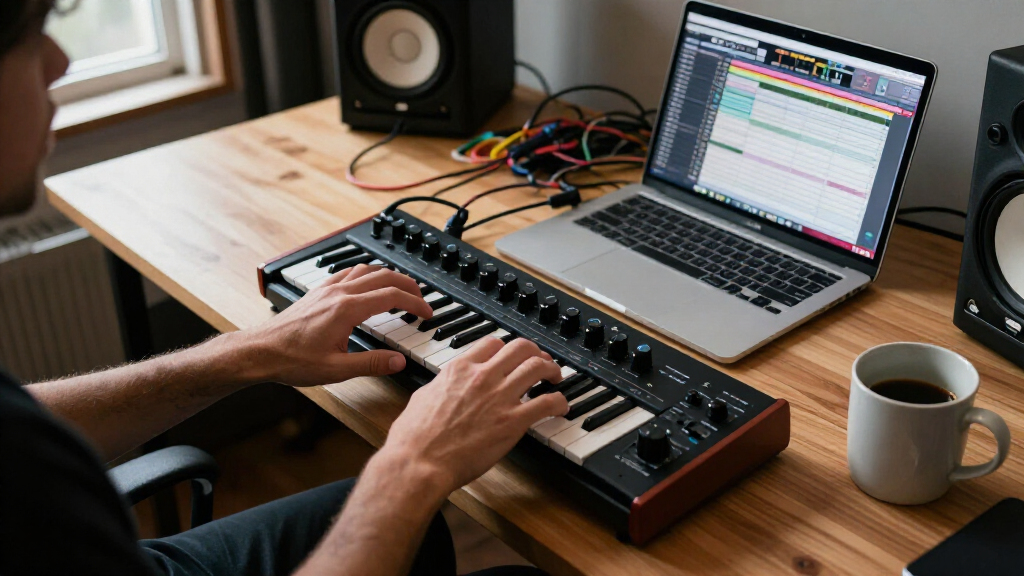
I ranked these products by how well they serve music production in a compact setup, not by size or feature count alone. I weighed sound-making capability, access to useful controls, sequencing or performance tools, portability, and how easily each option can fit into a computer-based or hardware workflow. Standalone operation matters for producers who want to make ideas away from a desk; MIDI and connection options matter more for those building around a DAW.
The order reflects practical versatility for a broad range of producers, then more specialized strengths. The microKORG S leads as an all-in-one instrument, while the PRO-800 earns a distinct place for analog polyphony and the FM-1 for portable digital sequencing. The J-6 and other focused instruments can be better choices for specific workflows, but their narrower roles keep them from leading the overall ranking. I also distinguish the MPK Mini Play MK3 from dedicated synths because its central role is control, not deep sound design.
| compact synthesizers for music production | Synthesis |
|---|---|
| Korg microKORG S Compact Analo | Analog modeling |
| Stylophone The Original Pocket | — |
| M-VAVE FM-1 Orange 6-Operator | Six-operator FM with 32 algorithms |
| Behringer PRO-800 Classic Anal | Analog signal path with VCO, VCF, and VCA |
| Behringer AKS MINI Synthesizer | — |
| Roland n/vision Portable Bouti | Wavetable |
| Akai Professional MPK Mini Pla | — |
| Roland AIRA Compact J-6 CHORD | — |
| Behringer UB-Xa MINI Synthesiz | Analog |
Factors to Consider When Choosing Compact Synthesizers For Music Production
Compact synths can fill very different jobs: a main keyboard, a sound module, a sketchpad, or a controller for a computer-based studio. I’d decide what role is missing from your setup before comparing presets or effects. These factors can prevent a small instrument from becoming an awkward addition rather than a useful production tool.
Choose the instrument’s job before its sound
Start by asking whether you need a primary sound source, a portable idea generator, or a controller for software instruments. A dedicated synth makes its own sound, while a MIDI controller mainly sends performance data; a hybrid may do both but still have limits in either role. Buying a controller when you want standalone sound design can lead to extra software and setup steps. Buying a self-contained synth when you mainly need DAW control can leave you paying for functions you rarely use. Write down the two or three tasks you expect to do most often, then favor the instrument built around those tasks.
Treat portability as a whole-system question
A small case does not automatically make a synth convenient to use away from home. Check power needs, speakers or headphone output, cables, and computer requirements alongside its dimensions. Battery operation can make spontaneous writing easier, but a tiny screen or crowded controls may slow editing once you sit down to arrange a track. Built-in speakers are useful for quick sketches, though they are not a substitute for monitoring decisions on headphones or studio speakers. Consider the complete travel setup, including the way you’ll save and transfer ideas.
Match the control layout to your sound-design habits
Producers who shape a patch while playing often benefit from direct access to oscillator, filter, and envelope controls. A preset-led workflow can be faster when the goal is to find a sound and get back to arranging. More controls do not always mean faster results: a compact panel can crowd labels and make adjustments less precise. Before choosing, decide whether you prefer to build sounds from scratch, tweak presets, or work from sequenced patterns. That preference often matters more day to day than the number of synthesis features.
Check how it fits your DAW and hardware
Confirm the connections and synchronization options your current setup actually uses, such as USB MIDI, standard MIDI, audio outputs, or clock sync. MIDI connectivity does not always mean audio travels through the same cable, so check whether you’ll still need a separate audio connection. Workflow friction can outweigh sound quality if recording requires extra routing every session. Hardware producers should also check how the synth handles external clock and pattern changes, while DAW users may care more about reliable MIDI mapping. Plan the signal path before buying rather than assuming compact gear will connect seamlessly.
Decide whether keys, pads, or sequencing matter most
Mini keys save space but can feel cramped for two-handed parts or expressive playing. If you mainly enter bass lines and short melodies, a small keyboard may be a sensible compromise; for chord performance, test the layout against your usual playing style if possible. A built-in sequencer can capture ideas without a computer, but it may not replace the editing and arrangement tools in your DAW. Sequencing is most useful when it matches your process, not simply because it appears on the feature list. Choose the interface that makes your common musical gestures easy to repeat.
Pay for useful flexibility, not unused complexity
Spending more can make sense when the synth will serve as a central instrument for several years, especially if you need richer playing options or direct sound control. A simpler device may be the better value when it solves one clear problem, such as portable chord sketches or a compact controller for software. Avoid choosing on preset count alone: the sounds you can shape and the ease of recording them often matter more. Match complexity to your willingness to learn and maintain a workflow. Leave room in your decision for the cables, stands, headphones, or software the instrument may need.
Frequently Asked Questions
Can a compact synthesizer replace a full-size studio keyboard?
It can replace one for producers who mainly record short parts, program sequences, or use a separate controller for extended playing. Compact keys and limited panel space may feel restrictive for piano-style performance or detailed live automation. A smaller synth can still be a strong studio sound source even if it is not your main keyboard. Decide whether you need it to play parts directly or mainly to create and record sounds.
Should I choose a synth with built-in speakers for production?
Built-in speakers are useful for sketching, practicing, and checking an idea without setting up monitors. They are generally best treated as a convenience rather than a reliable way to judge a finished mix. For production decisions, headphones or studio speakers provide a more useful reference. If you already work at a fixed desk, prioritize the sound engine and connections over speakers; if you write in different places, they can make a compact instrument easier to use.
Is a MIDI keyboard with onboard sounds the same as a synthesizer?
Not necessarily. A MIDI controller’s main job is to send notes and control data to a computer or other instrument, while a synthesizer generates sound itself. Some compact keyboards include onboard sounds, but their sound editing and standalone production features may be more limited than those of a dedicated synth. Check whether you can make, shape, and record the sounds you want without relying on a computer before treating a controller as a synth replacement.
Do I need a built-in sequencer to make complete tracks?
No. A sequencer is valuable for capturing patterns and building ideas without a DAW, but a computer-based workflow can handle those tasks and offer deeper arrangement and editing. A hardware sequencer may be especially useful if you want a portable setup or prefer performing patterns from the instrument. Before paying for one, check whether it supports the pattern length, timing, and synchronization you use. The best choice depends on where you want composition and editing to happen.
How can I tell whether a compact synth will work with my existing setup?
List the inputs and outputs on your interface, computer, and other instruments, then compare them with the synth’s connection options. Check audio routing separately from MIDI: a device may send performance data over USB while still requiring a dedicated audio cable to record its sound. If you use external hardware, confirm clock synchronization and MIDI compatibility before buying. A simple connection diagram can reveal whether you need an extra interface, adapter, or power supply.
Conclusion
For a single compact instrument that can cover several studio and sketching roles, my best overall pick is the Korg microKORG S. I’d choose the Behringer PRO-800 as the best premium-style pick for producers who want dedicated analog polyphony, and the M-VAVE FM-1 as the best value-oriented portable choice for a battery-powered FM workflow with sequencing features. Beginners who want a straightforward chord-based way into arranging may prefer the Roland AIRA Compact J-6, while the MPK Mini Play MK3 makes more sense for someone seeking a compact controller with onboard sounds rather than a full sound-design instrument. For focused needs, the Stylophone offers a pocket-sized performance format, while the other specialized Roland and Behringer models suit buyers drawn to their particular synthesis approaches. Choose by the job you need done, then confirm that the connections and controls fit the rest of your setup.
Halloween Picks

Pumpkin Halloween Fog Machine with 12-Color LEDs, Bluetooth Speaker, and Remote

27FT Giant Inflatable Pumpkin Lighted Outdoor Halloween Decor

10-Foot Halloween Inflatable Double-Headed Dragon Archway
As an affiliate, we earn on qualifying purchases.