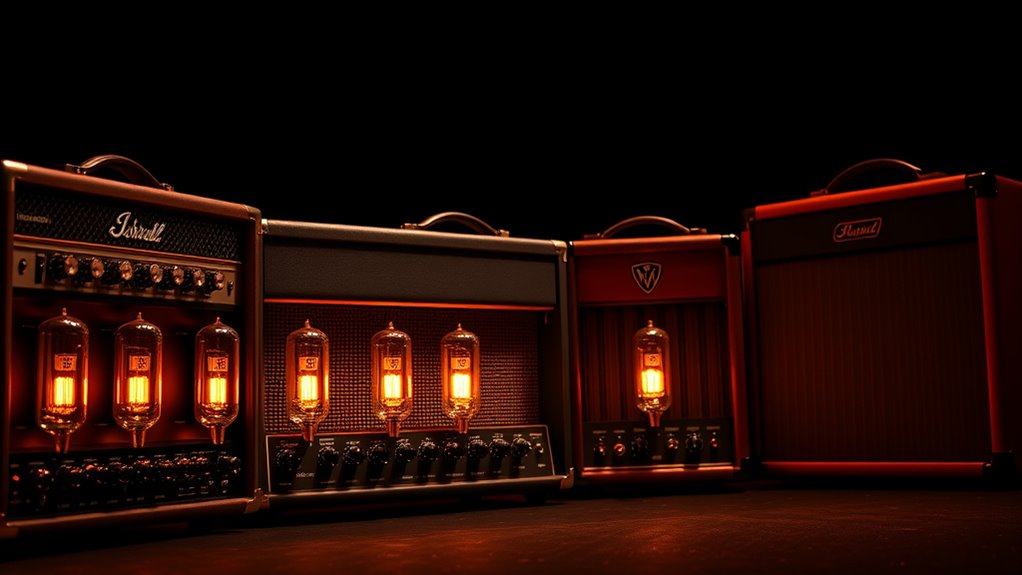

Choosing the right premium tube guitar amplifier defines your sonic signature, balancing raw power with nuanced responsiveness. The Fender Blues Deluxe Reissue stands out as the best overall pick for its iconic clean-to-crunch versatility and legendary build quality. For those prioritizing classic British chime, the Vox AC30C2 remains unmatched, while the Orange OR15H offers a compact, high-gain alternative for modern players. Buyers face a tradeoff between portable combo units and powerful heads, as well as between vintage authenticity and modern reliability features like tube life multipliers. Continue reading to explore how these fourteen models stack up against one another.

Get audio and creator gear delivered free with Prime
- Fast, free delivery on millions of items
- Prime Video, Amazon Music and more included
- Member-only deals all year
Complete the kit


Key Takeaways
- The Fender Blues Deluxe Reissue dominates the mid-range category by offering the perfect balance of volume, tone, and iconic aesthetics without the bulk of larger stacks.
- Bugera’s INFINIUM series provides a significant reliability advantage over traditional vintage-style amps, extending tube life by up to 20 times, which is critical for touring musicians.
- The Vox AC30C2 and Vox AC15C1 highlight a clear power tradeoff; the 30W model offers headroom for band settings, while the 15W is ideal for home studio work but lacks stage volume.
- Compact tube heads like the Electro-Harmonix MIG-50 and Orange OR15H prove that high-wattage tone does not require heavy cabinets, appealing to players who prioritize portability.
- Value options like the Monoprice 1×12 and OriPure 15W deliver solid tube tone at a fraction of the cost of major brands, though they often compromise on component quality and resale value.


| guitar amplifiers tube premium | Channels | Wattage | Weight |
|---|---|---|---|
| Electro-Harmonix MIG-50 2-Chan | 2 | 50 watts | 25 pounds |
| Vox AC30C2 2×12" 30W Guitar Tu | 2: Normal and Top Boost | — | 32.2 kg |
| Orange OR15H 15W Compact Tube | 1 | — | 19 pounds |
| Fender Blues Junior Guitar Amp | — | — | — |
| Fender Hot Rod DeVille 212 IV | 2 | 60 watts | 49.7 pounds |
| Fender Blues Deluxe Reissue Tu | 2 | 40 Watts | — |
| Bugera V22 INFINIUM 22-Watt Vi | 2 | 22 Watts | 42.8 pounds |
| Fender Pro Junior IV Guitar Am | 1 | 15 Watts | 20 pounds |
| Bugera V5 INFINIUM 5-Watt Clas | 1 | 5 Watts | 22.1 pounds |
| Vox AC15C1 1×12" 15W Guitar Tu | 2 | 15 Watts | 56.1 pounds |
| Fender Hot Rod Deluxe 30th Ann | 1 | 40 watts | — |
| Fender Blues Junior IV Guitar | 1 | 15 watts | — |
| OriPure 15W All Tube Guitar Am | — | 15 watts | 6.6 pounds |
| Monoprice 1×12 Guitar Stack Tu | 2 | 30 watts | 66 pounds |
More Details on Our Top Picks
Electro-Harmonix MIG-50 2-Channel 50-Watt Tube Guitar Amp Head
I’d choose the MIG-50 for a player who wants the feel of a classic, high-headroom tube head without committing to a combo. Its 50-watt output and two independently controlled channels give it more room for a loud band setting than the Orange OR15H, whose 15-watt output is better suited to smaller spaces and controlled volume. The vintage Bassman-style tonal character makes the MIG-50 a strong match for players who prefer a direct, responsive foundation and shape their sound with their guitar, pedals, or external cabinet setup.
The tradeoff is a comparatively bare-bones format: there are no built-in effects, and the head needs a separate speaker cabinet. At 25 pounds, it is also less convenient to carry than its compact-head format might suggest. I’d rank it for its power and vintage voice, not for all-in-one convenience.
Pros:- 50-watt tube output offers more headroom than the Orange OR15H.
- Two independent volume controls allow distinct channel-level settings.
- Vintage-inspired tone is suited to players who want a classic, responsive foundation.
- High-quality components are specified for a durable build.
Cons:- Requires a separate speaker cabinet to use.
- At 25 pounds, it is not especially light for a compact amp head.
- No built-in effects or digital features.
Best for: Guitarists seeking a vintage-voiced, 50-watt tube head for band rehearsals or gigs who already own a suitable speaker cabinet.
Not ideal for: Players wanting a ready-to-play combo, onboard effects, or a lighter grab-and-go amp; this head requires a separate cabinet and has no built-in effects.
- Amplifier type:Tube amp head
- Wattage:50 watts
- Channels:2
- Power source:Corded electric
- Output type:XLR or 6.35 mm jack
- Color:Black
- Weight:25 pounds
- Dimensions:9.5 × 19.7 × 8 inches (D × W × H)
Our verdict“Choose the MIG-50 if you want vintage-style tone and substantial headroom from a tube head, and already have a cabinet to pair with it.”
Vox AC30C2 2×12″ 30W Guitar Tube Combo Amp – Celestion Speakers
The Vox AC30C2 is the lineup’s clear choice for players who want a signature British combo sound with its speakers built in. Its 30-watt tube design, Top Boost circuit, and pair of 12-inch Celestion Greenbacks give it a broader, more immediately usable package than the cabinet-dependent Electro-Harmonix MIG-50. Normal and Top Boost channels, plus the Top Boost treble and bass controls, let players shape contrasting sounds without relying entirely on pedals.
That full combo setup brings a real carrying cost: the listed weight is 32.2 kg, making it a less appealing choice for frequent load-ins than the 19-pound Orange OR15H head. The AC30C2 also commits to its own distinctive voice rather than the MIG-50’s vintage-inspired head-and-cab flexibility. I’d pick it for players who want classic Vox character and expansive speaker projection, but skip it if portability is a priority.
Pros:- Top Boost circuit delivers the model’s defining articulate Vox-style tone.
- Two 12-inch Celestion Greenback speakers provide a built-in stereo-free 2×12 combo setup.
- Normal and Top Boost channels offer distinct starting points for shaping sounds.
- Effects loop supports integration of external effects.
Cons:- Listed weight of 32.2 kg makes regular transport demanding.
- Its 2×12 combo format is less modular than a separate head and cabinet.
- The distinctive Vox voice may not suit players seeking a more neutral amp platform.
Best for: Players who want classic Vox Top Boost tones, two 12-inch speakers, and a complete tube combo for rock, blues, or classic-rock settings.
Not ideal for: Musicians who carry their amp frequently, need a compact rig, or want to choose a separate cabinet; the 2×12 combo is heavy and less modular than the MIG-50 head.
- Amplifier type:Tube combo
- Output wattage:30 watts
- Channels:2: Normal and Top Boost
- Speakers:Two 12-inch Celestion Greenbacks
- Power tubes:EL84
- Preamp tubes:12AX7
- Effects loop:True bypass
- Weight:32.2 kg
Our verdict“Pick the AC30C2 if signature Vox tone and a powerful 2×12 combo matter more to you than easy transport.”
Orange OR15H 15W Compact Tube Guitar Amp Head
For a tube head that can move between rehearsal and studio setups, I’d put the Orange OR15H ahead of the larger combos here. Its output switches between 15 and 7 watts, giving players a lower-power option for settings where the MIG-50’s 50 watts would be more than they need. The three-band EQ also gives more direct tonal control than the MIG-50’s described tone-shaping options, while the all-tube effects loop accommodates external effects in the signal chain.
This is a single-channel head, so it doesn’t offer the MIG-50’s two independent channel volumes or the Vox AC30C2’s Normal and Top Boost choices. It also requires a separate cabinet, and 15 watts may not provide enough output for larger venues or very loud bands. I’d favor the Orange for compactness and flexible output, not for maximum clean headroom or an all-in-one rig.
Pros:- Switches between 15 and 7 watts for different playing environments.
- Three-band EQ gives direct control over tonal shaping.
- All-tube effects loop supports external effects.
- At 19 pounds, it is lighter than the MIG-50 head.
Cons:- Single-channel design offers fewer channel options than the MIG-50 or Vox AC30C2.
- 15-watt maximum may fall short for large venues or loud bands.
- Requires a separate speaker cabinet.
Best for: Guitarists who need a compact, single-channel tube head for home recording, rehearsal, or smaller gigs and want switchable output levels.
Not ideal for: Players who need high-volume clean headroom, multiple channels, or a complete combo; its 15-watt maximum can be limiting in large venues and it needs a cabinet.
- Amplifier type:Tube amp head
- Output wattage:15 watts, switchable to 7 watts
- Channels:1
- EQ bands:3
- Effects loop:All-tube
- Connector:6.35 mm jack
- Enclosure material:Stainless steel
- Weight:19 pounds
Our verdict“Choose the OR15H if you want a portable, lower-powered tube head with useful output switching and can work within its single-channel limits.”
Fender Blues Junior Guitar Amplifier, Lacquered Tweed
The Fender Blues Junior suits players who want a straightforward tube combo with familiar Fender styling and a few useful onboard extras. Its EL84 and 12AX7 tubes, Jensen P12N speaker, and spring reverb make it a more self-contained option than either the cabinet-dependent Orange OR15H or the Electro-Harmonix MIG-50. A foot-switchable FAT option adds a thicker sound when you want more weight from the amp, without asking you to build a multi-channel rig.
Its 15-watt output puts it well below the Vox AC30C2’s 30 watts and the DeVille’s 60, so it is better matched to smaller settings than players chasing substantial stage headroom. The reverb may also feel basic beside a pedal-based setup, and the available details give no weight figure, so I wouldn’t assume it is easy to carry. This is the simpler combo pick, not the loudest or most flexible one.
Pros:- Jensen P12N speaker is specified as part of the combo.
- Onboard spring reverb adds ambience without requiring a separate pedal.
- Foot-switchable FAT option provides a thicker tonal setting.
- EL84 and 12AX7 tube configuration supports a classic tube-amp format.
Cons:- 15-watt output offers less headroom than the AC30C2 and Hot Rod DeVille 212 IV.
- Onboard reverb may not satisfy players seeking more varied effects.
- The listed product details do not provide a weight for planning transport.
Best for: Blues and roots players who want a tube combo with a Jensen speaker, onboard spring reverb, and a foot-switchable thicker-voicing option.
Not ideal for: Players who need high stage volume, advanced effects, or a clearly lightweight combo; its 15-watt output is limited compared with the DeVille and AC30C2.
- Power tubes:EL84
- Preamp tubes:12AX7
- Speaker:Jensen P12N
- Cabinet:Lacquered tweed
- Output wattage:15 watts
- FAT option:Foot-switchable
- Reverb:Onboard spring reverb
Our verdict“Choose the Blues Junior if you want a simple, tweed-style tube combo with built-in reverb and don’t need the greater output of the DeVille.”
Fender Hot Rod DeVille 212 IV Guitar Amplifier, Black, with 2-Year Warranty
The Hot Rod DeVille 212 IV is the high-output combo choice in this group. Its 60 watts and dual 12-inch Celestion speakers are aimed at players who need a commanding stage rig, rather than the lower-volume feel of the Blues Junior or Orange OR15H. Modified preamp circuitry and updated spring reverb add useful tonal character, while the pine cabinet keeps the package specified as lighter than some comparable builds—though the actual listed weight is still 49.7 pounds.
That output and speaker configuration make it less suited to small rooms or musicians who regularly carry their gear alone. Its two-channel layout is also less expansive than amps with more channel options, and it remains a substantial combo beside the modular MIG-50 head. I’d rank it for gigging volume and built-in projection, not portability or a compact home setup.
Pros:- 60-watt output is the highest listed among these five products.
- Dual 12-inch Celestion speakers provide substantial built-in speaker capacity.
- Modified preamp circuitry and improved spring reverb add tonal features for gigging.
- Two-year warranty is included in the product title.
Cons:- At 49.7 pounds, it can be cumbersome to move regularly.
- Its high output is more than many small-room players need.
- Two channels offer fewer channel choices than some more flexible amp layouts.
Best for: Gigging guitarists who need a loud 2×12 tube combo with 60-watt output, spring reverb, and an included two-year warranty.
Not ideal for: Home players in small rooms or musicians who need to carry an amp frequently; its 60-watt output and 49.7-pound weight favor stage use over easy transport.
- Amplifier type:Tube combo
- Wattage:60 watts
- Speaker configuration:Two 12-inch Celestion speakers
- Channels:2
- Cabinet material:Pine
- Color:Black
- Weight:49.7 pounds
- Warranty:2 years
Our verdict“Choose the DeVille 212 IV if you need substantial stage volume from a tube combo and can accommodate its weight and output.”
Fender Blues Deluxe Reissue Tube Combo Guitar Amplifier, 40 Watts, Tweed
This amplifier stands out for its versatility in mid-sized venues, offering a sweet spot between bedroom practice and small club gigs. Compared to the Fender Pro Junior IV, the Blues Deluxe Reissue provides significantly more headroom and two channels, making it far more adaptable for players who need both clean and overdriven sounds without pedal assistance. The 40-watt output delivers enough volume to compete with a drummer, whereas lower-wattage options often struggle in live settings. However, this power comes at the cost of portability; the unit is notably heavy and bulky. While the spring reverb is a classic Fender feature, the lack of built-in effects beyond that means players often need an external pedalboard. It is a dedicated stage tool rather than a compact studio companion.
Pros:- 40 watts provide ample headroom for live performances
- Two-channel design allows for clean and overdriven tones
- Classic tweed aesthetics and vintage Fender voicing
- Built-in spring reverb adds depth without pedals
Cons:- Heavy and bulky construction makes transport difficult
- Limited modern connectivity features
- Lacks built-in effects beyond reverb
Best for: Gigging guitarists who need reliable stage volume and two-channel switching for blues or classic rock.
Not ideal for: Home players or those with limited storage space, as the cabinet is large and heavy.
- Wattage:40 Watts
- Speaker Size:12 inches
- Channels:2
- Amp Type:Tube
- Dimensions:20.5″D x 26″W x 12″H
- Color:Tweed
- Warranty:5-year limited
Our verdict“A solid choice for players needing stage-ready volume and classic Fender character in a single package.”
Bugera V22 INFINIUM 22-Watt Vintage 2-Channel Tube Combo with Tube Life Multiplier
The Bugera V22 INFINIUM distinguishes itself with INFINIUM technology, which significantly extends tube life compared to traditional amplifiers like the Fender Blues Deluxe Reissue. This feature is a major advantage for players who want tube tone without the frequent, costly tube replacements. The EL84 power tubes deliver a tighter, more British-voiced crunch that contrasts with the smoother, American-style breakup of Fender models. While the 22-watt output is sufficient for rehearsals and small gigs, it lacks the sheer volume of the 40-watt Fender options. The build quality is robust, but the weight remains substantial. This amp is ideal for those prioritizing longevity and specific EL84 tonal characteristics over raw power or brand heritage.
Pros:- INFINIUM technology greatly extends tube lifespan
- EL84 tubes provide a distinct, tight crunch tone
- Robust construction with a quality Turbosound speaker
- Two channels offer versatile gain staging
Cons:- Heavy at 42.8 pounds for a 22-watt amp
- Limited to 22 watts, restricting large venue use
- Lacks built-in effects other than reverb
Best for: Musicians who want long-lasting tubes and a tighter, EL84-driven crunch without frequent maintenance.
Not ideal for: Players seeking high-wattage stage volume or traditional American Fender tonal voicing.
- Wattage:22 Watts
- Speaker Size:12 inches
- Channels:2
- Tube Type:EL84
- Dimensions:10.63″D x 22.44″W x 17.48″H
- Weight:42.8 pounds
- Amp Type:Tube
Our verdict“A practical choice for players who value tube durability and British-style crunch over maximum volume.”
Fender Pro Junior IV Guitar Amplifier, Lacquered Tweed, with 2-Year Warranty
For players who prioritize portability and dynamic response above all else, the Fender Pro Junior IV is hard to beat. It is significantly lighter and smaller than the Fender Blues Deluxe Reissue, making it easy to transport to rehearsals or studios. The 15-watt output pushes tubes into natural breakup at manageable volumes, a feature that larger amps like the Vox AC15C1 also offer but often with more weight. The single-channel design forces players to shape tone via guitar volume and picking dynamics, rewarding touch sensitivity. However, this simplicity means no channel switching or built-in reverb. It is a purist’s tool, best suited for players who use pedals for effects and value the tactile interaction between guitar and amp over convenience features.
Pros:- Extremely lightweight and portable design
- Touch-sensitive response rewards dynamic playing
- Classic lacquered tweed aesthetic
- High-quality Jensen speaker delivers clear tone
Cons:- Single channel limits tonal variety without pedals
- 15 watts may struggle against loud drummers
- No built-in effects like reverb or tremolo
Best for: Studio musicians and gigging players who value lightweight portability and touch-sensitive tube breakup.
Not ideal for: Players who need channel switching, built-in reverb, or high-wattage stage volume.
- Wattage:15 Watts
- Speaker Size:10 inches
- Channels:1
- Dimensions:10″D x 17″W x 17″H
- Weight:20 pounds
- Color:Lacquered Tweed
- Warranty:2 years
Our verdict“An excellent choice for purists who want classic Fender tone in a highly portable, no-frills package.”
Bugera V5 INFINIUM 5-Watt Class-A Tube Amplifier Combo with INFINIUM Tube Life Multiplier
The Bugera V5 INFINIUM is designed for low-volume playing, making it ideal for home use where tube saturation is desired without disturbing others. Unlike the Fender Pro Junior IV, which is still relatively loud at 15 watts, the V5’s 5-watt Class-A design and power attenuator allow for true tube breakup at whisper-quiet levels. The INFINIUM tube life technology adds further practicality for hobbyists who may not replace tubes frequently. However, the 8-inch speaker lacks the fullness and projection of the 12-inch speakers found in the Vox AC15C1 or Fender Blues Deluxe. This amp is not a stage tool; it is a specialized practice unit that delivers authentic tone in a compact, affordable footprint.
Pros:- Power attenuator allows tube tone at low volumes
- INFINIUM technology extends tube life
- Compact size perfect for home studios
- Authentic ’60s preamp tones
Cons:- 5 watts is too quiet for most live gigs
- 8-inch speaker lacks low-end depth
- Single channel limits tonal flexibility
Best for: Home players and studio musicians needing authentic tube tone at low volumes.
Not ideal for: Gigging musicians who need stage volume or players seeking a larger speaker for fuller low-end.
- Wattage:5 Watts
- Speaker Size:8 inches
- Channels:1
- Amp Type:Class A Tube
- Dimensions:8.62″D x 13.94″W x 14.02″H
- Weight:22.1 pounds
- Color:Black
Our verdict“A specialized amplifier for players who prioritize low-volume tube saturation and portability over stage power.”
Vox AC15C1 1×12″ 15W Guitar Tube Combo Amp with 2 Channels, Tremolo, and Reverb
The Vox AC15C1 offers a distinct British chime and grind that sets it apart from the American Fender tones found in the Fender Blues Deluxe Reissue. With built-in tremolo and reverb, it provides essential vintage effects directly from the amp, reducing the need for external pedals. The 12-inch Celestion speaker delivers a focused mid-range that cuts through a mix, ideal for rock and classic pop. However, the 15-watt power is modest, and the weight is considerable, making it less portable than the Fender Pro Junior IV. This amplifier is for players who specifically want the iconic Vox character and integrated vintage effects, accepting the trade-off of significant weight and limited headroom for larger venues.
Pros:- Built-in tremolo and reverb effects
- Distinctive British VOX tonal character
- 12-inch Celestion speaker provides clear projection
- Two channels offer versatile gain options
Cons:- Very heavy for a 15-watt amplifier
- 15 watts limits use in large, loud venues
- Short warranty on tubes and footswitches
Best for: Rock and pop guitarists seeking iconic British tone and built-in vintage effects.
Not ideal for: Players who need high-wattage volume or prefer American-style clean tones.
- Wattage:15 Watts
- Speaker Size:12 inches
- Channels:2
- Effects:Reverb, Tremolo
- Dimensions:15.2″D x 28.1″W x 21.9″H
- Weight:56.1 pounds
- Color:Vintage
Our verdict“A classic British amplifier for players who want integrated vintage effects and iconic chime, despite its weight.”
Fender Hot Rod Deluxe 30th Anniversary 40-Watt Guitar Combo Amplifier
This 40-watt all-tube combo stands out for its headroom and reliability on stage. Unlike the Fender Blues Junior IV, which struggles to stay clean at high volumes, the Hot Rod Deluxe maintains clarity even when pushed. The modified preamp circuitry delivers a smoother breakup that many players prefer for rock and blues contexts. However, the single-channel design means you rely heavily on pedals for tonal variety. While the black western vinyl looks sharp, the weight can be a burden for frequent travelers compared to lighter options like the OriPure head. It is a workhorse amp, but it lacks the built-in versatility of multi-channel competitors.
Pros:- 40 watts of all-tube power provides ample stage volume.
- Smooth spring reverb adds depth to clean tones.
- Durable construction with a stylish anniversary aesthetic.
Cons:- Single channel limits tonal flexibility without external pedals.
- Heavier than smaller practice amps, impacting portability.
Best for: Gigging guitarists who need reliable, loud clean-to-crunch tones without a pedalboard.
Not ideal for: Home players who want built-in overdrive channels or compact setups.
- Wattage:40 watts
- Speaker Size:12 inches
- Amplifier Type:Tube
- Channels:1
- Warranty:2-year limited
Our verdict“Choose this if you need a loud, reliable stage amp with classic Fender clean headroom.”
Fender Blues Junior IV Guitar Amplifier with Speaker, Black, 2-Yr Warranty
The Blues Junior IV is the go-to choice for players who want authentic tube breakup at lower volumes. Compared to the Hot Rod Deluxe, it compresses and saturates much earlier, making it ideal for recording or small clubs where 40 watts is overkill. The mid-boost footswitch is a significant advantage, allowing you to cut through a mix without changing your core tone. However, the 31-pound weight is surprising for a 15-watt amp, making it less portable than it appears. It also lacks the reverb depth found in larger Fender combos, and the single channel can feel restrictive if you do not use pedals.
Pros:- Excellent natural overdrive at moderate volumes.
- Includes a useful mid-boost footswitch.
- Compact footprint fits easily in small spaces.
Cons:- Surprisingly heavy for its wattage class.
- Limited headroom for large venues.
Best for: Studio musicians and club players who prioritize early breakup and mid-range punch.
Not ideal for: Players needing high volume for large outdoor stages or heavy pedalboard users seeking simplicity.
- Wattage:15 watts
- Speaker:12-inch Celestion
- Reverb:Spring reverb
- Channels:1
- Warranty:2 years
Our verdict“Pick this for its legendary blues-rock tone that shines in controlled volume environments.”
OriPure 15W All Tube Guitar Amplifier Head OA-H15
This 15-watt tube head offers a minimalist approach that appeals to players building custom rigs. Unlike the Monoprice 1×12 Stack, which is a massive, heavy integrated system, the OriPure OA-H15 is tiny and lightweight, fitting into almost any pedalboard or rack. The handcrafted output transformer is a notable feature for this price point, promising detailed harmonic response. However, it is not a standalone solution; you must buy a separate cabinet, which adds cost and setup complexity. The single-channel design also means you need external pedals for clean/overdrive switching, unlike the dual-channel Monoprice. It is a niche tool for those who value portability over convenience.
Pros:- Extremely compact and lightweight for transport.
- Handcrafted output transformer enhances tonal detail.
- Durable aluminum casing protects internals.
Cons:- Requires a separate speaker cabinet to function.
- Single channel limits tonal variety without pedals.
Best for: Pedalboard builders and players with existing speaker cabinets who want a lightweight tube core.
Not ideal for: Beginners or players who want a plug-and-play solution without buying extra gear.
- Wattage:15 watts
- Type:Tube Head
- Material:Aluminum
- Weight:6.6 pounds
- Warranty:1 year
Our verdict“Select this head if you are building a custom lightweight rig and already own a cabinet.”
Monoprice 1×12 Guitar Stack Tube Amplifier – 30-Watt, With Celestion V30 and Reverb
The Monoprice Stage Right provides a complete 30-watt tube stack experience that rivals more expensive brands. Its biggest advantage over the Fender Hot Rod Deluxe is the dual-channel design, offering distinct clean and overdrive voicings right from the amp. The inclusion of a Celestion Vintage 30 speaker ensures a classic rock and metal-friendly mid-range punch. However, the 66-pound weight makes it cumbersome to transport compared to the lighter OriPure head or even the Blues Junior. The build quality, while solid, feels less refined than Fender’s heritage models. It is a fantastic value proposition, but you pay for it in portability and aesthetic polish.
Pros:- Two channels with independent EQ and gain stages.
- Includes a high-quality Celestion Vintage 30 speaker.
- Comes with a footswitch and cables for immediate use.
Cons:- Extremely heavy at 66 pounds, difficult to move.
- Large footprint requires significant stage or home space.
Best for: Rock and metal players who want built-in overdrive and a Celestion V30 tone in a stack format.
Not ideal for: Musicians who need to carry gear on public transit or prefer vintage aesthetics.
- Wattage:30 watts
- Speaker:12-inch Celestion V30
- Channels:2
- Weight:66 pounds
- Included:Footswitch, cables
Our verdict“Buy this if you want a versatile, two-channel tube stack with a Celestion speaker at a competitive price.”

How We Picked
This roundup prioritizes tonal character, build integrity, and practical usability for players ranging from home studio enthusiasts to gigging professionals. I evaluated each amplifier based on its ability to deliver authentic tube saturation, the quality of its preamp and power amp sections, and the durability of its chassis and components. Special attention was paid to maintenance factors, such as tube accessibility and heat management, which significantly impact long-term ownership costs.
Ranking was determined by a weighted assessment of versatility, stage readiness, and value proposition. Models that offer multiple channels, effects loops, or reliable tube-saving technologies were favored for their utility. However, traditional single-channel designs were not penalized if their specific tonal niche—such as pure vintage cleans—was executed with exceptional clarity and responsiveness.
Factors to Consider When Choosing Guitar Amplifiers Tube Premium
Selecting a premium tube amplifier is less about choosing the most expensive unit and more about matching the amplifier’s character to your playing style and environment. The market is saturated with options, but understanding the fundamental differences in design and application will save you from costly mistakes.
Wattage and Headroom: Matching Power to Purpose
Tube amplifier wattage behaves differently than solid-state power; a 15-watt tube amp can be deafeningly loud in a small room, whereas a 50-watt model might barely break up at home. Headroom refers to the volume level at which the amp begins to distort, and high-headroom amps like the Fender Hot Rod DeVille stay clean until very loud. If you play in a band, you likely need 30 to 50 watts to compete with drums without being overpowered. Conversely, for home practice, a 5-watt model like the Bugera V5 allows you to drive the tubes into saturation at conversation-level volumes. Never assume higher wattage means better tone; it often means less practical usability in domestic settings.
Combo vs. Head and Cabinet: Portability and Tone Shaping
The choice between a combo amplifier and a head-and-cabinet setup affects both transport logistics and tonal flexibility. Combos like the Fender Blues Junior offer an integrated experience where the speaker and amp are matched from the factory, providing a cohesive sound right out of the box. Heads like the Electro-Harmonix MIG-50 allow you to swap cabinets to alter your voice, offering greater versatility for studio work or varied stage setups. However, heads require buying a separate cabinet and speaker, which increases cost and complexity. For beginners or those with limited space, a combo is almost always the smarter investment, while pros often prefer the modularity of a head.
Tube Types and Maintenance: EL84 vs. 6L6/6V6
Understanding the power tubes in an amplifier reveals its sonic personality before you even plug in. EL84 tubes, found in Vox and Orange amps, produce a brighter, chimey tone with earlier breakup, ideal for classic rock and indie. 6L6 and 6V6 tubes, common in Fender models, offer a deeper low end, more headroom, and a smoother, singing sustain typical of blues and country. Maintenance costs vary by tube type; EL84s are generally cheaper and easier to replace than the larger 6L6s. If you dislike frequent tube changes, look for amps with tube bias controls or digital monitoring to simplify upkeep.
Reliability Features: Bias Control and Tube Life Multipliers
Traditional tube amps require regular biasing, a technical adjustment that can be intimidating for non-technicians. Modern designs, particularly from Bugera, incorporate INFINIUM tube life multipliers, which monitor and extend tube lifespan, reducing maintenance frequency. Fixed-bias amps are generally more stable than cathode-biased ones, though cathode bias is often preferred for its simpler, vintage-friendly character. If you travel frequently, prioritize amps with robust chassis construction and protective features against thermal stress. Ignoring these reliability factors can lead to frequent repairs and downtime, negating the initial cost savings of a cheaper unit.
Brand Heritage vs. Modern Value: The Cost of Prestige
Brands like Fender, Vox, and Orange carry a legacy that influences resale value and perceived tone, but this comes at a premium price. Emerging brands like OriPure and Monoprice offer similar circuit designs at a fraction of the cost, often using comparable components. The tradeoff lies in fit and finish; major brands typically use higher-quality transformers, capacitors, and chassis materials that contribute to long-term durability. While a budget tube amp may sound 90% as good, the remaining 10%—often found in the touch sensitivity and dynamic response—justifies the higher price for professional players. Beginners should weigh whether they need the brand recognition or just the fundamental tube tone.
Frequently Asked Questions
Do I really need a premium tube amplifier if I have good digital modelers?
Digital modelers have advanced remarkably, but they still struggle to replicate the complex harmonic distortion and dynamic responsiveness of true tube saturation. A premium tube amp reacts to your picking dynamics and guitar volume knob adjustments in a way that feels organic and immediate, which many players find inspiring. If you value nuance and interaction with your instrument, a tube amp remains superior. However, if you require silent practice, consistent recording levels, and a wide variety of sounds without carrying heavy gear, a high-end modeler might be the more practical choice for your specific workflow.
How important is the speaker choice in a tube amplifier?
The speaker is arguably half of your tone, as it shapes the final output of the amplifier circuit. Premium amps often come with high-quality speakers like Celestion V30s or Greenbacks, which are voiced specifically to complement the amp’s character. Swapping speakers can dramatically alter brightness, tightness, and breakup characteristics, but it requires technical knowledge to match impedance and wattage correctly. If you are unsure, stick with the factory-matched combo setup, as manufacturers like Fender and Vox have spent decades perfecting these pairings for their specific circuits.
Is it worth buying a lower-wattage tube amp and using a power attenuator?
A power attenuator allows a high-wattage amp to drive its power tubes into saturation at lower volumes, which is beneficial for home use. However, this setup adds cost and can sometimes alter the tone if the attenuator is not high quality. Buying a lower-wattage amp like the Bugera V5 or Orange OR15H is often more straightforward and ensures the amp is designed to sound good at that volume. Attenuators are best for players who already own a large amp and want to use it in smaller venues, rather than a primary solution for new buyers.
What is the difference between a 2-channel and 3-channel tube amp?
A 2-channel amp typically offers a clean channel and an overdrive channel, covering most basic needs for blues and rock. A 3-channel amp adds a high-gain or lead channel, providing more versatility for metal or hard rock without relying on external pedals. Models like the Orange OR15H or Electro-Harmonix MIG-50 often feature these multi-channel designs. If you play multiple genres, a 3-channel amp saves pedalboard space and ensures consistent tone across settings. For purists who prefer stacking pedals, a simple 1-channel amp like the Fender Pro Junior might offer a more transparent platform.
How does tube bias affect the performance of my amplifier?
Tube bias determines how much current flows through the power tubes when no signal is present. Incorrect bias can lead to poor tone, increased hum, or even tube failure. Fixed-bias amps require occasional adjustment, often by a technician, while cathode-biased amps (self-biasing) are simpler to maintain but may have less headroom. Premium amps often include bias controls or indicators to make this process easier. If you plan to swap tubes frequently for tonal experiments, choose an amp with accessible bias controls to avoid repeated service costs.
Conclusion
The Fender Blues Deluxe Reissue earns the title of Best Overall for its unmatched blend of classic tone, robust build, and stage-ready volume. For those seeking the best value, the Bugera V22 INFINIUM delivers professional features and reliability at an accessible price point. Beginners will find the Bugera V5 or Fender Pro Junior to be the most approachable entry points into tube tone due to their simplicity and manageable size. If you prioritize premium British voicing, the Vox AC30C2 remains the definitive choice, while the Orange OR15H is the best compact head for players needing portability without sacrificing gain. Each of these fourteen amplifiers serves a distinct niche, so match the wattage and channel configuration to your specific playing environment to make the right investment.
Halloween Picks
halloween
As an affiliate, we earn on qualifying purchases.