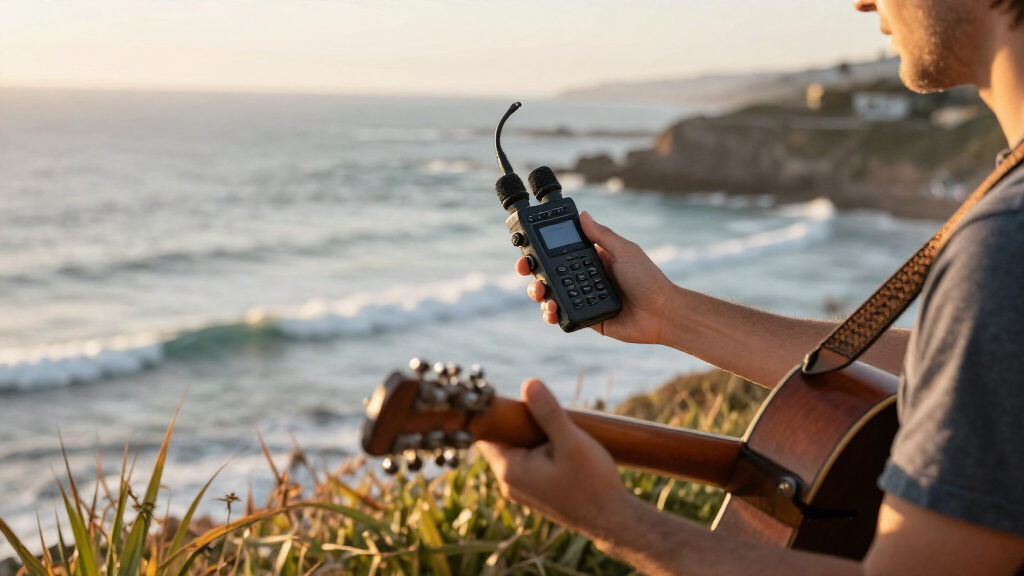

The Zoom H2essential is my best overall pick among these portable audio recorders because it offers flexible stereo capture for a wider range of recording situations than a basic voice recorder. The Zoom H1essential is a simpler, compact choice, while the Zoom F3 suits field recording where dependable two-channel capture and 32-bit float recording matter more than built-in microphones. The main tradeoff is between easy voice-note features, versatile microphones, and the inputs or recording formats needed for external gear. Storage capacity and bundles can also affect convenience, but they do not replace the need to match a recorder to the sound source. Read on for the full breakdown and help choosing the right recorder for your work.

Get audio and creator gear delivered free with Prime
- Fast, free delivery on millions of items
- Prime Video, Amazon Music and more included
- Member-only deals all year
Complete the kit


Key Takeaways
- The Zoom H2essential ranks first for versatility: its handheld stereo-recording approach fits more types of location recording than the voice-focused models in this lineup.
- The Zoom H1essential is the straightforward compact alternative: it is a better fit for simple stereo capture than the more involved H4 Essential or F3, which serve buyers needing more recording flexibility.
- The Zoom F3 prioritizes field-recording control over all-in-one convenience: it is the specialist pick for two-channel recording and 32-bit float, while the H2essential and H1essential are easier to use as self-contained handheld recorders.
- The PodTrak P4 stands apart by workflow: its podcast-focused controls make it a more relevant choice for spoken-word sessions than a general handheld recorder, but less suitable as a pocket voice-note device.
- The voice-recorder models compete on everyday utility, not the same feature set as Zoom’s field units: storage, playback, voice activation, and password protection may matter more for notes and meetings than advanced recording formats.
| Zoom H2essential Handheld Recorder |  | Best for Flexible Recording Patterns | Microphones: 3 built-in | Recording patterns: 9 | Recording modes: Mono, stereo, and surround | VIEW LATEST PRICE | See Our Full Breakdown |
| Tonfarb 64GB Digital Voice Recorder with Playback |  | Best for Voice Notes and Playback | Storage: 64 GB | Audio formats: MP3 and WAV | Maximum recording bitrate: 1536 kbps PCM | VIEW LATEST PRICE | See Our Full Breakdown |
| Zoom H1 XLR 2-Channel Portable Recorder with 32-Bit Float Recording |  | Best for Portable XLR Recording | Channels: 2 | Inputs: 2 locking XLR/TRS combo inputs; 3.5 mm stereo input | Recording format and resolution: WAV, 32-bit / 96 kHz | VIEW LATEST PRICE | See Our Full Breakdown |
| Zoom H1essential Portable Stereo Recorder |  | Best for Simple Stereo Field Recording | Microphone: Built-in X/Y stereo microphones | Recording format: WAV | Recording: 32-bit float | VIEW LATEST PRICE | See Our Full Breakdown |
| Zoom PodTrak P4 Portable Podcast Recorder |  | Best for Portable Multi-Person Podcasts | Microphone inputs: 4 XLR inputs with phantom power | Headphone outputs: 4, with individual volume controls | Recording: Multitrack WAV | VIEW LATEST PRICE | See Our Full Breakdown |
| EVIDA 128GB Digital Voice Recorder with Voice Activation, Playback, and Password Protection |  | Best for Long-Running Lectures and Meetings | Storage: 128GB | Recording formats: MP3 at 128 or 192 kbps; WAV at 1536 kbps | Microphone: Built-in mono microphone with noise cancellation | VIEW LATEST PRICE | See Our Full Breakdown |
| Zoom H1essential Handy Recorder Bundle with Lavalier Microphone and Accessories |  | Best Ready-to-Record Bundle | Recording format: 32-bit float | Built-in microphones: X/Y microphones | Maximum sound pressure level: 120 dB SPL | VIEW LATEST PRICE | See Our Full Breakdown |
| Zoom H1essential 2-Track 32-Bit Float Portable Audio Recorder Bundle with APH-1e Accessories |  | Best Compact Stereo Recorder Bundle | Tracks: 2 | Recording format: 32-bit float | Microphones: X/Y stereo | VIEW LATEST PRICE | See Our Full Breakdown |
| Zoom H4 Essential Handheld Recorder |  | Best for Multitrack and External-Mic Recording | Recording tracks: 4 | Audio resolution: 32-bit float | Sample rate: Up to 96 kHz | VIEW LATEST PRICE | See Our Full Breakdown |
| Cappsu Digital Voice Recorder with Playback, 32GB Built-In Memory |  | Best Lightweight Everyday Voice Recorder | Built-in memory: 32GB | Maximum recording bitrate: 1536 kbps | Recording modes: Manual and voice-activated | VIEW LATEST PRICE | See Our Full Breakdown |
| Tonfarb 136GB Digital Voice Recorder with Playback |  | Best for Long, Hands-Free Recording | Storage: 136GB total: 8GB built-in plus included 128GB TF card | Recording formats: MP3, WAV | Recording quality: Up to 1536 kbps PCM | VIEW LATEST PRICE | See Our Full Breakdown |
| Sunlan 16GB Digital Voice Recorder with Playback |  | Best Lightweight Pick for Lectures | Storage: 16GB | Recording format: WAV | Recording bitrate: 1536 kbps | VIEW LATEST PRICE | See Our Full Breakdown |
| Zoom F3 Professional 2-Channel Field Recorder |  | Best for Professional Field Recording | Channels: 2 | Recording technology: 32-bit float WAV with dual A/D converters | Inputs: 2 locking XLR/TRS | VIEW LATEST PRICE | See Our Full Breakdown |
| HoTiyan 8GB Digital Voice Recorder with Voice Activation and MP3 Player |  | Best for Playback Review and Study | Storage: 8GB | Recording formats: MP3, WAV | Microphone: Built-in stereo microphone | VIEW LATEST PRICE | See Our Full Breakdown |
| EVISTR L357 64GB Digital Voice Recorder with Playback |  | Best Balanced Everyday Recorder | Storage: 64GB | Recording formats: MP3, WAV | Microphone: Built-in stereo microphone | VIEW LATEST PRICE | See Our Full Breakdown |
| portable audio recorder | Storage |
|---|---|
| Zoom H2essential Handheld Reco | SD card, up to 2 TB |
| Tonfarb 64GB Digital Voice Rec | 64 GB |
| Zoom H1 XLR 2-Channel Portable | — |
| Zoom H1essential Portable Ster | — |
| Zoom PodTrak P4 Portable Podca | — |
| EVIDA 128GB Digital Voice Reco | 128GB |
| Zoom H1essential Handy Recorde | — |
| Zoom H1essential 2-Track 32-Bi | SD card |
| Zoom H4 Essential Handheld Rec | SD card, up to 1TB |
| Cappsu Digital Voice Recorder | — |
| Tonfarb 136GB Digital Voice Re | 136GB total: 8GB built-in plus included 128GB TF card |
| Sunlan 16GB Digital Voice Reco | 16GB |
| Zoom F3 Professional 2-Channel | MicroSD, up to 512GB |
| HoTiyan 8GB Digital Voice Reco | 8GB |
| EVISTR L357 64GB Digital Voice | 64GB |
More Details on Our Top Picks
Zoom H2essential Handheld Recorder
The H2essential is the most adaptable handheld choice here when a recording may need to shift between a single speaker, a stereo scene, and surround capture. Its three built-in microphones and nine patterns offer more placement options than the H1essential’s fixed X/Y stereo microphones, while 32-bit float recording helps accommodate unpredictable changes in volume without constant gain adjustment. It can also act as a USB microphone and save a separate SD-card recording, a useful safeguard for streams or remote sessions. The tradeoff is a more involved set of recording choices than a simple voice recorder, and it runs on two AA batteries. Bluetooth timecode is useful only with compatible H2essential units, so it is not a general-purpose sync solution.
Pros:- Three built-in microphones and nine patterns cover mono, stereo, and surround recording.
- 32-bit float recording supports sessions with unpredictable volume changes.
- Can work as a USB microphone while recording a backup to an SD card.
- Audible menu navigation in seven languages supports blind and visually impaired users.
Cons:- Requires two AA batteries rather than an integrated rechargeable battery.
- Bluetooth timecode synchronization is limited to compatible H2essential units.
- More recording patterns may take longer to configure than the H1essential’s fixed X/Y setup.
Best for: Field recordists, interviewers, and independent creators who want one handheld recorder for several microphone patterns and recording situations.
Not ideal for: Buyers who only need quick voice memos or prefer a fixed, simple stereo setup; the pattern options may add unnecessary complexity.
- Microphones:3 built-in
- Recording patterns:9
- Recording modes:Mono, stereo, and surround
- Maximum recording quality:32-bit float / 96 kHz
- Storage:SD card, up to 2 TB
- USB interface:USB 3.0 Type-C
- Power:2 AA batteries; up to 20 hours
- Weight:6.72 ounces
Our verdict“Choose the H2essential if recording-pattern flexibility matters more than the H1essential’s simpler stereo workflow.”
Tonfarb 64GB Digital Voice Recorder with Playback
The Tonfarb is geared toward spoken-word capture and review, rather than the microphone and input flexibility of the Zoom recorders. One-touch recording, voice activation, and scheduled recording suit meetings, lectures, or interviews where a user wants to start recording without working through a more production-focused setup. Its 64GB storage and playback tools, including A-B looping and bookmarks, also make it useful for revisiting specific passages. Compared with the Zoom H1essential, it is more focused on file organization and listening back than stereo field recording or USB microphone use. The tradeoff is that the listed 32-hour average battery life differs from the stated maximum of 48 hours, and it relies on a single AAA battery. Noise reduction is included, but the supplied information does not specify how it behaves across different recording environments.
Pros:- One-touch recording and saving make quick voice capture straightforward.
- 64GB of storage provides room for extended spoken-word recording.
- Voice activation and scheduled recording support hands-off capture.
- A-B looping and bookmarks help locate and replay sections.
Cons:- Uses one AAA battery, and listed battery-life figures vary by use.
- Does not offer the specified 32-bit float recording or dedicated XLR inputs found on Zoom options.
- The supplied data does not specify a maximum recording resolution beyond the bitrate listing.
Best for: Students, meeting attendees, and interviewers who want a compact recorder with voice activation and built-in tools for reviewing long recordings.
Not ideal for: Musicians and field recordists who need 32-bit float capture, dedicated external microphone inputs, or clearly specified stereo recording control.
- Storage:64 GB
- Audio formats:MP3 and WAV
- Maximum recording bitrate:1536 kbps PCM
- Microphone:Built-in stereo
- Battery:1 AAA battery, included
- Screen:1.44 inches
- Continuous recording time:Up to 48 hours
- Dimensions:0.47 × 1.45 × 4 inches
Our verdict“Pick the Tonfarb for voice notes and convenient playback tools, not for flexible music or field production.”
Zoom H1 XLR 2-Channel Portable Recorder with 32-Bit Float Recording
The H1 XLR is the practical pick when the microphones or instruments matter more than built-in stereo mics. Its two locking XLR/TRS combo inputs give a compact recorder a direct connection to external sources, while 32-bit float WAV recording and an OLED waveform display help with capture and monitoring. That makes it a better fit for a small field interview or instrument setup than the H1essential, whose built-in X/Y microphones are the simpler choice for recording a scene without extra gear. The H2essential offers more built-in microphone patterns, but it does not replace the H1 XLR’s two locking inputs for external sources. The tradeoff is a short listed battery life of up to 10 hours on two AA batteries, plus a compact set of connections compared with a larger recording rig.
Pros:- Two locking XLR/TRS combo inputs accommodate microphones and instruments.
- 32-bit / 96 kHz WAV recording supports high-resolution capture.
- OLED waveform display provides a visual recording monitor.
- SDXC support allows cards up to 1 TB.
Cons:- Runs on two AA batteries, with up to 10 hours of listed battery life.
- Two input channels limit simultaneous external-source recording.
- Does not include the built-in X/Y stereo microphones provided by the H1essential.
Best for: Mobile journalists, musicians, and small production teams who need to connect two external microphones or instruments directly to a portable recorder.
Not ideal for: People who want a self-contained recorder for ambient stereo capture, or a larger multichannel setup with more than two external sources.
- Channels:2
- Inputs:2 locking XLR/TRS combo inputs; 3.5 mm stereo input
- Recording format and resolution:WAV, 32-bit / 96 kHz
- Display:0.96-inch OLED waveform display
- Memory support:SDXC cards up to 1 TB
- Power:2 AA batteries
- Battery life:Up to 10 hours
- Weight:6.4 ounces
Our verdict“Choose the H1 XLR if you need two external inputs in a small recorder and can supply your own microphones.”
Zoom H1essential Portable Stereo Recorder
For buyers who want to capture stereo sound without bringing separate microphones, the H1essential is the most direct choice in this group. Its built-in X/Y microphones suit interviews, lectures, music, and environmental audio, while 32-bit float recording helps handle sudden changes in loudness. USB-C adds another role: it can serve as a microphone for a computer or compatible mobile device. Compared with the H2essential, it offers fewer microphone patterns, but that fixed stereo approach makes setup less involved. It is also lighter at 92 g than the listed H1 XLR, though the H1 XLR is the better match for external microphones and instruments. The limitations are a maximum listed recording time of 10 hours and dependence on two AAA batteries.
Pros:- Built-in X/Y stereo microphones capture a scene without separate microphones.
- 32-bit float recording helps manage sudden changes in sound level.
- USB-C supports use as a microphone with computers and compatible mobile devices.
- Spoken menu guidance supports accessible operation.
Cons:- Uses two AAA batteries and lists up to 10 hours of digital recording time.
- Fixed X/Y stereo microphones offer less pattern flexibility than the H2essential.
- No XLR inputs for directly connecting professional microphones.
Best for: Students, podcasters, and field recordists who want a lightweight, self-contained stereo recorder with USB-C microphone use.
Not ideal for: Creators who need XLR inputs, multiple microphone patterns, or extended sessions beyond the listed 10-hour recording time.
- Microphone:Built-in X/Y stereo microphones
- Recording format:WAV
- Recording:32-bit float
- USB interface:USB Type-C
- Storage capacity:Up to 1 TB
- Battery:2 AAA batteries
- Digital recording time:Up to 10 hours
- Weight:92 g
Our verdict“Choose the H1essential for uncomplicated stereo capture; step up to the H2essential for more recording patterns or the H1 XLR for external inputs.”
Zoom PodTrak P4 Portable Podcast Recorder
The PodTrak P4 is the specialist option for recording a group, not a pocket recorder for casual field notes. Four XLR inputs with phantom power let a small podcast team connect multiple microphones, and four headphone outputs with individual volume controls give each participant a separate listening level. Phone and USB connections, mix-minus, and programmable sound pads also make remote interviews and live show elements easier to manage than on the H1 XLR or H1essential. That studio-style workflow comes with a portability penalty: at 130 g it remains carryable, but its layout is less compact than a simple handheld recorder, and its listed battery life is only up to 3.5 hours on two AA batteries. Choose it for podcast sessions rather than long, untended recording days.
Pros:- Four XLR inputs with phantom power support multiple microphones.
- Four headphone outputs have individual volume controls for participants.
- Phone and USB connections, mix-minus, and sound pads support remote interviews.
- Multitrack WAV recording supports a podcast-focused production workflow.
Cons:- Listed battery life is up to 3.5 hours on two AA batteries.
- Larger control layout is less suited to quick, one-handed field recording than the H1essential.
- USB interface is limited to 2-in/2-out.
Best for: Podcast hosts and small teams recording several microphone-equipped guests, including remote interview participants.
Not ideal for: Solo field recordists or anyone needing long battery-powered sessions, a small pocket recorder, or more than two in/out USB channels.
- Microphone inputs:4 XLR inputs with phantom power
- Headphone outputs:4, with individual volume controls
- Recording:Multitrack WAV
- Remote interview inputs:TRRS phone jack and USB
- Sound pads:4 programmable pads
- USB interface:2-in/2-out, USB 2.0
- Battery life:Up to 3.5 hours on 2 AA batteries
- Weight:130 g
Our verdict“Choose the PodTrak P4 for multi-person podcast sessions and remote guests, but not for extended field recording on batteries.”
EVIDA 128GB Digital Voice Recorder with Voice Activation, Playback, and Password Protection
The EVIDA is the capacity-focused choice here: its 128GB of storage gives frequent lecture or meeting recorders room for many files without relying on a removable card. Six voice-activation sensitivity levels let me tailor how it responds to quieter speech or background noise, while password protection and bookmarks help organize private or lengthy sessions. Compared with the Cappsu V02, it offers much more listed storage and longer continuous recording, but it is heavier and lacks the Cappsu’s headphone jack. MP3 and WAV options add flexibility, though the built-in microphone is mono rather than a stereo capture setup like the Zoom H1essential models. I’d choose it for straightforward speech capture, not music or detailed environmental recordings.
Pros:- 128GB of storage reduces the need to manage or swap memory cards.
- Six voice-activation sensitivity settings allow adjustment for different speech environments.
- Records in MP3 and WAV, with playback, bookmarks, and A-B repeat.
- Password protection and USB file transfer support private, organized recording workflows.
Cons:- Mono built-in microphone is less suited to stereo ambience or musical performances.
- No headphone jack for monitoring recordings directly from the device.
- Uses a C battery, and the listed maximum continuous recording time is 54 hours.
Best for: Students and professionals recording frequent lectures, interviews, or meetings who want substantial built-in storage and voice-triggered recording.
Not ideal for: Musicians and field recordists who need stereo imaging or headphone monitoring, since this model has a mono built-in microphone and no headphone jack.
- Storage:128GB
- Recording formats:MP3 at 128 or 192 kbps; WAV at 1536 kbps
- Microphone:Built-in mono microphone with noise cancellation
- Voice activation:6 sensitivity levels
- Maximum continuous recording time:54 hours
- Connectivity:USB 2.0
- Headphone jack:None
- Weight:3.35 ounces
Our verdict“Choose the EVIDA for speech-focused recording with generous onboard storage, but skip it if stereo capture or headphone monitoring matters.”
Zoom H1essential Handy Recorder Bundle with Lavalier Microphone and Accessories
This bundle makes the Zoom H1essential easier to take straight into a recording session: it includes a lavalier microphone, windscreen, memory card, batteries, and cloth. Its 32-bit float recording reduces the pressure to set input levels precisely, which is useful when a speaker’s volume or a live sound source can change unexpectedly. The built-in X/Y microphones handle sounds up to 120 dB SPL, while pre-record and auto-record add practical flexibility. Compared with the separately bundled H1essential package in this list, this version includes a lavalier microphone and four AAA batteries, but the other bundle specifies stereo recording up to 96 kHz and USB-microphone use. The included card is only 32GB, and this listing describes microphone operation as mono, so buyers seeking clearly specified stereo capture should check the other H1essential bundle.
Pros:- 32-bit float recording reduces the need to adjust levels before unpredictable takes.
- Bundle includes a lavalier microphone, furry windscreen, microSDHC card, and four AAA batteries.
- Built-in X/Y microphones are rated for sound levels up to 120 dB SPL.
- Pre-record, auto-record, overdubbing, and playback-speed adjustment support varied recording tasks.
Cons:- The included microSDHC card has 32GB capacity.
- Microphone operation is listed as mono, limiting confidence for buyers seeking stereo capture.
- Relies on AAA batteries rather than a specified built-in rechargeable battery.
Best for: Mobile interviewers and creators who want a portable recorder with a lavalier mic, wind protection, and batteries in one package.
Not ideal for: Buyers who need a clearly specified stereo workflow or a larger included memory card; the bundle card is 32GB and its microphone operation is listed as mono.
- Recording format:32-bit float
- Built-in microphones:X/Y microphones
- Maximum sound pressure level:120 dB SPL
- Included memory card:32GB microSDHC
- Headphone jack:3.5 mm
- Recording features:Overdubbing, pre-record, auto-record, playback-speed adjustment
- Bundle accessories:Lavalier condenser microphone, furry windscreen, four AAA batteries, cloth
- Hardware interface:1/4-inch
Our verdict“Pick this H1essential bundle for an accessory-ready interview setup, but choose the other H1essential package if stereo recording and USB-microphone capability are priorities.”
Zoom H1essential 2-Track 32-Bit Float Portable Audio Recorder Bundle with APH-1e Accessories
For buyers who want stereo field capture without stepping up to a larger multi-input recorder, this H1essential bundle is the clearest fit. Its two-track X/Y stereo microphones record at up to 96 kHz, and 32-bit float audio helps handle changes in loudness without making gain adjustments the center of the session. USB-C operation also lets it serve as a microphone with computers and mobile devices, giving it more desk-to-field flexibility than the EVIDA or Cappsu voice recorders. Compared with the other H1essential bundle here, this package lists stereo capture and USB-microphone compatibility, while the other includes a lavalier mic and batteries. The tradeoff is that storage depends on an SD card, and its 96 kHz ceiling is lower than some specialized recording workflows may call for. A windscreen and padded case make transport more practical.
Pros:- X/Y stereo microphones capture spatial detail in a compact handheld format.
- 32-bit float recording helps accommodate unexpectedly quiet or loud sources.
- USB-C connection supports use as a microphone with PC, Mac, iOS, and Android devices.
- Included padded case and hairy windscreen are useful for carrying and outdoor recording.
Cons:- Recording requires an SD card rather than built-in storage.
- Maximum sample rate is 96 kHz.
- Two tracks offer less input flexibility than the Zoom H4 Essential’s four-track setup and XLR/TRS inputs.
Best for: Solo podcasters, journalists, and field recordists who need a compact stereo recorder that can also connect as a USB microphone.
Not ideal for: Users who want built-in storage or multiple external microphone inputs; this model records to an SD card and is a two-track recorder.
- Tracks:2
- Recording format:32-bit float
- Microphones:X/Y stereo
- Maximum sound pressure level:120 dB SPL
- Maximum sample rate:96 kHz
- Storage:SD card
- USB connectivity:USB-C; compatible with PC, Mac, iOS, and Android
- Included accessories:Hairy windscreen, padded shell case, AC adapter, USB-C cable
Our verdict“Choose this bundle for portable stereo recording and USB-mic flexibility, but move to the H4 Essential if you need external XLR/TRS inputs.”
Zoom H4 Essential Handheld Recorder
The H4 Essential earns its place by offering a more expandable recording setup than the pocket-sized H1essential models. It combines built-in stereo microphones with two XLR/TRS combo inputs, so I can capture a room or live performance while connecting external microphones or other sources. Four-track recording and 32-bit float make it a stronger fit for music, podcast production, and video work where separate sources need their own tracks. Compared with either H1essential bundle, it is less compact and its listed battery life is 10 hours, but it provides input options those two-track recorders do not. USB-C supports streaming or connection to another device, and simultaneous SD-card backup can add reassurance during important sessions. Its larger body and AA power make it less convenient for casual pocket recording.
Pros:- Four-track recording supports separate capture of multiple sources.
- Two XLR/TRS combo inputs accommodate external microphones and other audio gear.
- Built-in stereo microphones and 32-bit float support flexible field recording.
- USB-C connectivity and simultaneous SD-card backup support connected recording workflows.
Cons:- Larger and heavier than the H1essential handheld recorders.
- Listed battery life is 10 hours, and the recorder uses two AA batteries.
- SD-card storage requires removable media rather than built-in memory.
Best for: Musicians, podcasters, and filmmakers who need a handheld recorder with built-in stereo microphones plus connections for external microphones or instruments.
Not ideal for: Students or casual note-takers who want a lightweight, simple voice recorder; its external inputs and four-track workflow add bulk and complexity.
- Recording tracks:4
- Audio resolution:32-bit float
- Sample rate:Up to 96 kHz
- Inputs:2 XLR/TRS combo inputs
- Connectivity:USB-C
- Storage:SD card, up to 1TB
- Power and battery life:2 AA batteries; up to 10 hours
- Weight:243 g
Our verdict“Choose the H4 Essential when external inputs and multitrack capture matter more than pocketable size or long battery runtime.”
Cappsu Digital Voice Recorder with Playback, 32GB Built-In Memory
At 1.6 ounces, the Cappsu is the easy-carry speech recorder in this group, with 32GB of built-in memory and one-click recording rather than a more involved field-recorder setup. Voice activation can pause during silence, extending the listed recording time to 50 hours in that mode; manual continuous recording is rated for up to 20 hours. It also includes earphones and an external microphone, and USB-C makes file transfer straightforward. Compared with the EVIDA, the Cappsu is lighter and has a headphone jack, but it provides less storage and shorter continuous recording time. Unlike the Zoom H1essential bundles, it is built around voice notes rather than stereo field capture or 32-bit float. The listed battery is nonstandard, and close placement to the sound source is recommended for more balanced recordings.
Pros:- Lightweight 1.6-ounce body is easy to carry for everyday voice recording.
- 32GB of built-in memory works without a separate TF card.
- Voice activation can extend recording time to a listed 50 hours by pausing during silence.
- Includes a 3.5 mm earphone set, external microphone, and USB-C cable.
Cons:- Continuous recording is listed for up to 20 hours, shorter than the EVIDA’s 54-hour maximum.
- Uses an included nonstandard battery.
- Speech recordings may need the recorder placed close to the sound source for balanced results.
Best for: Commuters, students, and interviewers who want a very light recorder for voice notes and speech-focused sessions.
Not ideal for: Musicians and outdoor recordists who need stereo microphones, robust field-recording controls, or long continuous recording without interruption.
- Built-in memory:32GB
- Maximum recording bitrate:1536 kbps
- Recording modes:Manual and voice-activated
- Continuous recording time:Up to 20 hours
- Voice-activated recording time:Up to 50 hours
- Connectivity:USB Type-C
- Headphone jack:3.5 mm
- Weight:1.6 ounces
Our verdict“Pick the Cappsu for lightweight, everyday speech capture with built-in memory, but choose a Zoom H1essential for stereo field recording.”
Tonfarb 136GB Digital Voice Recorder with Playback
I’d choose the Tonfarb 136GB when long sessions and generous onboard capacity matter more than a streamlined recording setup. Its included 128GB TF card supplements 8GB of built-in storage, while voice activation can help limit stretches of silence. One-touch recording, including startup from powered-off, is handy when a meeting or interview begins without warning. Compared with the EVISTR L357, Tonfarb offers more total storage and longer stated recording time per charge, but EVISTR provides adjustable recording gain and longer stated playback time. The metal casing and A-B repeat add practical touches for carrying and reviewing files. I’d keep the advertised maximum recording hours in perspective: actual capacity varies by format and settings, and the listed weight is inconsistent across the product information.
Pros:- Includes a 128GB TF card alongside 8GB of built-in storage.
- One-touch recording can start from the powered-off state.
- Voice activation and dual noise-reduction microphones suit hands-free speech recording.
- Metal casing, A-B repeat, and password protection add useful handling and playback features.
Cons:- Advertised maximum recording time varies with recording format and settings.
- Product information gives conflicting weights.
- Built-in microphones limit flexibility compared with recorders that accept external XLR inputs.
Best for: Students, interviewers, and meeting attendees who want one-touch recording, voice activation, and ample included storage for long sessions.
Not ideal for: Field recordists who need external XLR microphones or dependable, clearly stated file-capacity estimates; this is a built-in-microphone recorder, and its maximum-time figures depend on settings.
- Storage:136GB total: 8GB built-in plus included 128GB TF card
- Recording formats:MP3, WAV
- Recording quality:Up to 1536 kbps PCM
- Microphones:Built-in dual noise-reduction microphones
- Battery life:Up to 68 hours
- Battery:1100mAh rechargeable lithium battery
- Connections:USB-C, USB 2.0, 3.5 mm headphone jack
- Size and weight:0.47 × 1.45 × 4 inches; listed weight varies between 97 g and 100 g
Our verdict“Choose the Tonfarb for long speech sessions and included storage, but look to the Zoom F3 if you need external-mic inputs and more production-oriented recording control.”
Sunlan 16GB Digital Voice Recorder with Playback
At 35 g, the Sunlan is the lightest straightforward speech recorder in this group, making it a sensible option for students who want something easy to carry every day. Its voice-activated recording can reduce empty stretches in lecture or meeting files, and recordings can be played through the built-in speaker or a 3.5 mm headphone jack. Unlike the HoTiyan H-10001, it records only WAV, so there’s less format flexibility for people who want MP3 files. The tradeoff is a simple, speech-focused feature set: 16GB is less than the Tonfarb 136GB’s included capacity, and the listed seven-hour playback time is much shorter than its more-than-30-hour recording time. I’d pick it for portable lecture capture, not as an all-day music player or a recorder for stereo field sound.
Pros:- Lightweight 35 g body is easy to carry in a pocket or bag.
- Voice activation can cut down on silent stretches in recordings.
- Built-in speaker and 3.5 mm jack offer two playback options.
- 16GB storage and WAV recording suit speech-focused use.
Cons:- Records in WAV only, unlike the MP3 and WAV options from HoTiyan and EVISTR.
- Mono microphone is less suited to capturing stereo ambience.
- Playback time is listed as seven hours, considerably less than its recording time.
Best for: Students and meeting attendees who want a very light recorder for WAV speech capture, with voice activation and simple playback.
Not ideal for: People who need stereo recording, MP3 recording, or extended playback away from a charger; the built-in microphone is mono and playback is listed at seven hours.
- Storage:16GB
- Recording format:WAV
- Recording bitrate:1536 kbps
- Microphone:Built-in mono microphone with noise cancellation
- Recording time:More than 30 hours continuous
- Playback time:7 hours
- Connections:USB interface; 3.5 mm headphone jack
- Size and weight:0.5 × 1.4 × 3.3 inches; 35 g
Our verdict“Pick the Sunlan for lightweight lecture and meeting capture, but choose a stereo MP3/WAV model if you want more recording-format flexibility.”
Zoom F3 Professional 2-Channel Field Recorder
The Zoom F3 is the clear choice here for recording with external microphones rather than relying on a pocket recorder’s built-in mic. Its two locking XLR/TRS inputs help keep cables secure, while 32-bit float recording and dual A/D converters give more room for recordings with unpredictable volume changes without constant manual gain adjustments. Compared with the EVISTR L357, the F3 is built around production workflows and external inputs, not simple voice notes and onboard stereo capture. That capability comes with a steeper setup burden: you need microphones and a MicroSD card, and portable power relies on two AA batteries unless using a USB workflow. I’d rank it above the voice recorders for location sound and set work, but below them for someone who just wants to start recording a lecture in one touch.
Pros:- 32-bit float recording with dual A/D converters helps accommodate widely varying sound levels.
- Two locking XLR/TRS inputs provide connections for external microphones and other audio sources.
- Ultra-low-noise preamps support cleaner recordings in demanding field conditions.
- Supports battery-powered and USB workflows, plus wireless control.
Cons:- Requires two AA batteries for battery-powered operation.
- External microphones and a MicroSD card are needed for a working recording setup.
- More involved than pocket voice recorders for quick, casual speech capture.
Best for: Film crews, location sound recordists, and musicians using external microphones who need two secure inputs and headroom for changing levels.
Not ideal for: Students or casual note-takers seeking an all-in-one recorder with built-in microphones; the F3 requires external microphones and MicroSD storage.
- Channels:2
- Recording technology:32-bit float WAV with dual A/D converters
- Inputs:2 locking XLR/TRS
- Preamps:Ultra-low-noise
- Storage:MicroSD, up to 512GB
- Power:2 AA batteries or USB workflow
- Digital recording time:Up to 73 hours
- Size and weight:3.04 × 2.95 × 1.88 inches; 8.48 ounces
Our verdict“Choose the Zoom F3 for serious two-input field recording with external microphones, not for simple voice notes or built-in-mic convenience.”
HoTiyan 8GB Digital Voice Recorder with Voice Activation and MP3 Player
The HoTiyan earns its place through playback controls that make reviewing speech more flexible than on a basic recorder. A-B repeat lets you loop a section, and variable playback speed can help when studying a lecture or checking an interview transcript. It also records MP3 or WAV, offers voice activation, and includes a stereo microphone—a broader set of everyday tools than the mono, WAV-only Sunlan. The tradeoff is limited capacity: 8GB is modest beside the EVISTR L357’s 64GB or the Tonfarb 136GB’s included storage. Its stated recording life is up to 20 hours per charge, so it also trails several higher-capacity options for lengthy sessions. I’d choose it for reviewing and organizing short-to-medium recordings, not for long field assignments or large archives.
Pros:- A-B repeat and variable playback speed make it easier to review specific passages.
- Stereo microphone and noise reduction support speech and basic stereo capture.
- Records MP3 and WAV and can also play MP3 files.
- Voice activation, password protection, and timestamped filenames offer practical file-management tools.
Cons:- 8GB storage is limited beside the EVISTR L357 and Tonfarb 136GB.
- Recording time is listed at up to 20 hours per charge.
- USB 2.0 Type B is less convenient than the USB-C connection on the EVISTR L357.
Best for: Students and interviewers who regularly replay short passages and want voice activation, stereo capture, and MP3/WAV support in a compact recorder.
Not ideal for: People recording long events or keeping a large library on the device; 8GB storage and up to 20 hours of recording per charge constrain extended use.
- Storage:8GB
- Recording formats:MP3, WAV
- Microphone:Built-in stereo microphone
- Recording time:Up to 20 hours continuous
- Playback time:Up to 8 hours with earphones
- Connections:USB 2.0 Type B; 3.5 mm headphone jack
- Playback features:A-B repeat and variable playback speed
- Screen:1.1 inches
Our verdict“Choose the HoTiyan if replay and study features matter more than storage capacity or long recording sessions.”
EVISTR L357 64GB Digital Voice Recorder with Playback
The EVISTR L357 balances capacity, controls, and portability more evenly than the smaller-storage HoTiyan or the far more capacious Tonfarb 136GB. Its 64GB storage leaves room for ongoing speech recordings without relying on the included card approach used by Tonfarb, while adjustable gain and seven voice-activation sensitivity levels give users more control over what gets captured. USB-C file transfer, scheduled recording, and MP3/WAV support make it a practical daily recorder for lectures, interviews, and personal notes. The metal body is compact, though the one-inch screen limits how much file information is easy to view. Its up-to-32-hour recording life is shorter than Tonfarb’s stated 68 hours, and the built-in microphones make it less suitable than the Zoom F3 for external-mic field work.
Pros:- 64GB storage supports extended use without depending on an included memory card.
- Seven recording-gain and seven voice-activation sensitivity levels offer useful adjustment.
- USB-C transfers files to Windows and Mac, and the recorder supports MP3 and WAV.
- Metal construction, scheduled recording, and playback controls suit regular everyday use.
Cons:- Recording time is listed as up to 32 hours per charge, shorter than the Tonfarb 136GB’s stated 68 hours.
- The one-inch screen gives limited room for reviewing files and settings.
- Built-in microphones do not offer the external XLR/TRS flexibility of the Zoom F3.
Best for: Regular lecture and interview recorders who want substantial onboard storage, adjustable voice activation, and straightforward USB-C file transfer.
Not ideal for: Field producers needing external XLR inputs or users who prioritize the longest stated battery life; the L357 records through its built-in stereo microphone and is rated for up to 32 hours.
- Storage:64GB
- Recording formats:MP3, WAV
- Microphone:Built-in stereo microphone
- Recording bitrate:Up to 1536 kbps
- Recording controls:7 gain levels; 7 voice-activation sensitivity levels
- Battery life:Up to 32 hours recording; up to 35 hours playback
- Connections:USB Type-C; 3.5 mm headphone jack
- Size and weight:3.86 × 1.2 × 0.47 inches; 2.24 ounces
Our verdict“Choose the EVISTR L357 for a practical balance of storage and recording controls, unless you need professional external-mic inputs or longer stated battery life.”
How We Picked
I ranked these portable audio recorders by how well their stated design fits common recording jobs: capturing ambient sound, recording interviews, making voice notes, connecting microphones, or running a podcast session. I gave more weight to useful recording flexibility, clear role-specific controls, and the ability to match inputs and recording formats to the source than to headline storage figures alone. Build and handling, setup demands, playback or file-management features, and whether a bundle adds practical accessories also shaped the comparison.
The ranking favors recorders that can serve multiple real-world uses without asking every buyer to learn a specialist workflow. That puts the H2essential ahead as the broad-use pick, while the H1essential is a simpler compact option and the F3 ranks as a focused field tool. Podcast hardware and digital voice recorders follow according to their narrower strengths; models with similar voice-note functions are separated by stated capacity and features, not assumed sound quality or unverified performance.
Factors to Consider When Choosing Portable Audio Recorders
Before choosing, I would start with the sound source and the way files need to be handled, not the largest capacity number. A recorder that is convenient for lectures may be awkward for a stereo ambience session, while a field unit can feel needlessly complex for quick reminders. These broader checks can help prevent buying features that do not solve your recording problem.
Match the recorder to the sound source
For a single speaker, built-in microphones and simple playback may be enough; for environmental sound, microphone placement and stereo capture matter more. Recording a podcast or interview with external microphones calls for compatible inputs and controls that suit the session. A common mistake is choosing by the word “professional” without checking whether the recorder can connect to the microphone you already own. If you mostly capture quick notes, an elaborate input setup adds little value. If you plan to record changing sources, prioritize flexibility over a device designed for only one routine.
Decide whether built-in microphones or external inputs matter more
Built-in microphones make a recorder faster to deploy and reduce the extra gear you need to carry. External microphone inputs can improve placement options and support a more deliberate interview or field setup, but cables, stands, and power needs add complexity. Check the number and type of inputs against your actual sources before purchasing; connector names alone do not guarantee a suitable setup. Buyers sometimes pay for inputs they never use, or discover too late that a recorder depends on a connection their microphone does not support. Choose the simplest system that handles your planned recording sessions.
Choose a recording format with your editing habits in mind
Format features affect how much correction is possible after recording and how much work the files may require. 32-bit float can offer more flexibility when recording levels are difficult to predict, but it is not a substitute for good microphone placement or a workflow that can handle the files. A basic voice recorder may be a more natural fit when the priority is capturing and replaying spoken notes, not editing detailed audio. Consider what software or device will open your recordings and whether you need to share them quickly. Paying for advanced formats makes sense when the recording conditions justify them.
Treat storage claims as one part of file management
More built-in or supplied storage can reduce how often you need to transfer files, but capacity alone does not tell you how easy the recorder is to manage. Longer sessions, higher-quality formats, and frequent recordings all change how quickly space is used. Check whether the device supports removable storage, how files are transferred, and whether playback controls make it easy to find a particular take. Voice activation may help with note-taking, but it can also be a poor fit if quiet openings or pauses matter. Think about your transfer and backup routine before selecting a recorder based on capacity alone.
Weigh portability against the controls you need
A smaller recorder is easier to carry and use quickly, but compact layouts can make connections and controls less convenient during a longer session. Larger or more specialized units may provide a more suitable working setup for microphones, podcast participants, or field use. Consider where you will place the recorder, how often you will adjust settings, and whether you need to operate it while monitoring sound. A bundle can reduce the number of accessories to source separately, though included extras only help if they match your setup. Choose for the recording environment, not pocket size alone.
Pay for workflow improvements, not feature count
The biggest reason to spend more is usually a better fit for a demanding workflow: external sources, multiple speakers, repeat field sessions, or less predictable recording levels. For occasional reminders, simple playback and uncomplicated file transfer may matter more than advanced controls. A podcast recorder can save setup effort in a recurring spoken-word workflow, while a general handheld unit may be more flexible for varied location work. Avoid paying extra for bundled accessories that duplicate gear you already have. A feature earns its place when it reduces friction in the recordings you actually make.
Frequently Asked Questions
Should I choose a digital voice recorder or a handheld stereo recorder?
I would choose a digital voice recorder when the main job is capturing speech for later playback, with features such as voice activation or password protection guiding the decision. A handheld stereo recorder is a better match when you want to capture environmental sound, music, or a wider sound field. The product names do not guarantee equal microphone quality, so compare the stated recording design and inputs rather than assuming every device suits every source. If your work includes both interviews and ambience, a more versatile handheld model may prevent an early upgrade. If it is mostly spoken notes, simpler controls can be the more useful choice.
Is 32-bit float worth choosing for interviews or field recordings?
It can be helpful when loudness is unpredictable and you want more room to adjust levels later, particularly for field work or fast-moving interviews. It does not remove the need to place microphones well, monitor the recording, or confirm that your editing workflow can handle the files. For quiet, controlled voice notes, the added format flexibility may not change your results enough to justify a more specialized recorder. Think about how often a sudden volume change could spoil a take and how costly a missed recording would be. If those risks are frequent, 32-bit float becomes more compelling.
Can I use a portable recorder with an external microphone?
Only if the recorder has an input compatible with the microphone and its connection needs. Before buying, check connector type, input count, and any required power or adapter; a matching-looking cable does not prove compatibility. A built-in-microphone recorder can be faster for spontaneous capture, while an external microphone offers more choice in placement and recording style. Podcast and field setups often benefit from external connections, but they add gear to carry and configure. If you have not chosen a microphone yet, select the recorder and microphone as a system.
Does more built-in storage mean I can record for longer?
It gives you more space for files, but recording time also depends on the format and settings used. A large capacity figure does not explain transfer speed, backup convenience, or how easily you can find a specific recording later. For frequent sessions, consider file transfer and backup habits as well as storage size. Voice activation may reduce some unnecessary recording, but it may not suit sessions where quiet speech or pauses need to be preserved. Pick capacity around your session length and how often you can offload files.
Which type of recorder is the better choice for a podcast?
For a recurring podcast workflow, look at a podcast-focused unit such as the Zoom PodTrak P4 and check that its connections and controls match the number of people and microphones in your sessions. A general handheld recorder can make more sense for solo narration or when location recording matters as much as podcast production. Do not choose based on the word “podcast” alone: confirm compatibility with your microphones and how you plan to monitor and transfer recordings. If you need a recorder for both interviews on location and everyday capture, a versatile handheld may cover more jobs. A dedicated podcast setup earns its place when it simplifies a regular session.
Conclusion
For the best overall fit, I recommend the Zoom H2essential for buyers who want one handheld recorder suited to varied location work. The best value depends on the job: the Zoom H1essential is the sensible compact pick for straightforward stereo recording, while the voice-recorder options make more sense for buyers whose priorities are notes, playback, and storage. For a premium, specialist field setup, I would choose the Zoom F3 when two-channel recording and 32-bit float matter more than built-in microphones; podcasters should look to the Zoom PodTrak P4 for its dedicated workflow. Beginners who want a direct route into handheld stereo recording should start with the H1essential, while buyers needing voice activation or password protection should compare the EVIDA and relevant digital voice recorders. Match the recorder to the sound source and session routine, and the right choice becomes much clearer.
Evergreen bestsellers Picks

Vitamix VX1 Professional-Grade Blender, 64 oz, Black

Sony WH-1000XM6 Wireless Noise-Canceling Headphones, Black

TCL 75-Inch QM8L Series 4K QLED Smart Google TV
As an affiliate, we earn on qualifying purchases.