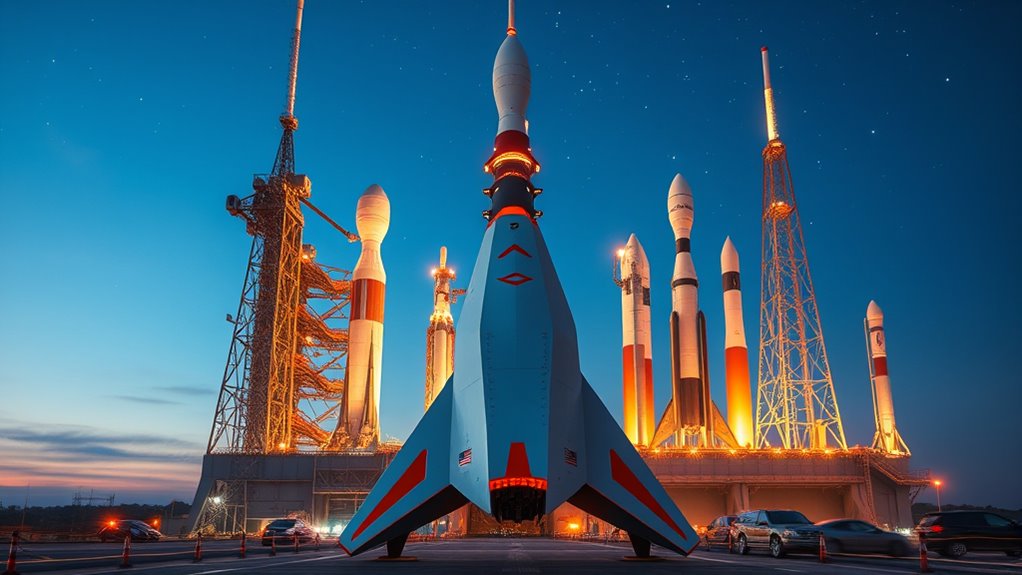

In 2025, the space race accelerates with Artemis missions aiming to establish a sustainable lunar presence, focusing on resource utilization like water ice and long-term habitats. Private ventures are also making strides by investing in asteroid mining and spacecraft technology to support lunar bases and space infrastructure. This year marks a shift from exploration to building the foundation for future space colonies and industries. Stay tuned to discover how these efforts are shaping humanity’s cosmic future.
Key Takeaways
- Artemis missions aim to establish sustainable lunar bases by 2025, focusing on resource utilization and long-term habitation.
- Private companies are investing in asteroid mining technology to access rare minerals and support lunar infrastructure.
- International collaborations are enhancing technological innovation for lunar colonization and space resource development.
- 2025 marks a pivotal year where space exploration shifts from distant goals to tangible human activities on the Moon and beyond.
- Space agencies and private ventures are integrating advanced nanotechnologies to accelerate resource extraction and habitat development.

Have you wondered how the global race to explore space will unfold in 2025? It’s an exciting time, with governments and private companies pushing the boundaries of what’s possible in space exploration. The Artemis missions stand at the forefront of this push, aiming to establish a sustainable human presence on the Moon. This isn’t just about landing astronauts; it’s about laying the groundwork for lunar colonization, where people can live and work on the Moon long-term. These missions are designed to test new technologies, develop habitats, and harness lunar resources that could support future colonies. As you follow these efforts, you’ll see how international collaboration and innovation are shaping the future of lunar living. But the ambitions go even further. Beyond establishing a lunar base, the race extends into asteroid mining, which promises to liberate vast mineral wealth from near-Earth objects. Companies and space agencies are developing plans to prospect asteroids for precious metals and rare materials, which could revolutionize industries here on Earth and provide the materials needed for space manufacturing. This targeted approach to resource extraction could reduce our dependence on terrestrial mining and open new economic frontiers. In 2025, you’ll notice that private ventures are becoming key players in this arena. They’re investing heavily in spacecraft, robotic miners, and orbiting platforms to identify and harvest asteroid resources. These efforts are complemented by government initiatives, creating a dynamic landscape where innovation accelerates rapidly. As you keep an eye on these developments, it’s clear that the push for lunar colonization and asteroid mining is interconnected. Resources from the Moon’s surface, like water ice, could support lunar bases and serve as fuel for spacecraft, making further space exploration more feasible. Similarly, advanced nanotechnologies are increasingly being integrated into spacecraft and mining equipment to improve efficiency and durability. Resources from the Moon’s surface, like water ice, could support lunar bases and serve as fuel for spacecraft, making further space exploration more feasible. At the same time, asteroid mining could supply the raw materials needed for building infrastructure both on the Moon and in deeper space. The progress made in 2025 will set the stage for a future where space isn’t just a destination for exploration but a new frontier for sustainable human activity. The key to this progress lies in harnessing advanced technologies, fostering international partnerships, and encouraging private innovation. If you’re curious about the future of humanity beyond Earth, 2025 will be a pivotal year, demonstrating how lunar colonization and asteroid mining are transforming space from a distant dream into a tangible reality. It’s a race driven by visionaries, scientists, and entrepreneurs who believe the next chapter of human history is written among the stars.
Frequently Asked Questions
What Are the Long-Term Goals of Artemis Missions?
Your long-term goal with the Artemis missions is to establish lunar habitation and pave the way for deep space exploration. By building sustainable bases on the Moon, you’ll create a stepping stone for future missions to Mars and beyond. These efforts aim to develop new technologies, guarantee crew safety, and expand human presence in space, ultimately making deep space exploration more feasible and opening new frontiers for humanity.
How Do Private Ventures Coordinate With Nasa’s Space Programs?
You see private ventures coordinate with NASA through public-private collaboration, sharing expertise, technology, and resources. They work within regulatory frameworks set by NASA and other agencies to guarantee safety and compliance. You might notice these partnerships involve joint missions, data sharing, and contract work, all designed to foster innovation, reduce costs, and accelerate progress. This collaboration helps both parties achieve their goals faster and more effectively.
What New Technologies Are Being Developed for Space Race 2025?
You’ll see groundbreaking technologies like emerging propulsion systems that boost spacecraft speed and efficiency, making missions quicker and more cost-effective. Advanced habitat tech is also in development, creating safer, more sustainable living environments for astronauts on long journeys. These innovations aim to push space exploration forward, enabling deeper space missions and supporting future colonies, ultimately revolutionizing how humans explore and inhabit space.
How Will International Partnerships Influence the Missions?
International partnerships are like bridges connecting different worlds, making space exploration more powerful. You’ll see international diplomacy foster collaboration, reducing competition and sharing resources. Technology sharing accelerates innovation, enabling missions to achieve what alone might take decades. These collaborations will strengthen trust, pool expertise, and distribute costs, ensuring that the Artemis missions succeed. Your involvement in such partnerships could lead to groundbreaking discoveries and a more united effort in exploring the cosmos.
What Are the Potential Risks of Increased Private Sector Involvement?
You face potential risks from increased private sector involvement, including intensified commercial competition that could lead to resource conflicts and prioritization issues. Regulatory challenges might also emerge, as governments struggle to create consistent policies for private companies operating in space. These risks could hinder collaboration, delay missions, or compromise safety standards, making it essential to establish clear regulations and fair competition frameworks to ensure smooth progress in space exploration efforts.
Conclusion
As you watch the Artemis missions and private ventures push boundaries, one thing’s clear: the race to space is far from over. With new alliances forming and breakthroughs on the horizon, the next chapter could redefine humanity’s future. Are you ready to see what’s next? The universe holds secrets yet to be uncovered, and the race for discovery is just beginning. Stay tuned—what lies ahead might change everything you thought you knew.