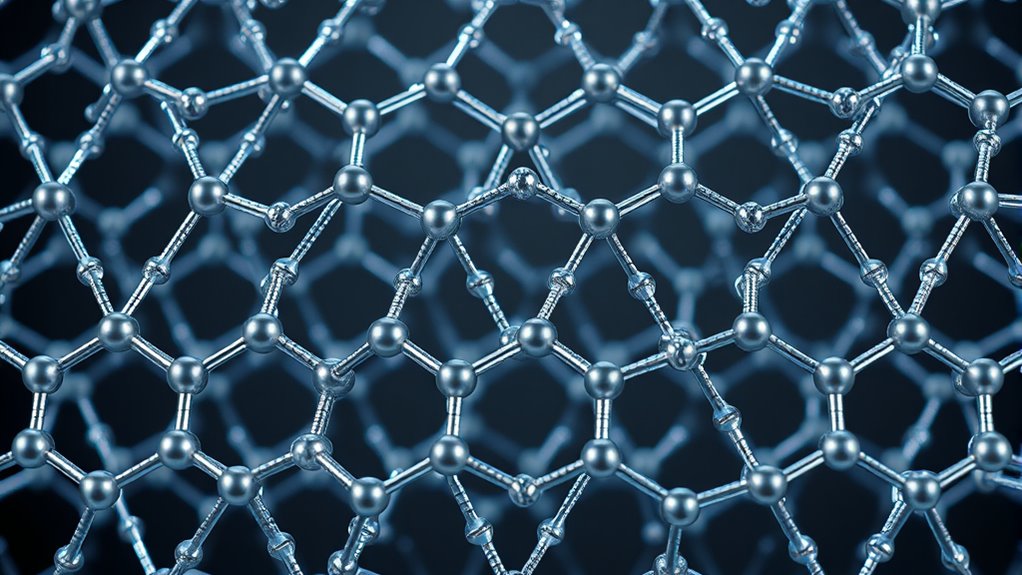

Metal-organic frameworks (MOFs) are highly adaptable materials that excel at capturing carbon dioxide. By precisely tuning pore sizes and adding chemical groups like amines, you can optimize their ability to selectively trap CO₂ while ignoring other gases. These improvements make MOFs more efficient and customizable for different industrial needs. If you want to discover how these innovations work together to advance carbon capture technologies, there’s much more to explore ahead.
Key Takeaways
- MOFs can be tailored with specific pore sizes to selectively trap CO₂ molecules while excluding other gases.
- Functionalization, such as adding amine groups, enhances chemical interactions and increases CO₂ adsorption capacity.
- Combining pore size optimization and functionalization creates highly selective and efficient materials for carbon capture.
- Precise tuning of MOF structures improves capacity and selectivity in complex gas mixtures like flue gases.
- These adjustable properties make MOFs promising, scalable solutions for reducing greenhouse gas emissions.

Have you ever wondered how scientists create materials with incredible porosity and tunable properties? It’s a fascinating process that involves meticulous design at the molecular level. When it comes to Metal-Organic Frameworks (MOFs), pore size optimization plays a crucial role. By carefully adjusting the size of the pores, you can enhance the material’s ability to selectively trap carbon dioxide molecules while allowing other gases to pass through. This precision is vital because it directly impacts the efficiency and capacity of MOFs in carbon capture applications. If the pores are too small, CO₂ molecules can’t enter; if they’re too large, the selectivity drops, and unwanted gases might get captured instead. That’s why researchers employ advanced techniques to fine-tune pore dimensions, ensuring they’re just right for targeted gas molecules.
Alongside pore size optimization, functionalization strategies significantly boost the performance of MOFs. Functionalization involves modifying the internal surfaces of the pores with specific chemical groups that can interact strongly with CO₂. For example, adding amine groups can create sites that form chemical bonds with carbon dioxide, greatly increasing adsorption capacity. This approach not only improves the amount of CO₂ a MOF can capture but also enhances selectivity, making the material more effective in complex gas mixtures like flue gases from power plants. You might think of functionalization as giving the MOF a sort of “chemical handshake” with CO₂ molecules, making them stick together more effectively.
The combination of pore size optimization and functionalization strategies allows scientists to design MOFs tailored for specific carbon capture needs. It’s about creating a material that’s both highly selective and capable of capturing large amounts of CO₂ efficiently. You can think of this process as customizing a lock and key, where the pore size acts as the lock’s shape, and the functional groups serve as the key’s teeth, ensuring a perfect fit. These innovations mean MOFs can be engineered to work under various conditions and gas compositions, making them versatile tools in the fight against climate change. By controlling pore size and carefully choosing functional groups, you’re essentially designing a highly specialized sponge that can selectively and effectively trap carbon dioxide from industrial emissions. This precise engineering opens new avenues for sustainable, scalable carbon capture solutions that could considerably reduce greenhouse gas levels in our atmosphere.
Frequently Asked Questions
Can MOFS Be Recycled After Carbon Capture?
Yes, you can recycle MOFs after carbon capture. Recycling methods like thermal regeneration and solvent washing help restore their adsorptive capacity. Conducting a lifecycle analysis guarantees the process remains sustainable and cost-effective. By properly recycling MOFs, you extend their lifespan, reduce waste, and improve overall efficiency in carbon capture applications. This approach helps maximize environmental benefits while maintaining the economic viability of using MOFs.
How Do MOFS Compare to Traditional Carbon Capture Materials?
It’s no coincidence that MOFs outperform traditional materials in many ways. You’ll find their high adsorption efficiency and tunable structures give them an edge, making them more effective at capturing CO₂. Plus, their impressive structural stability means they withstand repeated use without losing performance. While conventional materials have limitations, MOFs offer a versatile, durable alternative that can markedly improve your carbon capture efforts.
Are MOFS Cost-Effective for Large-Scale Deployment?
You might find MOFs cost-effective for large-scale deployment if their economic feasibility improves and manufacturing challenges are addressed. Currently, high production costs and complex synthesis methods limit their widespread use. However, ongoing research aims to develop scalable, cheaper manufacturing processes. If these hurdles are overcome, MOFs could become a viable, efficient alternative for carbon capture, especially given their high surface area and tunability.
What Are the Environmental Impacts of MOF Production?
Producing MOFs can substantially impact the environment, though sustainable synthesis methods are improving. You might worry about their ecological footprint, as traditional methods often use harsh chemicals and energy. But, with greener practices, you can reduce pollution and waste. While some environmental costs remain, ongoing innovations aim to make MOF production more eco-friendly, helping you harness their benefits without wreaking havoc on the planet.
How Do Temperature and Humidity Affect MOF Performance?
You’ll find that temperature and humidity substantially influence MOF performance. Higher temperatures can enhance thermal stability but may reduce adsorption capacity, while humidity causes moisture interference, blocking pores and decreasing efficiency. To optimize MOFs, you need to control environmental conditions, ensuring they operate within stable temperature ranges and are protected from excess moisture. This approach helps maintain their effectiveness for carbon capture, making them more reliable and durable in real-world applications.
Conclusion
So, here you are, relying on metal-organic frameworks to save the planet from carbon emissions. It’s almost funny—these tiny, porous structures promise to trap mountains of CO₂ while we keep burning fossil fuels. Maybe, just maybe, technology will outsmart our habits. Or perhaps, in the end, it’s a clever illusion that gives us hope while the real work remains undone. Either way, the future’s as uncertain as ever.