When choosing studio monitoring speakers, clarity, accuracy, and reliability are essential. The Yamaha HS5 stands out as the best overall pick for precision, while the PreSonus Eris E7 XT offers impressive value for larger setups. Compact options like the Edifier MR4 suit space-constrained environments, but tradeoffs include limited bass response. Budget-conscious buyers often face the challenge of balancing affordability with sound quality. Continue reading for a detailed breakdown of these options and what makes each one unique.

Get audio and creator gear delivered free with Prime
- Fast, free delivery on millions of items
- Prime Video, Amazon Music and more included
- Member-only deals all year
Key Takeaways
- Top picks balance sound accuracy with build quality, making them suitable for professional use and serious hobbyists.
- Larger drivers (5 inches and above) typically offer better low-end response, important for mixing bass-heavy genres.
- Connectivity versatility varies; models with multiple input options provide greater flexibility in different setups.
- Price often correlates with sound fidelity and durability, but some budget options still deliver surprisingly good performance.
- Compact monitors excel in small spaces but may sacrifice some low-frequency response compared to larger models.


More Details on Our Top Picks
Edifier MR4 42W Powered Monitor Speakers, 1″ Tweeter & 4″ Woofer, Balanced TRS/RCA/AUX, Monitoring and Music Mode, for PC, PS5, TV, Music Production & Gaming – White
This model stands out for delivering studio-quality sound with a flat response, making it a solid choice for both professional and casual environments. Compared with the JBL 305P MkII, the MR4 offers flexible connectivity options including TRS, RCA, and AUX, which broadens its compatibility with various devices. Its dual modes for monitoring and music playback provide an adaptable listening experience, but the plastic enclosure and size could be drawbacks for those seeking durability or space efficiency. The MR4’s 42W power output ensures clear, detailed sound, suitable for music production and gaming alike, although it requires a wired power source and may be less durable over time due to its plastic build.
Pros:- High-fidelity, flat response sound suitable for critical listening
- Multiple connectivity options including TRS, RCA, and AUX
- Dual modes for monitoring and casual music playback
- User-friendly controls for volume and sound modes
Cons:- Plastic enclosure may compromise long-term durability
- Size and cord dependence may be inconvenient for tight spaces
Best for: Music producers, gamers, and multimedia enthusiasts who need flexible connectivity and dual-use modes in a compact, powered monitor
Not ideal for: Small desk setups with limited space or users seeking wireless options, as these monitors are sizable and cord-dependent
- Power Output:42W
- Tweeter Diameter:2.54 cm
- Woofer Diameter:4 inches
- Inputs:TRS, RCA, AUX
- Enclosure Material:Plastic
- Dimensions:7.2″D x 12.1″W x 16.9″H
Bottom line: This monitor suits those who value versatile connectivity and dual functionality in a compact form with professional sound quality.
PreSonus Eris 3.5 Studio Monitors, Pair — Powered, Active Monitor Speakers for Near Field Music Production, Desktop Computer, Hi-Fi Audio
The Eris 3.5s excel at providing accurate, studio-quality sound within a compact footprint, making them ideal for desktop setups. Unlike the larger M-AUDIO BX4, these monitors are more space-efficient while still delivering clear highs and a surprisingly solid low end thanks to their 3.5-inch drivers. The inclusion of room tuning controls allows for quick adjustment to different environments, but their limited low-end extension means they might fall short for listeners who crave deep bass without an external subwoofer. Their 50W power and multiple inputs make them versatile for multimedia, but their size constraints limit their bass response for more demanding users.
Pros:- Accurate, flat response ideal for mixing and critical listening
- Multiple input options for versatile connectivity
- Room tuning controls for environment-specific adjustments
- Compact design fits small desks easily
Cons:- Limited low-end extension without additional subwoofer
- No built-in Bluetooth, requiring wired connection
- Less suitable for large or bass-heavy music genres
Best for: Home producers, multimedia users, and students who need precise sound in a small space without breaking the bank
Not ideal for: Users seeking deep bass or large-room sound, as these monitors lack the size and power for substantial low-end reproduction
- Power:50 Watts
- Woofer Size:3.5 inches
- Tweeter:1-inch silk-dome
- Inputs:¼-inch TRS, RCA, ⅛-inch TRS aux
- Features:Room tuning controls, headphone output
- Dimensions:Compact size
Bottom line: Great for space-constrained environments where accurate, professional sound is needed at an affordable price.
Mackie CR3.5 3.5-inch Creative Reference Powered Studio Monitors
The Mackie CR3.5 monitors offer a balanced sound profile with flexible placement options, such as switchable desktop and bookshelf modes. Compared to the Edifier MR4, these are smaller and more portable, making them suitable for users who need to move or adjust their setup frequently. The inclusion of a tone control knob allows for basic sound tailoring, but the 3.5-inch drivers limit deep bass response, and the build quality could be more robust for long-term durability. They are well-suited for casual producers, gamers, or content creators who prioritize flexibility and ease of use over ultimate low-end power.
Pros:- Multiple input options including TRS, RCA, and 3.5mm jack
- Switchable modes for desktop or bookshelf placement
- Tone control knob for quick sound adjustments
- Compact and lightweight design
Cons:- Limited bass due to small drivers
- Build quality could be improved for durability
- Requires subwoofer for deep bass extension
Best for: Students, hobbyists, or professionals needing adaptable, space-efficient monitors for casual and semi-professional work
Not ideal for: Users requiring deep bass or high durability for intensive studio use, as the small drivers and build quality might fall short
- Speaker Size:3.5 inches
- Enclosure Material:Metal, Plastic
- Mounting Type:Tabletop
- Audio Output Mode:Stereo
Bottom line: A flexible choice for users who need portable, adjustable monitors without demanding deep bass or heavy-duty construction.
M-AUDIO BX4 Pair 4.5″ Wired Studio Monitors and PC Speakers for Recording and Multimedia with Music Production Software
The BX4 monitors deliver high-quality sound with 4.5-inch Kevlar woofers, offering a noticeable upgrade in bass depth compared to smaller monitors like the PreSonus Eris 3.5. Their 120W power handling ensures ample headroom for detailed mixing and multimedia playback, but their larger size and wired-only design mean they are less suited for portable or space-restricted setups. The included MPC Beats software adds value for budding producers, but the monitors’ primary focus on studio use might be overkill for casual listeners who don’t need such detailed accuracy. Compared to the JBL 305P MkII, the BX4 provides more power and deeper bass, but at a higher cost and larger footprint.
Pros:- High-fidelity sound with deep bass and crisp highs
- Multiple input options including ¼-inch, ⅛-inch, and RCA
- Includes music production software for creative workflow
- Ample power for detailed mixing and multimedia
Cons:- Requires significant space due to larger footprint
- Limited portability with wired-only connection
- Designed mainly for studio use, less suited for casual listening
Best for: Intermediate to advanced producers who want serious monitoring capability with music production tools included
Not ideal for: Casual users or those prioritizing wireless connectivity and compactness, as these monitors are larger and wired only
- Driver Size:4.5 inches
- Power:120W
- Inputs:¼-inch, ⅛-inch, RCA
- Connectivity:Wired
- Included Software:MPC Beats
- Cabinet Material:Acoustically-Inert MDF
Bottom line: Ideal for serious creators seeking professional sound with added software, provided space and wiring are not constraints.
JBL 305P MkII 5″ 2-Way Active Studio Monitors (Pair)
The JBL 305P MkII stands out with its impressive imaging and powerful, detailed sound, thanks to dual 41-watt amplifiers and the wide sweet spot. Compared to the Edifier MR4, these monitors offer a more refined stereo image and greater power, making them suitable for critical mixing and sound design. Their boundary EQ and HF trim provide room-specific adjustments, but they require ample space for optimal placement and might be overkill for casual or small-scale use. The robust MDF enclosure and power output ensure durability and high SPL for larger rooms, but their size and cost may be unnecessary for entry-level or hobbyist setups.
Pros:- Excellent clarity with broad stereo imaging
- Powerful dual 41W amplifiers for dynamic range
- Adjustable boundary EQ and HF trim for room tuning
- High-quality MDF enclosure for durability
Cons:- Requires space for proper placement
- May be more than necessary for casual listening
- Higher price point compared to smaller monitors
Best for: Professional or semi-professional producers needing precise stereo imaging and room calibration features
Not ideal for: Casual users or those with limited space or budget, as these monitors are larger and geared toward serious monitoring
- Number of Speakers:2
- Size:5 inches
- Power:2 x 41 Watts
- Inputs:XLR/TRS
- Enclosure Material:MDF
Bottom line: A top choice for professionals seeking detailed, room-adjustable monitors with wide imaging and high power capacity.
Edifier R1280T Powered Bookshelf Speakers – 2.0 Active Near Field Studio Monitors with Wooden Enclosure and 42W RMS Power
The Edifier R1280T stands out for its classic wooden finish and multiple input options, making it a flexible choice for those who want decent studio monitoring without breaking the bank. Compared to the Yamaha HS3, it offers more connectivity options and a remote control, though it sacrifices some precision in bass response. Its 4-inch woofers and 80 Hz bass cutoff may limit deep low-end reproduction, which could matter for critical mixing. The built-in EQ controls provide some room to tailor sound, but the lack of wireless streaming means it’s less convenient for modern wireless setups. Ideal for home studios, gaming, or casual listening in small spaces. However, those seeking ultra-flat accuracy or wireless convenience should look elsewhere.
Pros:- Affordable price point with solid build quality
- Multiple input options including AUX and RCA
- Remote control for easy adjustments
- Adjustable bass and treble for personalized sound
Cons:- Limited bass depth due to small woofer and frequency response
- No built-in Bluetooth for wireless streaming
- Requires external power source
Best for: Budget-conscious hobbyists or home users seeking versatile, stylish speakers for multiple uses
Not ideal for: Professional producers needing deep bass and flat response or users expecting wireless streaming
- Power:42 Watts RMS
- Speaker Type:Bookshelf
- Enclosure Material:Wood
- Frequency Response:80 Hz
- Connectivity:Auxiliary, RCA, Wired
- Driver Size:4 Inches
Bottom line: A practical, affordable choice for versatile use in small to medium spaces, but not ideal for critical audio work.
Edifier MR5 2.0 Studio Monitor Bookshelf Speakers, 110W RMS, Hi-Res Audio, Bluetooth 6.0, 3-Way Active Design, Room Compensation, XLR/TRS/RCA Inputs, Compact Size, Black
The Edifier MR5 makes a strong case for those needing more power and detailed sound, thanks to its 110W RMS output and 3-way design. Compared to the Yamaha HS3, it offers greater loudness, a wider frequency response (46Hz–40kHz), and advanced room tuning controls, making it suitable for critical listening. Its multiple wired inputs, including XLR and TRS, appeal to producers and engineers, but its larger size and higher power demand mean it’s less suited for tiny desks. While the Bluetooth 6.0 adds convenience, some may find setup a bit involved. Best suited for small studio environments or serious hobbyists who want a more detailed, customizable listening experience. Those with very limited space or seeking ultra-portability might prefer smaller models like the Yamaha HS3.
Pros:- High power and wide frequency range for detailed sound
- Multiple wired inputs including XLR and TRS
- Room tuning controls for precise calibration
- Supports Hi-Res audio with 24-bit/96kHz
Cons:- Larger footprint may not suit tiny spaces
- Requires some setup and calibration for best sound
- No waterproof rating, not suitable outdoors
Best for: Small studio owners or audiophiles wanting detailed sound with room correction
Not ideal for: Users with very limited space or those who prefer wireless-only setups
- Power:110W RMS
- Frequency Response:46Hz–40kHz
- Driver Size:5 inches (woofer), 3.75 inches (mid), 1 inch (tweeter)
- Connectivity:Bluetooth 6.0, XLR, TRS, RCA, AUX
- Dimensions:11″D x 6.3″W x 10.4″H
- Material:MDF
Bottom line: A powerful, feature-rich monitor ideal for small studios and detailed listening, but not for very compact spaces or outdoor use.
Edifier MR3 Powered Studio Monitor Speakers, Hi-Res Audio Certified Bluetooth V5.4 Active Bookshelf Loudspeakers, 2.0 Computer Speakers with Headphone Output, RCA, AUX, Balanced TRS Input – Black (Pair)
The Edifier MR3 offers a compelling blend of Hi-Res certification and versatile connectivity, making it ideal for users who want accurate sound for music, gaming, and casual production. Compared to the Yamaha HS3, it’s more feature-packed, with Bluetooth V5.4, app control, and a headphone output, providing more convenience and flexibility. Its 3.5-inch drivers deliver a broad frequency response (40Hz–40kHz), suitable for critical listening and detailed editing. However, the plastic enclosure impacts durability somewhat, and its modest 18W per channel power limits its use in large rooms or for loud mixing. The need for app-based control might be inconvenient for those preferring a straightforward setup. Best for desktop users, content creators, or hobbyists seeking accurate sound with wireless options. It’s less suitable for large venues or users prioritizing rugged build quality.
Pros:- Hi-Res Audio certification for accurate sound
- Multiple connectivity options including Bluetooth V5.4 and TRS
- App control for customizable sound modes
- Includes headphone output for monitoring
Cons:- Plastic enclosure may reduce durability
- Limited power output for large spaces
- Requires app for full functionality, which might be inconvenient
Best for: Content creators and gamers who want accurate, versatile speakers with wireless and app control
Not ideal for: Users needing rugged build for outdoor or large-room use or those avoiding app-based customization
- Power Output:18W*2 RMS
- Frequency Response:40Hz – 40kHz
- Drivers:3.5-inch mid-low, 1-inch tweeters
- Connectivity:Bluetooth V5.4, RCA, AUX, Balanced TRS
- Input Types:TRS, RCA, AUX, Headphone output
- Material:Plastic
Bottom line: A well-rounded, feature-rich monitor for desktop use and creative work, though less ideal for rugged or large-space environments.
Yamaha HS3 Powered Studio Monitor (Pair) in Black
The Yamaha HS3 excels for those needing a reliable, space-efficient studio monitor with a reputation for flat, transparent sound. Compared to the Edifier R1280T, it offers more accurate monitoring with a narrower frequency response (70Hz–22kHz), but less power and bass extension, making it ideal for nearfield setups rather than bass-heavy mixing. Its compact size—just over 8 inches tall—fits well into cramped studios or desktop environments. The inclusion of XLR/TRS combo inputs improves connectivity versatility. However, the small woofer limits its bass response, which could be a drawback for producers working with bass-heavy genres. It’s a straightforward, no-frills monitor best suited for critical listening in tight spaces.
Pros:- Compact size fits small spaces
- Trusted Yamaha quality for neutrality
- Multiple input options including XLR/TRS
- Includes necessary cables and accessories
Cons:- Limited bass response due to small woofer
- No waterproof or outdoor features
- Less suitable for large-room mixing
Best for: Small home studios or audio engineers needing accurate nearfield monitoring in limited space
Not ideal for: Producers requiring deep bass or larger listening environments
- Frequency Response:70Hz – 22kHz
- Output Power:26 W
- Woofer Diameter:3.5 Inches
- Input Types:XLR/TRS, RCA, Stereo Mini
- Enclosure Material:Wood
- Dimensions:7″D x 5.2″W x 8.8″H
Bottom line: An ideal choice for nearfield monitoring in tight spaces where accuracy is more important than deep bass.
ADAM Audio D3V Active Desktop Monitoring System with USB-C Connection (Pair, Black)
The ADAM Audio D3V delivers exceptional high-frequency detail thanks to its ribbon tweeter, making it stand out for critical listening and detailed music production. Compared with the Edifier MR5, it offers a more compact desktop form factor and superior high-frequency clarity, especially suited for mixing and mastering. Its USB-C connectivity simplifies digital connection to modern laptops and mobile devices, a big plus for producers on the go. The included adjustable stands help optimize listening angles, though placement requires care to avoid acoustical issues in small spaces. Its 80W power and precise imaging make it a top pick for desktop professionals, but it’s less suitable for large rooms or outdoor environments.
Pros:- Exceptional high-frequency detail with ribbon tweeter
- USB-C digital connectivity for modern devices
- Includes adjustable stands for optimal positioning
- Front headphone socket and volume control
Cons:- Limited to desktop use, not suitable for large spaces
- Requires careful placement to avoid acoustical issues
- Higher price point for specialized use
Best for: Music producers, songwriters, and enthusiasts requiring detailed high-frequency reproduction on a desktop
Not ideal for: Large-space setups or outdoor use where larger speakers are necessary
- Woofer Size:3.5 inches
- Tweeter:1.5 inches D-ART ribbon
- Amplifier Power:80 W
- Frequency Response:Extends down to 45 Hz
- Connectivity:USB-C, 1/4″ TRS
- Included Stands:Yes, adjustable at 15°
Bottom line: A focused, high-precision monitor ideal for desktop producers who want detailed, accurate sound reproduction.
Yamaha HS5 Powered Studio Monitor (Pair)
This pair of Yamaha HS5 monitors stands out for their precise sound reproduction, making them ideal for critical listening and mixing in near-field setups. Compared to the Edifier MR3, which offers Bluetooth connectivity and a more compact form, the HS5s prioritize accuracy over versatility. While they deliver a flat frequency response from 54 Hz to 30 kHz and feature a robust 70W bi-amp system, they are limited to near-field use and lack room correction features, which could be a drawback in less controlled environments. These monitors excel for those who need honest, transparent sound but require additional equipment for a full studio setup.
Pros:- Highly accurate sound with minimal coloration
- High-performance bi-amp system provides clean power
- Suitable for near-field monitoring in professional settings
Cons:- Limited to near-field listening, unsuitable for larger rooms
- No built-in room correction or acoustic tuning features
Best for: Professional audio engineers and serious home studio owners focused on detailed sound analysis.
Not ideal for: Casual musicians or hobbyists with limited space who prefer plug-and-play solutions, as they require extra equipment and space for optimal use.
- Number of Monitors:2
- Woofer Size:5 inches
- Tweeter Size:1 inch
- Frequency Response:54 Hz – 30 kHz
- Power:70W
- Inputs:XLR and TRS phone jack
Bottom line: This pick is ideal for those prioritizing precise, transparent sound in a dedicated near-field studio environment.
PreSonus Eris E7 XT 2-Way Active Studio Monitor
The PreSonus Eris E7 XT makes a strong case for versatile studio environments, thanks to its 6.5-inch woven composite low-frequency driver and a 1.25-inch silk-dome high-frequency transducer. Unlike the Yamaha HS5, which offers a more straightforward, accurate sound, the E7 XT provides adjustable acoustic controls such as level, high-pass filter, and LF/HF trims, allowing tailored response for different rooms. Its wide, controlled sweet spot and ported enclosure deliver deep, tight bass, but its bulk and need for proper acoustic treatment mean it’s less suited for small or cluttered spaces. If you need a monitor that adapts well to various environments, this model balances sound quality with flexible tuning options.
Pros:- Wide, controlled listening sweet spot
- Deep, punchy bass response
- Multiple acoustic tuning controls for customization
- Versatile connectivity options
Cons:- Bulky size may be challenging in small rooms
- Requires proper acoustic setup to unlock full potential
Best for: Mid-level producers and mixing engineers who work in variable or less controlled acoustic spaces.
Not ideal for: Tiny home studios or users seeking a plug-and-play experience without the need for acoustic setup and adjustments.
- Low-frequency driver:6.5-inch woven composite
- High-frequency transducer:1.25-inch silk-dome
- Waveguide:EBM waveguide
- Max SPL:up to 104 dB
- Enclosure material:Stainless Steel
- Connectivity:Versatile I/O
Bottom line: This monitor shines for users who need flexible, adjustable sound in varied environments but are willing to manage setup complexity.
Edifier MR3 Powered Studio Monitor Speakers, Hi-Res Audio Certified Bluetooth V5.4 Active Bookshelf Loudspeakers
The Edifier MR3 offers a compelling mix of Hi-Res Audio certification and multiple connectivity options, including Bluetooth, RCA, AUX, and TRS. Unlike the Yamaha HS5 or PreSonus E7 XT, which are more focused on accurate monitoring, the MR3 emphasizes convenience and versatility, making it suitable for casual listening, multimedia editing, or smaller home studios. Its flat response from 52 Hz to 40 kHz provides good clarity, but with only 18W of power, it’s not designed for large rooms or high-volume professional mixing. The app-based EQ and sound mode adjustments add flexibility, though they may add complexity for users seeking straightforward, high-fidelity monitoring.
Pros:- Hi-Res Audio certification ensures clear, detailed sound
- Multiple connectivity options including Bluetooth and wired inputs
- Customizable sound modes and app-based EQ
- Compact design ideal for desktops or small spaces
Cons:- Limited power output may not suffice for large rooms
- Requires app for full customization, which may be complex
Best for: Content creators and audio enthusiasts who value wireless connectivity and space-saving design for casual or semi-professional use.
Not ideal for: Audio professionals requiring high SPL levels or precise, flat monitoring for critical mixing in larger rooms.
- Power Output:18W*2 RMS
- Peak SPL:92.5dB
- Frequency Response:52Hz – 40kHz
- Connectivity:Bluetooth V5.4, RCA, AUX, TRS, Headphone output
- Drivers:3.5″ mid-low, 1″ tweeters
- Design:MDF cabinet
Bottom line: This speaker set suits users wanting wireless convenience and detailed sound in smaller or casual listening environments, not demanding high SPL or flat response for critical mixing.
How We Picked
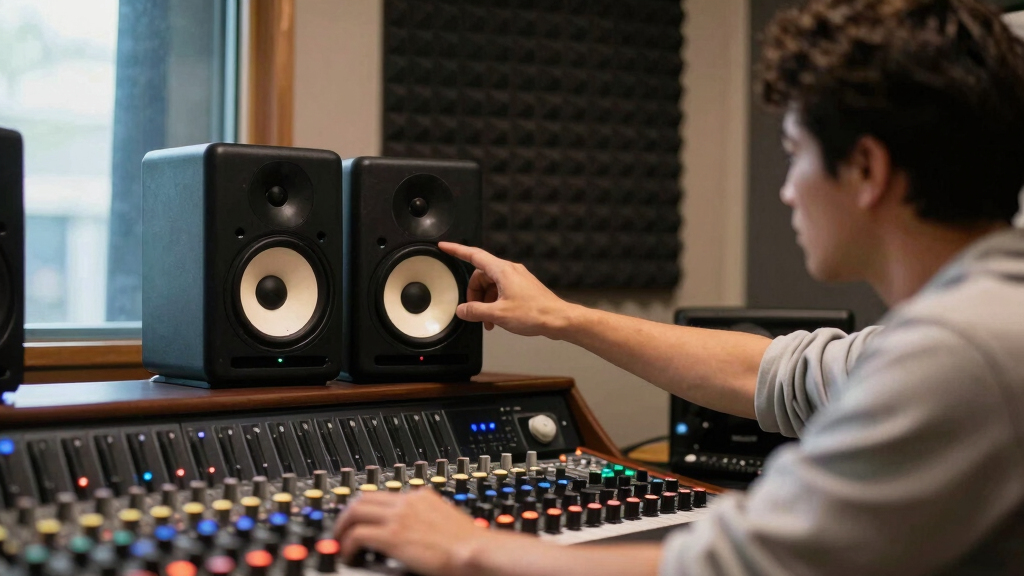
I evaluated each monitor based on performance, build quality, connectivity options, and overall value. Performance was judged through clarity, bass response, and neutrality—key for accurate mixing. Build quality and durability are critical for long-term use, especially in professional environments. Connectivity versatility ensures compatibility with various audio sources, while price was considered relative to features and performance. The ranking prioritizes monitors that deliver reliable, transparent sound suitable for both studio and home use, with a clear distinction between entry-level and premium options.Factors to Consider When Choosing Studio Monitoring Speakers
Choosing the right studio monitoring speakers involves understanding several key factors that impact your overall mixing accuracy and workflow. Beyond raw specifications, it’s important to consider how these speakers will fit into your space, your budget, and your specific needs. A well-matched monitor can elevate your production quality, but the wrong choice can lead to misjudged mixes and frustration. Here are the main considerations to keep in mind before making a purchase.Size and Driver Frequency Response
The size of the drivers influences the frequency response, especially the bass. Larger drivers (like 5 inches or more) tend to produce fuller low-end, which is beneficial for mixing bass-heavy music. Smaller monitors are more compact and suitable for near-field setups but may require a subwoofer for extended low-frequency accuracy. Consider your genre and space constraints when selecting driver size to ensure your mixes translate well on different systems.
Connectivity and Power
Look for monitors with versatile input options such as XLR, TRS, and RCA, allowing seamless integration with a variety of audio interfaces and devices. Active monitors with built-in amplification eliminate the need for external amps, simplifying setup and reducing clutter. Always check the wattage and power handling—more power can mean cleaner sound at higher volumes but isn’t always necessary for smaller rooms or low-volume work. Balance your connectivity needs with your budget to avoid missing out on essential features.
Room Size and Acoustic Treatment
Your room’s size and acoustic treatment significantly influence monitor performance. Smaller spaces can cause sound reflections and standing waves, affecting accuracy. Compact monitors are easier to position in tight spaces but may lack deep bass. Larger rooms benefit from monitors with bigger drivers and higher power to fill the space with accurate sound. Proper placement and acoustic treatment are as important as the monitors themselves to achieve a balanced mix.
Budget and Long-Term Value
Spending more generally yields better sound fidelity, durability, and feature sets, but there are excellent budget options that offer surprising performance. Consider how long you’ll use the monitors before upgrading and whether investing in a higher-end pair aligns with your professional goals. Sometimes, saving on initial cost can lead to compromises in sound accuracy or build quality, so weigh these factors carefully against your needs and budget.
Suitability for Your Skill Level and Use Case
Beginners should prioritize monitors that are easy to set up and interpret, often with flatter frequency responses to learn mixing fundamentals. Professionals may benefit from higher-resolution monitors with precise imaging and extended frequency response. Consider whether you need monitors for music production, mixing, mastering, or casual listening, as each use case might demand different features and performance levels. Matching the monitor’s capabilities to your skill level ensures better results and satisfaction.
Frequently Asked Questions
Do I need powered monitors or passive monitors?
Powered monitors come with built-in amplifiers, making them easier to set up and ideal for most modern home and professional studios. Passive monitors require an external amplifier, which adds complexity and cost. For simplicity and reliability, powered monitors are recommended, especially if you’re just building your setup or lack experience with external amplification. However, if you already have a high-quality amp, passive monitors can be a flexible choice, offering more customization options.
How important is room size when choosing monitors?
Room size plays a significant role in monitor selection. Smaller rooms benefit from near-field monitors that minimize sound reflections and focus on proximity listening. Larger spaces require monitors with bigger drivers and higher power to fill the room comfortably without losing fidelity. Proper placement and acoustic treatment are equally important to prevent sound issues like echo and standing waves, regardless of monitor size.
Can budget monitors deliver professional sound quality?
Many budget monitors now deliver surprisingly accurate sound, making them suitable for entry-level or hobbyist use. However, they may lack some of the refinement, low-end extension, or durability found in higher-end models. For critical mixing and long-term use, investing in a more capable pair can lead to better translation and less fatigue. Balance your budget with your goals—if you’re serious about your craft, a mid-range or premium monitor often pays off in the long run.
What features should I prioritize for music production?
For music production, prioritize monitors with a flat frequency response to ensure your mixes translate well across different systems. Good imaging and stereo separation are also important for spatial accuracy. Connectivity options should accommodate your setup, and durability is a plus for long-term reliability. Additionally, consider monitors with room compensation features or EQ adjustments to tailor sound to your specific environment, especially if acoustic treatment is limited.
How do I know if a monitor is suitable for mixing bass-heavy genres?
Monitors with larger drivers, typically 5 inches or more, tend to produce better low-end response, which is essential for accurately mixing bass-heavy genres. Additionally, look for models with sufficient power and good bass extension without distortion at higher volumes. Some monitors include bass tilt controls or room correction features that help tailor the sound to your space. Always consider the size of your room and whether a subwoofer might be needed to complement the monitors for full-range accuracy.
Conclusion
For those seeking the best overall performance, the Yamaha HS5 offers reliable, transparent sound suited for professional mixing. Budget-conscious buyers will find the PreSonus Eris E7 XT provides excellent value with larger driver size and versatility. Beginners should consider the Edifier MR4 for its simplicity and space-friendly design, while advanced users might prioritize premium options like the ADAM Audio D3V for detailed sound. Ultimately, your choice should align with your space, budget, and intended use—each monitor in this roundup has a clear role to play.
Fall Picks
fall essentials
As an affiliate, we earn on qualifying purchases.