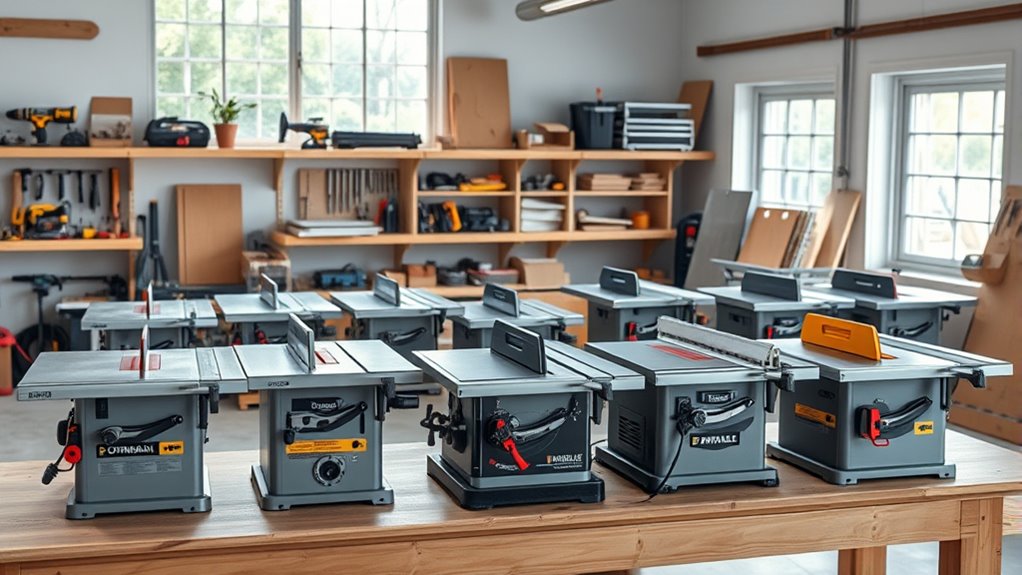

For serious DIY, I’d start with the DEWALT DWE7491RS as the best overall fit: its 10-inch blade, wide rip capacity, and rolling stand make it a practical balance of cutting room and mobility. The SawStop Contractor Saw is a stronger match for a dedicated shop where its safety system and premium fence matter more than portability, while the SKIL worm-drive saw stands out for buyers prioritizing torque and jobsite mobility. The main tradeoff is between a stable, spacious setup and a saw that can be moved or stored without a permanent footprint. Fence quality, support for large panels, and safety features can matter as much as motor power. Read on for the full breakdown and to find the right match for your projects and workspace.

Get audio and creator gear delivered free with Prime
- Fast, free delivery on millions of items
- Prime Video, Amazon Music and more included
- Member-only deals all year
Complete the kit


Key Takeaways
- The DEWALT DWE7491RS leads for all-around DIY use because it combines a 10-inch blade and substantial rip capacity with a rolling stand; it is a more versatile shop-and-jobsite choice than the compact 8-1/4-inch DEWALT models.
- Fixed-shop saws and portable saws solve different problems: the 36- and 52-inch T-Glide configurations and the SawStop Contractor Saw favor workspace and fence support, while the jobsite models favor storage and transport.
- A wider rip capacity is only useful when the workspace can support it. Large sheet goods call for room around the saw and outfeed support, not just longer rails.
- The SawStop Jobsite Saw PRO brings a distinctive safety system to a mobile format, while the SawStop Contractor Saw suits buyers who want a more permanent shop setup.
- Blade size and saw format shape the ceiling for projects: the 10-inch models suit broader general-purpose use, while the 8-1/4-inch DEWALT saws trade some capacity for a smaller, easier-to-store package.


| contractor table saws for serious diy | Power source | Blade size | Rip capacity | Weight |
|---|---|---|---|---|
| DEWALT Portable Table Saw with | Corded electric | 8-1/4 inches | 24.5 inches | 66 pounds |
| Contractor 1.75HP Saw with 36” | Corded electric | — | — | — |
| Delta 10-inch Contractor Table | — | — | 30 inches | 195 pounds |
| DEWALT 10-inch Table Saw with | Corded electric | 10 inches | 32.5 inches | 87 pounds |
| SKIL 10 Inch Heavy Duty Worm D | Corded electric | 10 inches | 30-1/2 inches | 94.3 pounds |
| DEWALT 15 Amp 8-1/4 in. Compac | — | 8-1/4 in. | 24.5 in. | — |
| SawStop Jobsite Saw PRO with M | Corded electric | 10 inches | — | 113 pounds |
| SKIL 15 Amp 10-Inch Jobsite Ta | Corded electric, 120 V | 10 inches | 25.5 inches | 51.2 pounds |
| Contractor 1.75 HP Saw with 52 | Corded electric, 110 V | — | — | — |
| SawStop 1.75HP Contractor Saw | Corded electric, 120 V | — | — | 256 pounds |
| DEWALT DWE7491RS 10-Inch Jobsi | Corded electric | 10 inches | 32-1/2 inches | — |
More Details on Our Top Picks
DEWALT Portable Table Saw with Stand, 8-1/4 inch, up to 48-Degree Angle Cuts (DWE7485WS)
For serious DIYers who need a capable saw without dedicating a permanent corner of the shop, the DEWALT DWE7485WS offers a useful balance of portability and sheet-goods capacity. Its 24.5-inch rip capacity can handle wide panel cuts, while the rack-and-pinion fence makes repeat adjustments easier than on less refined compact saws. The included stand and onboard accessory storage also make setup and packing away more practical. Compared with the DEWALT DWE7491X, this model is lighter and takes up less room, but its smaller 8-1/4-inch blade and narrower rip capacity limit its reach on thick stock and extra-wide cuts. At 66 pounds, it is portable rather than effortless to carry, and it still needs a corded outlet. I’d choose it for a space-conscious DIY shop, not as a substitute for a full-size contractor saw.
Pros:- 24.5-inch rip capacity supports useful sheet-goods cuts.
- Rack-and-pinion fence allows quick, controlled adjustments.
- Integrated stand and onboard storage simplify setup and packing.
- Compact footprint suits garages with limited workshop space.
Cons:- The 8-1/4-inch blade has less cutting depth than the 10-inch saws in this lineup.
- At 66 pounds, carrying it alone may be awkward.
- Corded operation requires access to an outlet.
Best for: DIYers who move between a compact home shop and project sites and still need to rip standard sheet goods.
Not ideal for: Woodworkers regularly cutting thick hardwood or extra-wide panels who would benefit from a 10-inch blade and the DWE7491X’s wider capacity.
- Blade size:8-1/4 inches
- Motor:15 amps
- Blade speed:5,800 RPM
- Rip capacity:24.5 inches
- Maximum cutting angle:48 degrees
- Voltage:120V
- Weight:66 pounds
- Power source:Corded electric
Our verdict“Choose the DWE7485WS if compact storage and jobsite mobility matter more than the cutting depth and capacity of a full-size saw.”
Contractor 1.75HP Saw with 36” Professional T-Glide Advance Fence, Rails & Extension Table
This contractor saw suits a serious DIYer building a stationary workspace around fence accuracy, work support, and a contact-activated safety system. The 36-inch T-Glide Advance fence and extension table offer a more shop-oriented setup than the portable DEWALT DWE7485WS, giving larger workpieces support and a substantial rip range. Its listed 1.75HP motor is aimed at demanding woodworking, though the supplied data does not specify a rip capacity or cutting depth, so I would verify those details before matching it to a particular project. Compared with the Delta 10-inch Contractor Table Saw, this model’s standout distinction is its stated skin-contact stopping system rather than the Delta’s documented cast-iron top and 30-inch capacity. The tradeoff is a large, heavy footprint and limited mobility; it makes little sense for a garage that must regularly return to car-parking duty.
Pros:- 36-inch T-Glide Advance fence supports accurate rip adjustments.
- Extension table helps support larger workpieces.
- Listed skin-contact safety system adds a distinct safety feature.
- 1.75HP motor is specified for demanding woodworking.
Cons:- Large dimensions require substantial, dedicated floor space.
- Corded design and shop-sized form make it poorly suited to frequent transport.
- Product data does not provide rip capacity or cutting-depth figures.
Best for: DIY woodworkers setting up a dedicated shop who prioritize a substantial fence, extension support, and the listed contact-activated safety feature.
Not ideal for: DIYers who need a saw they can fold away or move between sites, or buyers who require confirmed rip-capacity and cutting-depth figures before choosing.
- Motor power:1.75 HP
- Blade length:10 inches
- Blade speed:4,000 RPM
- Fence:36-inch T-Glide Advance
- Voltage:110V
- Dimensions:69.13 x 45 x 34.75 inches
- Power source:Corded electric
- Warranty:2 years with registration
Our verdict“Pick this saw for a permanent DIY shop where its fence, extension table, and stated safety system outweigh the missing capacity details and fixed footprint.”
Delta 10-inch Contractor Table Saw
The Delta is the most traditional stationary-shop choice here: a cast-iron top, steel extension wings, and a Biesemeyer-style fence prioritize a steady, repeatable setup over easy transport. Its 30-inch rip capacity handles a broad range of cabinet and furniture stock, while the 10-inch blade and listed dado capacity expand the kinds of cuts a well-equipped DIY shop can make. Compared with the portable DEWALT DWE7491X, the Delta is far heavier at 195 pounds and less convenient to move, but its cast-iron table gives it a more fixed-shop character. It is not the largest-capacity option in this group—the DWE7491X reaches 32.5 inches—and its 2.5-inch dust port may call for a suitable extraction setup. I’d favor it for a dedicated workspace, not a garage that needs frequent rearrangement.
Pros:- Cast-iron table and steel extension wings provide a substantial work surface.
- Biesemeyer-style fence supports controlled, accurate rip cuts.
- 30-inch rip capacity accommodates a wide range of project stock.
- Listed dado capacity supports dado-blade operations.
Cons:- At 195 pounds, it is difficult to reposition.
- Large dimensions call for a dedicated workshop area.
- The 2.5-inch dust port may require an adapter for dust collection.
Best for: Furniture and cabinet DIYers with a permanent workshop who value a substantial cast-iron table and a 30-inch rip capacity.
Not ideal for: DIYers who need a portable saw, have limited floor space, or routinely need more than 30 inches of rip capacity.
- Blade diameter:10 inches
- Rip capacity:30 inches
- Dado capacity:13/16 x 8 inches
- Motor power:1,800 watts
- Blade speed:3,450 RPM
- Blade tilt:45 degrees left
- Depth of cut at 90 degrees:3-1/8 inches
- Weight:195 pounds
- Dust port:2.5 inches
Our verdict“Choose the Delta for a fixed workshop that benefits from cast-iron mass and fence accuracy, rather than jobsite mobility or maximum rip width.”
DEWALT 10-inch Table Saw with 15 Amp Motor, 32.5″ Rip Capacity, Dust Collection and Scissor Stand (DWE7491X)
The DEWALT DWE7491X earns the leading spot for serious DIY because it combines a full-size 10-inch blade with the widest documented rip capacity among these five saws: 32.5 inches. That extra width helps when breaking down large panels or cutting shelving without moving up to a heavy stationary contractor saw. Its rack-and-pinion fence makes width changes quick and repeatable, while the scissor stand gives it a practical route from storage to work. Compared with the compact DWE7485WS, it offers more blade and rip capacity; compared with the Delta Contractor Table Saw, it is far more jobsite-oriented, though still a substantial 87 pounds. The compromises are weight and a dust port that may need an adapter for a shop vacuum. I’d pick it as the most versatile one-saw choice for a serious DIYer.
Pros:- 32.5-inch rip capacity accommodates wide panels and shelving stock.
- 10-inch blade offers more cutting depth than the DWE7485WS.
- Rack-and-pinion fence supports fast, repeatable adjustments.
- Scissor stand and dust port suit jobsite and garage use.
Cons:- At 87 pounds, it is cumbersome for frequent solo transport.
- The 2.5-inch dust port may need an adapter for some vacuum systems.
Best for: Serious DIYers who need to cut wide sheet goods and hardwoods but still want a stand-mounted saw that can be stored or moved.
Not ideal for: Buyers who need a genuinely lightweight saw for frequent solo carrying or who want a permanent cast-iron shop setup.
- Blade size:10 inches
- Motor:15 amps
- Rip capacity:32.5 inches
- Voltage:120V
- Wattage:1,800 watts
- Dust collection port:2.5 inches
- Weight:87 pounds
- Power source:Corded electric
Our verdict“Choose the DWE7491X as a versatile primary DIY saw if wide cuts and full-size blade capacity matter more than easy lifting.”
SKIL 10 Inch Heavy Duty Worm Drive Table Saw with Stand – SPT99-11
The SKIL SPT99-11 is aimed at DIYers who want a 10-inch saw with high-torque worm-drive gearing and a wheeled stand, rather than a permanently planted contractor saw. Its stated 30-1/2-inch rip capacity and 3-5/8-inch depth of cut make it capable of handling broad stock and deep cuts, while the rack-and-pinion fence supports straightforward adjustments. Compared with the DEWALT DWE7491X, it gives up two inches of rip capacity but adds a worm-drive motor and large-wheel mobility. The stand can ease movement across a work area, though the saw itself weighs 94.3 pounds, so mobility should not be confused with easy lifting. Some supplied listing figures, including blade length and speed, appear implausible; I’d confirm those with the manufacturer before relying on them. This pick suits project-site movement better than a compact, hand-carried setup.
Pros:- Worm-drive gearing is specified to deliver high torque.
- 30-1/2-inch rip capacity supports wide workpieces.
- Listed 3-5/8-inch depth of cut handles deep stock.
- Large wheels and easy-load handles aid movement on the stand.
Cons:- The 94.3-pound weight makes lifting and vehicle loading difficult.
- Its rip capacity is slightly narrower than the DWE7491X.
- Some supplied blade and speed figures appear implausible and merit verification.
Best for: DIYers who move a full-size saw around a property or worksite and want worm-drive torque with a wheeled stand.
Not ideal for: Buyers who need a lightweight portable saw, maximum rip capacity, or cleanly verified specifications for every component.
- Blade size:10 inches
- Rip capacity:30-1/2 inches
- Depth of cut:3-5/8 inches
- Wattage:1,800 watts
- Voltage:120V
- Weight:94.3 pounds
- Power source:Corded electric
- Warranty:Limited 1 year
Our verdict“Choose the SPT99-11 if wheeled mobility and worm-drive torque suit your projects, but verify the questionable listing specifications before purchase.”
DEWALT 15 Amp 8-1/4 in. Compact Portable Jobsite Table Saw (DWE7485)
For serious DIYers who need a saw they can carry, store, and still use on full-size sheet goods, the DEWALT DWE7485 makes a strong case. Its 24.5-inch rip capacity handles 4×8 plywood or OSB, while the rack-and-pinion fence is designed for quick, controlled adjustments. The metal roll cage and tool-free Site-Pro guarding suit changing work areas better than a stationary contractor saw. Compared with the SKIL TS6307-00, this DEWALT prioritizes a smaller footprint over a 10-inch blade and slightly wider rip capacity. That tradeoff matters if your projects often involve thicker stock or deeper cuts. It is still a portable jobsite saw, so expect more noise and dust than a stationary setup, and less capacity than the larger contractor models in this roundup.
Pros:- Compact design is easier to transport and store than the larger contractor saws.
- 24.5-inch rip capacity accommodates full-size 4×8 sheet goods.
- Rack-and-pinion telescoping fence supports controlled adjustments.
- Metal roll cage base and tool-free guarding suit changing jobsite setups.
Cons:- The 8-1/4-inch blade offers less cutting depth than the 10-inch SKIL TS6307-00.
- Smaller work surface is less supportive for large or awkward stock.
- Portable operation can mean more noise and dust than a stationary saw.
Best for: DIYers who regularly break down full-size plywood but need a compact saw that stores easily between projects.
Not ideal for: Woodworkers who prioritize a 10-inch blade, deeper cuts, or a large stationary work surface.
- Motor power:15 Amp
- Blade size:8-1/4 in.
- Rip capacity:24.5 in.
- Fence type:Rack-and-pinion telescoping
- Base material:Metal roll cage
- Model number:DWE7485
Our verdict“Choose the DWE7485 if compact storage and sheet-goods capacity matter more to you than a 10-inch blade or a larger table.”
SawStop Jobsite Saw PRO with Mobile Cart Assembly – 1.5 HP 120V
The SawStop Jobsite Saw PRO is the jobsite choice for DIYers who put blade-contact protection high on their list without moving to a full-size stationary saw. Its SawStop Safety System is the standout difference from the DEWALT DWE7485 and SKIL TS6307-00, while the 10-inch blade and 24 5/8-inch table give it a more substantial work area than the compact DEWALT. That combination can suit repeat furniture and cabinetry cuts as well as general renovation work. The tradeoff is weight: at 113 pounds, it is portable in a mobile-cart sense, not an easy one-person carry. It also needs corded power, and its listed dimensions and table format do not match the broad support and rip capacity of the 52-inch-fence contractor saw. Choose it for safety and jobsite capability, not effortless transport.
Pros:- SawStop safety system is a distinctive blade-contact protection feature.
- 10-inch blade supports deeper cuts than the DEWALT DWE7485’s 8-1/4-inch blade.
- 24 5/8-inch table provides useful work support for a jobsite saw.
- 120V corded power fits standard compatible outlets.
Cons:- At 113 pounds, moving it is less convenient than carrying a compact portable saw.
- Corded operation limits use where suitable power is unavailable.
- Its jobsite format cannot match the extended fence support of the 52-inch contractor saw.
Best for: DIY woodworkers who want a 10-inch jobsite saw with blade-contact safety and can roll rather than carry their equipment.
Not ideal for: DIYers who need a lightweight saw for frequent solo loading or want the broad rip support of a stationary contractor model.
- Power source:Corded electric
- Voltage:120V
- Wattage:1800 watts
- Blade size:10 inches
- Table size:24 5/8-inch table
- Weight:113 pounds
- Safety system:SawStop Safety System
- Dimensions:48 x 29 x 36 in.
Our verdict“Pick the SawStop Jobsite Saw PRO if you want a mobile 10-inch saw with contact safety and can accommodate its weight.”
SKIL 15 Amp 10-Inch Jobsite Table Saw with Folding Stand (TS6307-00)
The SKIL TS6307-00 gives serious DIYers a useful balance of blade size, sheet capacity, and setup convenience. Its 10-inch blade and 25.5-inch rip capacity edge past the DEWALT DWE7485 on those two measures, making it a better fit when cuts in thicker stock or wider panels come up often. The included folding stand, rack-and-pinion fence, and dust-port elbow also make it a more complete mobile setup than a compact saw that needs separate support. Compared with the SawStop Jobsite Saw PRO, the SKIL forgoes the listed flesh-detection system, but its 51.2-pound weight is far easier to manage. It remains a corded saw, and the supplied 24-tooth blade may call for a different blade when cut finish matters. Its 0–45-degree bevel range is also a defined limit.
Pros:- 10-inch blade and 25.5-inch rip capacity offer more room for demanding cuts than the DEWALT DWE7485.
- Folding stand makes setup and storage more practical.
- Rack-and-pinion fence supports fast, accurate adjustments.
- Dust-port elbow helps direct dust toward collection.
Cons:- At 51.2 pounds, it is not as easy to carry as a smaller compact saw.
- Corded power restricts use away from suitable outlets.
- Bevel capacity is limited to 0–45 degrees, and the included blade has 24 teeth.
Best for: DIYers who want a 10-inch portable saw, folding stand, and enough rip capacity for sheet goods without stepping up to a heavy contractor saw.
Not ideal for: Buyers who need blade-contact safety technology, cordless operation, or a saw for bevel cuts beyond 45 degrees.
- Motor:15 A, 1800 W
- Power source:Corded electric, 120 V
- Blade size:10 inches
- Rip capacity:25.5 inches
- Bevel capacity:0–45 degrees
- Weight:51.2 pounds
- Included stand:Folding stand
- Included blade:24-tooth high-speed steel
Our verdict“Choose the SKIL TS6307-00 if you want a 10-inch portable setup with broad sheet capacity and can work within its corded, 45-degree bevel limits.”
Contractor 1.75 HP Saw with 52″ Professional T-Glide Advance Fence, Rails & Extension Table
When serious DIY projects call for repeatable long rips and room to support large panels, this 1.75 HP contractor saw stands apart from the jobsite models. Its 52-inch T-Glide Advance fence, rails, and extension table are aimed at wide work that the DEWALT DWE7485 and SKIL TS6307-00 cannot support in the same way. The listed 4000 RPM motor and 10-inch blade suit demanding woodworking cuts, while the SawStop safety system adds a layer of blade-contact protection not listed for those portable alternatives. The cost of that capacity is a fixed-shop footprint: at 85.25 inches long and 45 inches wide, this is not a saw to tuck away after each project. It is corded, and the supplied details do not list a rip-capacity measurement, so buyers should confirm the intended configuration before planning around a specific panel width.
Pros:- 52-inch T-Glide Advance fence and extension table support wide, repeatable cuts.
- 1.75 HP motor and 4000 RPM speed are suited to demanding woodworking tasks.
- SawStop safety system is a strong differentiator from the portable saws.
- Rails and extension table are included for a broad work setup.
Cons:- Large 85.25 x 45-inch footprint makes storage and repositioning difficult.
- Corded operation ties the saw to a powered workshop.
- Listed specifications do not state a rip-capacity figure, which buyers may need to verify.
Best for: DIY woodworkers with a dedicated shop who regularly rip wide panels, build cabinetry, or need a long fence for repeat cuts.
Not ideal for: DIYers working in a shared garage or on jobsites where the saw must be carried, folded, or stored between sessions.
- Horsepower:1.75 HP
- Power source:Corded electric, 110 V
- Motor speed:4000 RPM
- Wattage:1540 W
- Blade:10 in., carbide and high-speed steel
- Fence:52-inch T-Glide Advance
- Dimensions:85.25 x 45 x 34.75 in.
- Warranty:2 years with registration
Our verdict“Choose this contractor saw if wide, accurate panel rips are central to your shop work and you have room for its extended setup.”
SawStop 1.75HP Contractor Saw with 30” Premium Fence Assembly
The SawStop 1.75HP Contractor Saw is the premium shop-focused option for DIYers who want contact safety and a precision fence but do not need the 52-inch reach of the other contractor saw here. Its 30-inch Premium Fence Assembly gives up extension capacity compared with that model, but the shorter setup may suit projects that do not routinely involve very wide panels. Like the SawStop Jobsite Saw PRO, it has the brand’s contact-detection safety system; unlike that mobile-cart model, it is a 256-pound stationary-scale machine with a 61.75-inch length and 40.5-inch width. That weight and footprint favor a dedicated workshop, not occasional setup and teardown. The listed 40-tooth blade and 4000 rpm speed support general woodworking, though the product data’s 30-inch blade-length entry appears inconsistent with a 10-inch contractor saw and should be confirmed before purchase.
Pros:- SawStop contact-detection system provides a safety feature not listed on the SKIL or DEWALT jobsite saws.
- Premium 30-inch fence assembly supports precise rip cuts.
- 4000 rpm motor speed and a listed 40-tooth blade suit varied woodworking tasks.
- Contractor format offers a substantial shop setup compared with portable jobsite saws.
Cons:- At 256 pounds, it is difficult to move and calls for a stable, dedicated location.
- 30-inch fence capacity is shorter than the other contractor model’s 52-inch fence.
- The provided blade-length specification says 30 inches, which conflicts with the listed contractor-saw format and needs verification.
Best for: DIY woodworkers with a permanent workshop who value SawStop contact safety and a premium fence for regular precision cuts.
Not ideal for: Buyers who need a portable saw, regularly rip very wide panels, or want to avoid confirming the listed blade specification.
- Power source:Corded electric, 120 V
- Wattage:1680 W
- Motor speed:4000 rpm
- Fence assembly:30-inch Premium Fence Assembly
- Listed blade length:30 inches (confirm specification)
- Number of teeth:40
- Weight:256 pounds
- Dimensions:61.75 x 40.5 x 34.75 in.
Our verdict“Choose this SawStop if you have a fixed shop and want contact safety with a precision 30-inch fence rather than maximum rip reach.”
DEWALT DWE7491RS 10-Inch Jobsite Table Saw with Rolling Stand
The DWE7491RS earns this spot by combining a generous 32-1/2-inch rip capacity with a rack-and-pinion fence, making it a practical choice for serious DIYers who regularly break down plywood or wide boards. The fence adjusts quickly and stays aligned through changes in width, a useful advantage over compact jobsite options such as the DEWALT DWE7485, whose smaller blade and format are easier to store but limit large-panel work. Its folding rolling stand and onboard accessory storage also make setup and packing away more manageable.
The tradeoff is that this is still a 110-pound saw: the wheels help with rolling, not lifting into a vehicle or up steps. It also needs a suitable 15-amp circuit, and its jobsite format is less appealing than a stationary contractor saw for a permanent shop. I’d choose it for mobile projects that demand full-size capacity, not for frequent solo loading.
Pros:- 32-1/2-inch rip capacity accommodates wide cuts and large sheet materials.
- Rack-and-pinion fence supports fast, repeatable width adjustments.
- Folding rolling stand simplifies setup and movement across a work area.
- Onboard storage keeps key accessories and tools with the saw.
Cons:- At 110 pounds, it is difficult to lift or load without help despite the rolling stand.
- The motor calls for a suitable 15-amp circuit for operation.
- Its portable jobsite design is less suited to a dedicated, permanent workshop.
Best for: DIYers who need to cut full-size sheet goods and wide boards at different work sites, with a rolling stand for moving the saw around a level workspace.
Not ideal for: Anyone who must regularly lift a saw into a vehicle, carry it up stairs, or wants a stationary shop saw with a permanent cabinet-style setup.
- Model:DWE7491RS
- Motor power:15 Amp
- No-load speed:4,800 RPM
- Blade size:10 inches
- Rip capacity:32-1/2 inches
- Depth of cut at 90°:3-1/8 inches
- Depth of cut at 45°:2-1/4 inches
- Item weight:110 pounds
- Power source:Corded electric
Our verdict“Choose the DWE7491RS if you need near full-size ripping capacity in a movable setup and can work around its substantial weight.”

How We Picked
I compared these 11 saws around the needs of serious DIY work: repeatable cuts, practical fence capacity, support for common sheet and framing materials, setup and storage, and the usefulness of included stands or carts. I also weighed safety features, motor and drive design, shop footprint, and how much a buyer can do before needing additional stands, outfeed support, or workspace changes. A saw’s headline capacity mattered only when its overall format made that capacity usable.
The order favors versatility first: the DEWALT DWE7491RS ranks highest because it balances a full-size blade, wide ripping, and mobility. Dedicated-shop saws rank well for stability, fence capability, or safety but fall behind when portability matters; compact models rank lower for broad project range but remain compelling when storage and transport are the main constraints. Similar saws are separated by their stand, fence configuration, safety features, and intended workspace rather than by treating every 10-inch model as interchangeable.
| contractor table saws for serious diy | Power source |
|---|---|
| DEWALT Portable Table Saw with | Corded electric |
| Contractor 1.75HP Saw with 36” | Corded electric |
| Delta 10-inch Contractor Table | — |
| DEWALT 10-inch Table Saw with | Corded electric |
| SKIL 10 Inch Heavy Duty Worm D | Corded electric |
| DEWALT 15 Amp 8-1/4 in. Compac | — |
| SawStop Jobsite Saw PRO with M | Corded electric |
| SKIL 15 Amp 10-Inch Jobsite Ta | Corded electric, 120 V |
| Contractor 1.75 HP Saw with 52 | Corded electric, 110 V |
| SawStop 1.75HP Contractor Saw | Corded electric, 120 V |
| DEWALT DWE7491RS 10-Inch Jobsi | Corded electric |
Factors to Consider When Choosing Contractor Table Saws For Serious Diy
For a serious DIYer, the right saw is the one that fits both the work and the space around it. I’d decide how often the saw will move, what material I cut most, and whether I can support long or wide workpieces before comparing motor details. These factors can prevent a capable saw from becoming an awkward or underused purchase.
Choose the saw format around your actual workspace
A jobsite saw can be the smarter home-shop choice when the garage also needs to fit a car, storage, or other tools. A contractor-style saw with a larger table and rails can make repeated cuts feel more controlled, but it needs a permanent footprint and room to feed stock. Measure the saw in both working and stored positions, including the space needed for the operator and material. Buyers often measure only the table and overlook long rails or a stand’s deployed footprint. If you must move the saw after each session, a cart or folding stand may matter more than a modest gain in table area.
Match rip capacity to the work you can safely support
Wide rip capacity helps when breaking down sheet goods, but it does not make large panels easy to handle by itself. The infeed and outfeed sides need clear space, and the material should stay supported throughout the cut. Before paying for longer rails, plan where temporary supports or an outfeed table will go. A common mistake is buying maximum capacity for occasional plywood cuts while leaving no room to use it safely. If most projects use narrower boards, a shorter fence setup may be easier to store and quicker to set up.
Look beyond the motor label
Motor power and drive design influence how a saw handles demanding cuts, but they do not replace a sharp, suitable blade or a properly aligned fence. Think about the material thickness and cut frequency you expect rather than assuming the largest-sounding motor specification guarantees cleaner work. For dense stock or repeated ripping, a drive system designed around torque may appeal; for mixed shop projects, fence alignment and blade changes may affect day-to-day results more. Check what electrical supply the saw requires and whether your intended work area can provide it. Also account for blade availability and the cost of keeping task-appropriate blades on hand.
Treat the fence and work support as part of the saw
A fence that locks consistently and stays parallel to the blade helps make repeat cuts dependable. Long rails expand what the saw can rip, yet they also add bulk and can complicate storage. Check how the fence is adjusted and locked, and whether the table or extensions give enough support for the work you usually handle. For large panels, plan for a helper or a purpose-built support setup rather than relying on the fence to control the sheet. Buyers who mostly cut trim and narrower boards may gain more from a compact, easy-to-adjust setup than from the longest available rails.
Weigh safety features against setup, cost, and habits
Safety systems can change the way a saw is used, but they should sit alongside basic safeguards: a riving knife, blade guard, push sticks, and sound cutting habits. A dedicated brake system may be a priority for someone who uses a table saw often or shares a shop with other users, while another buyer may put more weight on a simple, mobile setup. Learn how any safety system operates, including what triggers it and what service or replacement steps may follow an activation. Do not assume a safety feature makes unsupported cuts or rushed work safe. Select the saw that supports careful routines you can maintain on every project.
Budget for the complete cutting setup
The saw is only one part of a useful station. A serious DIY setup may also need a quality blade, outfeed support, dust collection, push blocks, and storage for accessories. Dust collection deserves attention in a home shop, where fine debris can spread through living or shared spaces. Compare what comes with the saw against what you will need to add before the first project, including a stand if one is not included. Spending more makes sense when a better fence, safety system, or stable shop configuration addresses a frequent need; it is harder to justify paying for capacity that your projects and workspace cannot use.
Frequently Asked Questions
Should I choose a 10-inch saw or an 8-1/4-inch compact model for serious DIY?
I’d choose a 10-inch model if my projects regularly call for deeper cuts, broader material options, or more room to grow into furniture and renovation work. The 8-1/4-inch DEWALT models make more sense when portability and compact storage outweigh maximum cut capacity. A smaller saw can handle many common home projects, but it may impose limits as material gets thicker. Compare the published cut capacity at the angles you use, not just the blade diameter. If the saw will be your only table saw for years, a 10-inch format offers a wider range of uses.
Is a contractor-style saw worth choosing over a rolling jobsite saw for a home shop?
A contractor-style saw is a good fit when the saw can stay set up and you value a more substantial working area or a premium fence arrangement. A rolling jobsite saw is usually easier to relocate, store, and share between projects or locations. Neither format is automatically more accurate; alignment, fence quality, setup, and support all matter. Consider whether you can leave rails extended and maintain clear infeed and outfeed paths. If the saw must be packed away after each session, mobility may deliver more real value than a larger stationary footprint.
Do I need the widest rip capacity available for plywood projects?
Not necessarily. Wider capacity can help rip full or partial sheets, but large panels are awkward to control without adequate support and clear floor space. Many DIY projects can be planned around rough cuts from a track saw or circular saw, followed by accurate finishing cuts on a table saw. That approach can reduce strain on both the operator and the saw. Choose long rails when you have a recurring need for wide rips and room to support the material, not simply because the largest capacity sounds most capable.
How should I decide whether a SawStop model is right for my DIY shop?
I’d put the SawStop models high on the list if the saw will see frequent use, multiple people will operate it, or the included safety system is a major part of the buying decision. The Jobsite Saw PRO better suits buyers who need that feature in a mobile format; the Contractor Saw is aimed at a more settled shop. Compare the saw’s size and fence setup with your working space, and read the manufacturer’s information about system operation and service. Keep in mind that a safety system does not replace guards, push sticks, training, or attentive work. The higher-complexity setup may be less appealing if your main need is an easily stored saw for occasional cuts.
What should I budget for beyond the table saw itself?
Plan for at least a suitable blade, basic push tools, and a way to support material on the outfeed side. A dust collection solution can make a marked difference in a garage or shared space, especially during repeated cuts. Depending on the saw and your projects, you may also need an outfeed table, side support, or a more stable work surface. Check whether the stand or cart is included and whether it fits your storage and transport needs. Setting aside room and money for these items often improves safe, accurate work more than buying extra capacity you cannot use.
Conclusion
For the best overall balance, I recommend the DEWALT DWE7491RS to DIYers who want a 10-inch saw with broad rip capacity and a rolling stand. For a premium dedicated shop, choose the SawStop Contractor Saw when its safety system and premium fence fit your priorities; the T-Glide models are worth a close look when fence capacity and shop space lead your decision. For best value, consider the SKIL TS6307-00 if you want a 10-inch saw with a folding stand and do not need a premium shop configuration. For beginners, the DEWALT DWE7485 is a sensible compact starting point when storage and straightforward mobility matter more than a larger blade. For a specific need, pick the SKIL worm-drive saw for torque-minded mobile work or the SawStop Jobsite Saw PRO for a mobile format with its safety system. Match the saw to the space and support you can provide, and its listed capacity will be more useful in real projects.
Halloween Picks
halloween
As an affiliate, we earn on qualifying purchases.