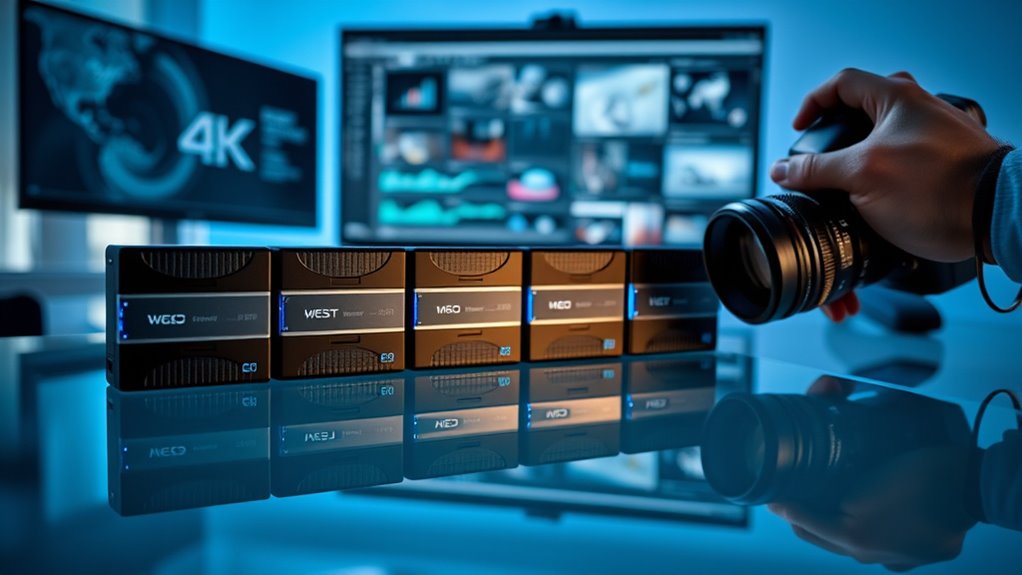

If you’re looking for the best enterprise-grade external SSDs in 2025, I recommend options like the Glyph Blackbox Plus for large projects, SanDisk Creator Pro for speed, and rugged drives like the Explorer 4TB for tough environments. The OWC Envoy Pro FX and Express 4M2 offer versatility with Thunderbolt and USB4 support, ensuring fast, reliable workflow. For more details on each and tips on choosing the right one, keep going—you’ll find everything you need here.
Key Takeaways
- High-capacity, ultra-fast SSDs like Glyph Blackbox Plus and SanDisk Creator Pro support large creative files with speeds exceeding 2000MB/s.
- Rugged, enterprise-grade designs such as IP67-rated and shockproof enclosures ensure durability in demanding environments.
- Compatibility with multiple interfaces (Thunderbolt 3, USB-C, USB4) guarantees seamless integration across various devices and platforms.
- Advanced thermal management and hardware encryption protect data integrity and security during intensive workflows.
- Investing in these reliable drives offers long-term value through enhanced performance, durability, and reduced risk of hardware failure.
Glyph Production Technologies Blackbox Plus SSD (7.6TB)
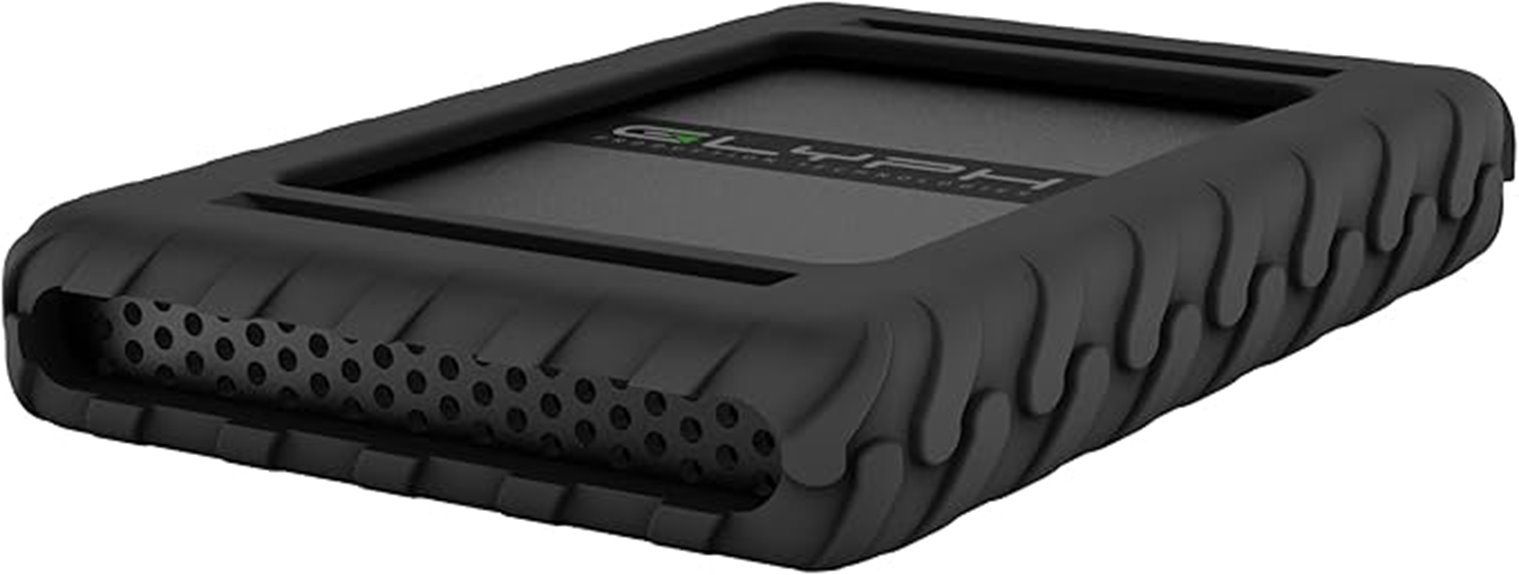
If you’re managing large-scale creative projects or handling extensive archives, the Glyph Production Technologies Blackbox Plus SSD with 7.6TB capacity is an excellent choice. I’ve used it for demanding workflows, and its high capacity guarantees I can store massive files without worry. The ultra-fast NVMe drive supports up to 1,050 MB/s read/write speeds via USB-C 3.2 Gen 2, making editing 8K or RAW footage smooth and efficient. Its fanless aluminum enclosure keeps heat in check, ensuring stable performance over long sessions. Plus, the external power supply guarantees consistent operation, even during intensive workloads, making it perfect for professional environments.
Best For: creative professionals and data-heavy workflows requiring high-capacity, fast, and stable storage solutions for large files and demanding projects.
Pros:
- Ultra-high capacity of 7.6TB ideal for extensive archives and large-scale projects
- Supports up to 1,050 MB/s read/write speeds for seamless editing of 8K/RAW footage
- Fanless aluminum enclosure ensures efficient heat dissipation and quiet operation
Cons:
- External power supply adds to setup complexity and portability considerations
- USB-C 3.2 Gen 2 compatibility may require additional adapters for older devices
- No built-in encryption or advanced security features
SanDisk 1TB Creator Pro Portable SSD
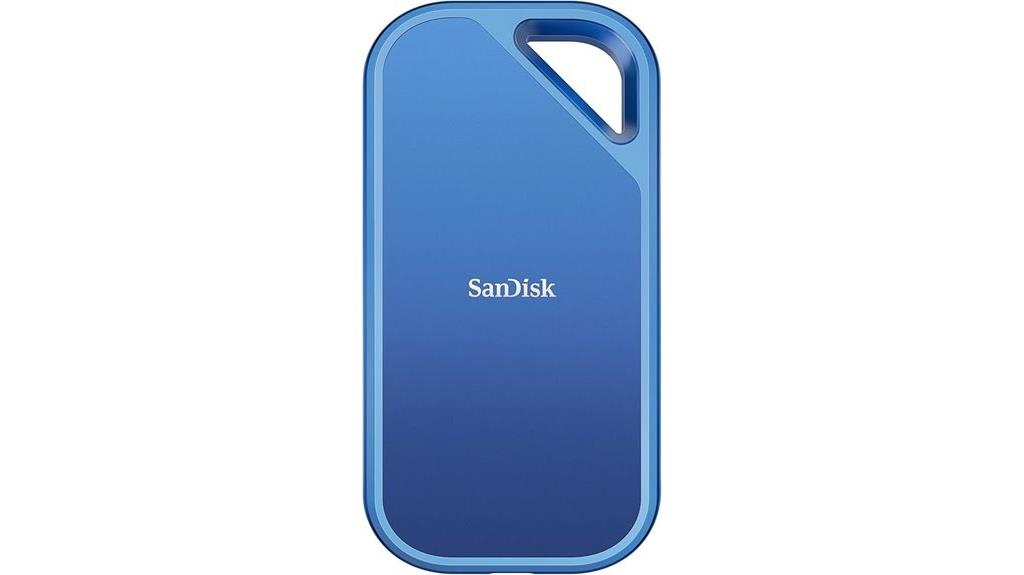
The SanDisk 1TB Creator Pro Portable SSD stands out as an ideal choice for creators and professionals who need fast, reliable storage on the go. With speeds up to 2000MB/s, it guarantees quick data transfers, making editing and backup seamless. Its USB-C and USB 3.2 Gen 2×2 interface deliver robust performance across devices. Built for durability, it features up to three-meter drop protection and IP65 water and dust resistance, perfect for demanding environments. Plus, it includes a month of Adobe Creative Cloud, empowering users to jumpstart projects immediately. This combination of speed, resilience, and added value makes the Creator Pro a top contender for serious creators.
Best For: creators and professionals who require fast, durable, and portable storage solutions for editing, backup, and content management on the go.
Pros:
- Ultra-fast transfer speeds up to 2000MB/s for efficient editing and backups
- Robust durability with IP65 water and dust resistance and up to 3-meter drop protection
- Includes a complimentary one-month Adobe Creative Cloud subscription for immediate content creation
Cons:
- Higher price point compared to standard external SSDs with lower speeds
- Limited to USB-C and USB 3.2 Gen 2×2 interfaces, may require adapters for older devices
- May be overkill for users with basic storage needs or less demanding workflows
Explorer 4TB Portable SSD with USB-C and USB 3.2 Gen 2

Looking for a rugged, high-speed external SSD that can keep up with demanding workflows? The Explorer 4TB Portable SSD offers impressive speeds up to 20 Gbps with USB 3.2 Gen 2, making data transfers quick and seamless. Its durable, shockproof, IP67-rated design protects against dust and water, perfect for on-the-go use. Available in capacities up to 8 TB, it’s built for creators who need reliable storage in tough environments. Compact and lightweight at just under 11 ounces, it pairs easily with modern devices via USB-C. Plus, with a five-year warranty, it’s a dependable choice for professional workflows.
Best For: professionals and creators needing durable, high-speed external storage for demanding workflows and rugged environments.
Pros:
- Extremely fast transfer speeds up to 20 Gbps for quick data handling
- Rugged, shockproof, and IP67-rated design offers excellent dust and water resistance
- Multiple capacity options up to 8 TB provide flexible storage solutions
Cons:
- Relatively heavy at just under 11 ounces, which may affect portability for some users
- Premium price point typical of high-performance rugged SSDs
- Limited to USB-C and USB 3.2 Gen 2 interfaces, which may require adapters for older devices
OWC 480GB Envoy Pro FX Portable NVMe M.2 SSD Drive
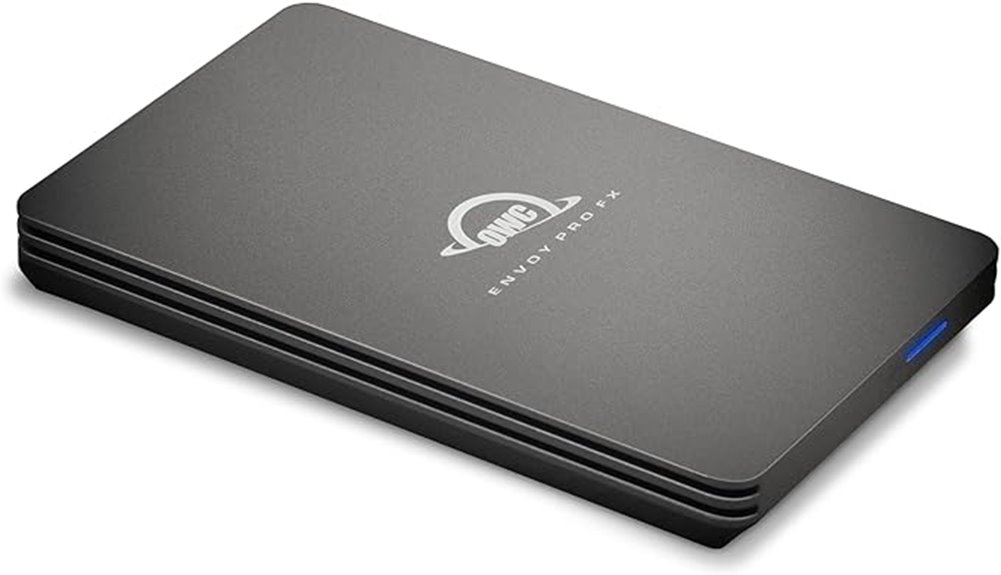
The OWC 480GB Envoy Pro FX Portable NVMe M.2 SSD Drive stands out for its impressive transfer speeds, making it an ideal choice for professionals who need fast, reliable data access on the go. It offers up to 2800MB/s transfer speeds with Thunderbolt 3, ensuring quick file transfers and seamless workflow. Its compatibility spans Macs, Windows, Linux, iPad Pro, Chromebook, and Surface devices, with included Thunderbolt and USB-C cables for versatile connectivity. Built to withstand demanding environments, it’s IP67 rated, drop, and shock resistant. Its fanless aluminum housing provides effective heat dissipation and silent operation, making it perfect for portable, enterprise-grade performance.
Best For: professionals and power users seeking a rugged, high-speed portable SSD for demanding workflows across multiple operating systems.
Pros:
- Ultra-fast transfer speeds up to 2800MB/s for quick data access and file transfers
- Versatile compatibility with Macs, Windows, Linux, iPad Pro, Chromebook, and Surface devices
- Rugged design with IP67 rating, drop and shock resistance for reliable performance in demanding environments
Cons:
- Higher price point compared to standard external SSDs with lower speeds
- No built-in encryption or advanced security features
- Limited storage capacity options beyond 480GB for users needing larger drives
OWC Express 4M2 USB4 External NVMe M.2 SSD Enclosure

For professionals demanding top-tier performance and reliability, the OWC Express 4M2 USB4 External NVMe M.2 SSD Enclosure delivers blazing speeds of up to 3200MB/s, making it ideal for demanding workflows. Its compatibility spans USB4, Thunderbolt, and USB-C Macs and PCs, ensuring versatility. Crafted from aircraft-grade aluminum, it offers rugged protection and effective heat dissipation, maintaining ideal SSD performance. The enclosure supports NVMe M.2 SSDs in various sizes and features a DIY-friendly install. With RAID support, including OWC SoftRAID, and a 2-year warranty, it combines speed, durability, and flexibility for professional creators.
Best For: professionals and content creators seeking high-speed, reliable external storage solutions compatible with various Macs and PCs.
Pros:
- Delivers blazing transfer speeds of up to 3200MB/s for demanding workflows
- Crafted from durable aircraft-grade aluminum for rugged protection and efficient heat dissipation
- Supports a wide range of NVMe M.2 SSD sizes and RAID configurations for maximum flexibility
Cons:
- May be more expensive compared to basic external enclosures
- Requires some technical knowledge for DIY installation and RAID setup
- Heavy or bulky design could be less portable for on-the-go use
ORICO 1TB Portable SSD with USB 3.2 Gen2x2
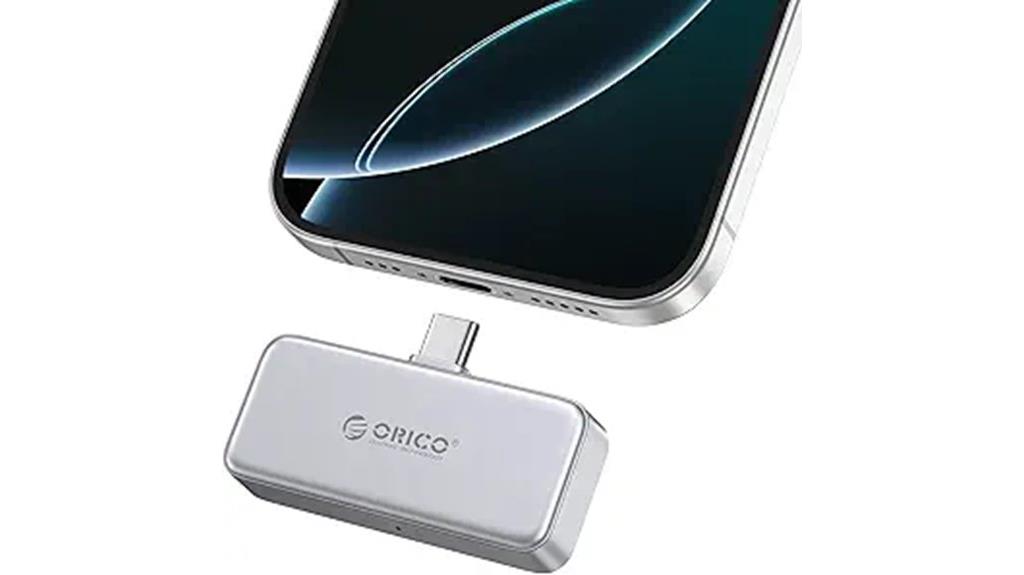
If you’re seeking a portable SSD that combines ultrafast transfer speeds with a compact design, the ORICO 1TB Portable SSD with USB 3.2 Gen2x2 is an excellent choice. It measures just 2.2 x 1.4 x 0.4 inches, weighs only 0.07 pounds, and features a durable alloy and plastic chassis with a magnetic side for secure attachment to devices like iPhones, MacBooks, and tablets. Supporting up to 20Gbps bandwidth, it delivers real-world speeds of 900-1300MB/s, making it ideal for large file transfers, 4K editing, and backups. Its broad compatibility and minimalistic design make it a versatile, high-performance option for creators on the go.
Best For: creative professionals and on-the-go users who need fast, reliable external storage for large files, video editing, and backups.
Pros:
- Ultra-fast transfer speeds up to 2000MB/s, ideal for 4K video editing and large file transfers
- Compact, lightweight, and portable design with a durable alloy and plastic chassis
- Broad compatibility with iOS, Android, Windows, and Linux devices, plus easy plug-and-play setup
Cons:
- Potential thermal throttling during prolonged intensive use due to heat buildup
- Some users report speeds on certain systems may be lower than advertised, around 900MB/s
- Slightly higher price point compared to basic portable SSDs, but justified by performance features
iDiskk Apple Certified 2TB External Hard Drive
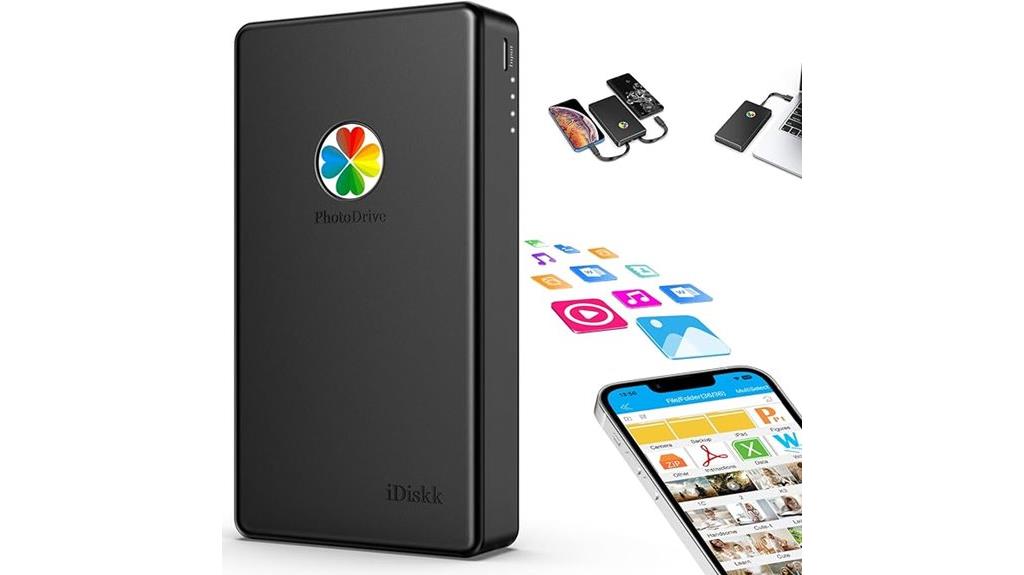
Anyone seeking a reliable and versatile external drive that seamlessly integrates with their Apple devices will find the iDiskk Apple Certified 2TB External Hard Drive an excellent choice. Certified by Apple’s MFi program, it’s compatible with iPhone, iPad, MacBook, and even Android phones. Its built-in 2000mAh battery makes it portable and easy to transfer or back up data on the go. With up to 2TB of storage, it supports direct media recording and automatic backups, all without needing extra software. Plus, advanced encryption keeps your files private, and the plug-and-play design ensures quick, hassle-free use wherever you are.
Best For: users seeking a reliable, portable external hard drive compatible with Apple devices and Android phones for quick data transfer, backup, and media access.
Pros:
- Certified by Apple’s MFi program, ensuring seamless compatibility with iPhone, iPad, and MacBook.
- Built-in 2000mAh battery allows for portable, on-the-go data transfer without external power sources.
- Supports automatic photo/video backup and direct media recording with encryption for privacy protection.
Cons:
- Limited to 2TB storage capacity, which may not suffice for very large data needs.
- Requires no software but may have limited functionality with certain device updates or OS versions.
- Physical connection may be less durable for frequent travel or rough handling.
Factors to Consider When Choosing Enterprise-Grade External SSDs for Creators

When choosing an enterprise-grade external SSD, I focus on matching the storage capacity to my project needs and ensuring fast transfer speeds for efficiency. Durability and device compatibility are also vital, especially when working in dynamic environments, while thermal management helps prevent overheating during extended use. By keeping these factors in mind, I can select a reliable drive that keeps my creative workflow smooth and secure.
Storage Capacity Needs
Choosing the right storage capacity for enterprise-grade external SSDs hinges on understanding your current project demands and future growth prospects. I evaluate whether I handle large-scale archives or data-heavy tasks, which may require drives over 7TB. If I work with high-resolution media like 8K footage or RAW images, I need substantial space for smooth editing and playback. I also consider if my team involves multiple users or collaborative projects, demanding scalable storage solutions that can expand over time. Long-term data management is vital—aligning SSD capacity with my archival, backup, and retrieval plans helps prevent frequent upgrades. By evaluating these factors, I guarantee my storage capacity not only meets immediate needs but also supports future expansion, maintaining efficiency and avoiding bottlenecks down the line.
Transfer Speed Importance
Transfer speed plays a critical role in ensuring that my workflow remains smooth and efficient, especially when working with high-resolution media files. Faster speeds mean less waiting and more creating, which is essential when handling large files like 8K videos or RAW footage. External SSDs with transfer rates of 2000MB/s or higher let me edit in real-time without lag, saving valuable time. High-speed drives also reduce bottlenecks across multiple storage devices, keeping my workflow fluid. Additionally, rapid data transfer helps prevent thermal throttling during intense tasks, maintaining consistent performance. Quick backups and restores are indispensable in demanding creative environments, and higher transfer speeds make this process seamless. Overall, prioritizing transfer speed ensures I stay productive and responsive during intensive editing sessions.
Durability and Resistance
High transfer speeds are essential for keeping my workflow smooth, but durability and resistance are equally important, especially when working in challenging environments. Enterprise-grade external SSDs often feature rugged designs with IP ratings like IP67 or IP65, protecting against dust, water, and shocks. Many models are shockproof and drop-resistant, capable of withstanding falls from 2-3 meters to prevent data loss. Durable enclosures made of aluminum or heat-dissipating materials help prevent damage from thermal stress and extend lifespan. Reinforced connectors and secure locking mechanisms ensure the drive can handle frequent cable connections without compromising integrity. These resilience features make enterprise SSDs reliable in demanding settings, whether outdoors or in harsh environments, guaranteeing data safety and device longevity when it matters most.
Compatibility With Devices
When selecting an enterprise-grade external SSD, it’s essential to guarantee it supports the connection interfaces of your devices, such as USB-C, Thunderbolt, or USB 3.2 Gen 2/2×2, for maximum compatibility. Confirm the SSD works seamlessly with your operating system—Windows, macOS, Linux, or iOS—to avoid integration issues. If you’re using specialized hardware or enclosures, check whether the SSD supports specific form factors like M.2 NVMe or 2.5-inch drives. Also, verify that it includes necessary cables or adapters, such as Thunderbolt or USB-C, for plug-and-play use. Finally, consider if the SSD offers features like driverless operation, making it easier to connect across diverse devices without hassle. Compatibility is key to ensuring smooth workflows and reliable performance.
Thermal Management
Effective thermal management is essential for maintaining the performance and durability of enterprise-grade external SSDs, especially for creators who rely on sustained high-speed data transfers. Heat-dissipating enclosures, like aluminum casings, help prevent overheating during intensive workflows, preserving both speed and lifespan. Some models incorporate active cooling solutions, such as built-in fans or external accessories, to enhance heat dissipation in demanding environments. If an SSD overheats, thermal throttling can occur, reducing transfer speeds and risking performance dips. Proper thermal design guarantees consistent operation during prolonged use, which is critical for professional workflows involving large files or continuous data access. Prioritizing thermal management features helps avoid performance degradation and extends the device’s lifespan, making it a key factor when choosing enterprise-grade SSDs.
Power Supply Stability
Choosing an enterprise-grade external SSD requires careful attention to power supply stability, as inconsistent power can lead to data corruption, drive failure, and performance issues. A reliable external power supply or robust power management system guarantees steady performance, especially during demanding workloads like high-speed transfers or intensive editing. Stable power delivery helps prevent thermal throttling and connectivity problems caused by fluctuations, maintaining ideal speeds. In professional environments, where data integrity is critical, reliable power stability reduces the risk of unexpected disconnections or data loss. Features such as dedicated power adapters or high-quality circuitry greatly enhance the drive’s overall stability and durability. Prioritizing power supply stability ensures your SSD performs reliably under heavy workloads and protects your valuable data.
Security and Encryption
Security and encryption are critical considerations for enterprise-grade external SSDs, especially for creators handling sensitive or valuable data. Hardware-based encryption, like AES-256 or XTS, safeguards data at rest, making it nearly impossible for unauthorized users to access information if the device is stolen. Many professional SSDs also support secure boot or password protection, adding an extra layer of security against physical theft. End-to-end encryption ensures data remains protected during transfer, minimizing interception risks. Compliance with industry standards like FIPS 140-2 or TCG Opal further enhances trust in a device’s security credentials. Regular firmware updates are essential, as they patch vulnerabilities and keep security measures current against emerging threats. Prioritizing these features guarantees your data remains safe in any environment.
Cost and Value
While enterprise-grade external SSDs often come with higher price tags, it’s important to evaluate whether their features justify the investment based on your specific workflow needs. These SSDs typically offer better long-term value through enhanced reliability, longer lifespan, and reduced risks of data loss during critical projects, saving you costs on data recovery or hardware replacements. Features like high transfer speeds (over 2000MB/s), robust build quality, and advanced thermal management can justify the higher cost by boosting productivity and minimizing downtime. When assessing cost versus value, consider compatibility with your existing hardware—many support multiple interfaces like USB-C, Thunderbolt, and NVMe—offering versatility and future-proofing. Investing in enterprise-grade SSDs makes sense in demanding environments, ensuring consistent performance and reducing the need for frequent replacements.
Frequently Asked Questions
How Do Enterprise SSDS Compare in Durability to Consumer-Grade Options?
Enterprise SSDs are way more durable than consumer-grade options, and I’ve seen this firsthand. They’re built to withstand constant heavy use, extreme temperatures, and rigorous workloads without failing. Consumer drives might be fine for everyday tasks, but I rely on enterprise SSDs for critical projects because they’re designed for longevity and reliability, ensuring my data stays safe even in demanding environments.
What Security Features Are Standard in Enterprise External SSDS?
Think of enterprise external SSDs as the Fort Knox of storage—they come with robust security features that keep your data locked tight. Standard options include hardware encryption like AES-256, secure erase functions, and sometimes even biometric authentication. These features guarantee your sensitive data stays confidential, giving you peace of mind. I’ve found that these security measures make enterprise SSDs a top choice for creators who value both speed and safety.
Can These SSDS Handle Multi-User Access Securely?
Yes, many enterprise-grade external SSDs can handle multi-user access securely. They often feature hardware encryption, secure access controls, and user authentication methods like biometric or password protection. I find these security measures essential because they ensure that sensitive data remains protected even when multiple users need access. When choosing an SSD, I always look for those with robust security features to keep my work safe and compliant with data regulations.
What Warranty and Support Options Are Typically Available?
Warranty and support options usually include a standard one-year warranty, but I recommend looking for extended coverage up to three or five years for peace of mind. Many brands offer dedicated customer support, including online chat, phone, and email assistance. Some also provide firmware updates and troubleshooting guides. I always choose SSDs with solid warranty policies and responsive support, ensuring I get quick help if any issues arise.
Are Enterprise SSDS Compatible With All Major Operating Systems?
Think of enterprise SSDs as universal translators—they’re designed to communicate smoothly across different systems. Generally, these SSDs are compatible with major OSes like Windows, macOS, and Linux, but it’s wise to check specific model specs. While they’re built for versatility, some formatting or drivers might be needed for peak performance. I recommend verifying compatibility details before purchase to guarantee seamless integration with your setup.
Conclusion
Choosing the right enterprise-grade external SSD can boost your creativity and guarantee reliable performance. Did you know that creators who upgrade to high-quality SSDs experience up to 50% faster workflow speeds? Investing in these top options means you’ll get unmatched speed, durability, and peace of mind. Don’t settle for less—your projects deserve the best. With the right drive, you’ll stay ahead and bring your ideas to life seamlessly.