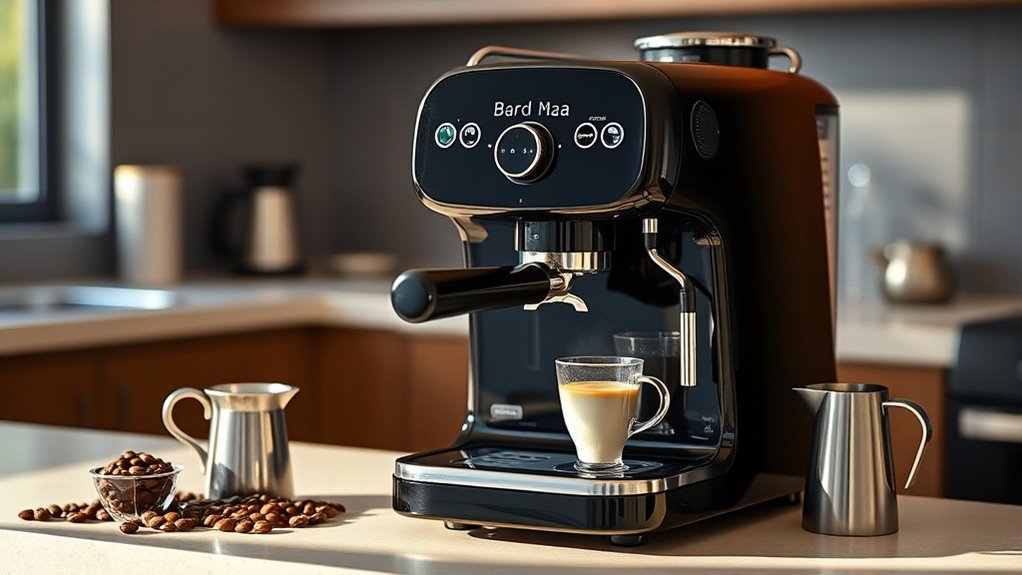

Starting with espresso at home is more accessible than ever, thanks to machines designed specifically for beginners. For 2026, I’ve identified top picks that balance ease of use, price, and quality. The VIOMI T1A PRO stands out for its touchscreen and versatility, ideal for those who want a feature-rich experience. The AERCANA is perfect for small spaces with rapid heating and straightforward operation, while the Stainless Steel Espresso Machine offers professional features in a compact form. Each has its strengths and tradeoffs, so your choice hinges on your priorities—whether that’s budget, size, or feature set.
Complete the kit


Key Takeaways
- Most beginner machines focus on semi-automatic operation for user control without overwhelming complexity.
- Size and design vary; compact models are better for small kitchens or offices, while larger units often offer more features.
- High-pressure pumps (20 bar) are common and essential for good espresso, but manual frothers require skill for perfect milk foam.
- Built-in features like pressure gauges and pre-infusion improve quality but add cost and complexity.
- Ease of cleaning and maintenance is key for beginners to stay consistent and enjoy their espresso experience.


| espresso machine for beginner | Wattage | Pressure | Voltage | Dimensions |
|---|---|---|---|---|
| VIOMI T1A PRO Espresso Machine | 1350 watts | 20 bar | 120 volts | 12.5"D x 6.2"W x 12.5"H |
| AERCANA Espresso Machine 20 Ba | 1450 watts | — | — | 12.2"D x 5.32"W x 11.5"H |
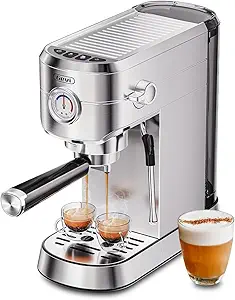
| Stainless Steel Espresso Machi | 1400 watts | 20 bar | 120 volts | 11.4 x 5.3 x 11.4 inches |
| Gevi 20 Bar Compact Espresso M | 1350 watts | 20 bar | 120 volts | — |
| De’Longhi Stilosa Compact Manu | — | — | — | — |
More Details on Our Top Picks
VIOMI T1A PRO Espresso Machine with Milk Frother and Cold Brew Maker
The VIOMI T1A PRO stands out for its versatility and user-friendly touchscreen, offering a range of coffee styles from cold brew to milk-based drinks. Its powerful 20-bar pump guarantees rich espresso, but its size and high wattage may be drawbacks in smaller kitchens or older homes. Compared to simpler models, it offers more customization, yet this added complexity could require a learning curve for absolute beginners.
Pros:- Powerful 20-bar extraction for rich flavor
- Touchscreen controls for intuitive customization
- Supports cold brew and milk drinks
- Removable water tank for easy cleaning
Cons:- Relatively large size may not fit compact spaces
- High wattage could be problematic for some outlets
- Limited to ground coffee, no pod compatibility
Best for: Those who want a multi-functional machine capable of different drinks and enjoy digital controls.
Not ideal for: Very small kitchens or users who prefer minimal operation and fewer features.
- Pressure:20 bar
- Wattage:1350 watts
- Voltage:120 volts
- Capacity:1.1 liters
- Dimensions:12.5″D x 6.2″W x 12.5″H
- Operation Mode:Semi-Automatic
Our verdict“A versatile, feature-rich option suited for beginners willing to learn more complex controls.”
AERCANA Espresso Machine 20 Bar, Compact Espresso Coffee Machine with Milk Frother
The AERCANA offers a quick 20-second heat-up and a compact silhouette, making it ideal for small kitchens or office spaces. Its 20-bar pump delivers rich espresso with crema, but manual operation and lack of a built-in grinder mean some skill is necessary for perfect results. It’s a straightforward choice for users who want quality without complexity.
Pros:- Rapid 20-second preheating
- Compact size fits in tight spaces
- High-pressure 20 bar pump for rich espresso
- Removable water tank for easy refilling
Cons:- No built-in grinder—requires ground coffee
- Manual operation involves a learning curve
- Limited beverage options beyond espresso and milk-based drinks
Best for: Users needing a space-efficient machine with fast brewing and simple operation.
Not ideal for: Beginners seeking automatic features or those without experience in manual espresso brewing.
- Wattage:1450 watts
- Output Pressure:20 bar
- Capacity:1 liters
- Dimensions:12.2″D x 5.32″W x 11.5″H
- Color:Silver
Our verdict“Ideal for small spaces and quick espresso, but requires familiarity with manual operation for best results.”
Stainless Steel Espresso Machine with Powerful Steam Wand
This Stainless Steel Espresso Machine combines sleek design with professional features like a rotating steam wand and rapid heat-up. Its 20-bar pump ensures quality extraction, but the learning curve may be steeper for beginners unfamiliar with manual frothing techniques. It’s an excellent choice for those who want to grow into their espresso skills while maintaining a stylish look.
Pros:- Fast heat-up in about 45 seconds
- Rotating steam wand for latte art
- Professional 20-bar pump for robust espresso
- Compact and stylish design
Cons:- Some learning required for milk frothing
- Limited color options (stainless only)
- No built-in grinder
Best for: Beginners who want a machine that can double as a semi-professional setup and are willing to learn steaming techniques.
Not ideal for: Absolute novices who prefer fully automatic or very simple machines without manual frothing.
- Wattage:1400 watts
- Voltage:120 volts
- Pressure:20 bar
- Material:Stainless Steel
- Dimensions:11.4 x 5.3 x 11.4 inches
- Removable Water Tank:57.5 oz
Our verdict“A stylish, capable machine suited for beginners ready to learn manual steaming and improve their skills.”
Gevi 20 Bar Compact Espresso Machine for Home, Latte, Cappuccino Coffee Maker
The Gevi 20 Bar offers a balance of power and simplicity, with features like a pressure gauge and steam wand, making it accessible for beginners. Its sturdy stainless steel housing ensures durability, and the intuitive controls ease new users into espresso-making. However, its small water tank and manual operation may require frequent refilling and some practice to master.
Pros:- Powerful 20-bar pressure for rich espresso
- Compact and durable stainless steel design
- Easy-to-use with pressure gauge and steam wand
- Includes auto shut-off for safety
Cons:- Limited water tank capacity requires frequent refilling
- Manual operation requires some skill
- No advanced automation features
Best for: Budget-conscious users who want a straightforward, durable machine for everyday espresso drinks.
Not ideal for: Those seeking advanced features like automatic milk frothing or larger capacity for frequent use.
- Pressure:20 bar
- Wattage:1350 watts
- Voltage:120 volts
- Water Tank Capacity:34 oz
- Material:Stainless Steel
Our verdict“A reliable, easy-to-use machine for beginners on a budget that still delivers quality espresso.”
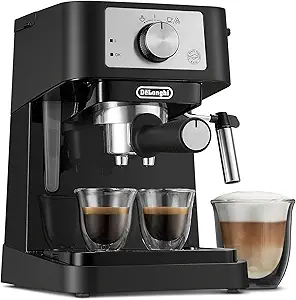
De’Longhi Stilosa Compact Manual Espresso Machine, Manual Milk Frother
The De’Longhi Stilosa offers a sleek, modern look with a 15-bar pump and manual milk frother, making it suitable for those who want to craft espresso with a personal touch. Its simplicity and included accessories make it easy to start, but manual frothing involves a learning curve, and lack of digital controls limits convenience for absolute beginners.
Pros:- Compact, stylish design fits modern kitchens
- Manual milk frother for personalized drinks
- Includes essential accessories
- Stainless steel boiler for durability
Cons:- Manual operation requires skill
- No digital or automatic features
- Limited capacity and features for advanced users
Best for: Design-conscious users who want a stylish machine and enjoy manually controlling their drinks.
Not ideal for: Users who prefer automatic features or minimal effort in milk frothing.
- Pump Pressure:15 bar
- Boiler Material:Stainless Steel
- Includes:Portafilter, filters, tamper
- Design:Contemporary
- Power:Not specified
Our verdict“A stylish, straightforward machine perfect for beginners willing to learn manual frothing and enjoy a sleek aesthetic.”

How We Picked
Our selection process prioritized machines that balance simplicity with quality, specifically aimed at those new to espresso brewing. I looked for models with semi-automatic operation, as fully manual machines tend to be more challenging for beginners. Size and design were important to ensure the machines fit comfortably in typical home kitchens. I also considered features like milk frothers, pressure consistency, and heating speed to gauge overall usability. Finally, I examined customer reviews and tradeoffs such as price, maintenance, and learning curve to recommend options that provide real value for newcomers.
Factors to Consider When Choosing Espresso Machine For Beginners
Choosing an espresso machine as a beginner involves balancing ease of use, size, features, and budget. A good beginner machine should simplify the brewing process while helping you develop your skills. Understanding key features like pressure, heat-up time, and milk frothing options will guide your decision. Here are some aspects to consider as you select your first espresso machine.Ease of Use
For beginners, machines with semi-automatic operation tend to be the best balance of control and simplicity. Features such as intuitive controls, clear indicators, and straightforward maintenance help make the learning process enjoyable rather than frustrating. Machines with preset functions or automatic milk frothers are even better for absolute newcomers, offering consistent results with less effort.
Size and Design
Consider your kitchen space. Compact models like the AERCANA or De’Longhi Stilosa are ideal for small counters, while larger, feature-rich machines like the VIOMI T1A PRO suit bigger kitchens or those who want more versatility. Style also matters—choose a design that complements your kitchen decor and feels inviting to use daily.
Features and Customization
High-pressure pumps (typically 15-20 bar) are standard and critical for good espresso. Features like pressure gauges, pre-infusion, and steam wands enhance quality but can add complexity. Decide if you want manual control for learning or prefer automatic features that simplify the brewing process. Remember, more features often mean a steeper learning curve and higher price.
Maintenance and Durability
Choose machines with removable water tanks and easy cleaning options. Durable materials like stainless steel increase longevity, and machines with fewer electronic components tend to require less troubleshooting. Regular cleaning keeps your machine performing well and your espresso tasting fresh.
Frequently Asked Questions
What is the ideal pressure for a beginner espresso machine?
The standard pressure of 15 to 20 bar is ideal for beginners, as it provides enough force to extract rich, flavorful espresso with crema. Machines with at least 15 bar ensure consistent pressure, which is key to good results, but higher pressure alone isn’t enough—technique and grind size matter too.
Should I choose a machine with automatic or manual milk frothing?
For beginners, automatic or semi-automatic milk frothers are recommended because they simplify the process and produce consistent microfoam. Manual frothers, like those on the Stilosa, give more control but require practice. If you’re just starting out, a machine with an automatic wand can help you enjoy milk-based drinks without the frustration of mastering manual techniques right away.
How important is size when selecting a beginner espresso machine?
Size is a key consideration, especially if your kitchen or workspace is limited. Compact models like the AERCANA or Gevi are easy to store and handle, making them ideal for apartments, offices, or small kitchens. Larger machines often include more features but require more counter space, so weigh your space constraints against your desired functionality.
Do I need a built-in grinder to make good espresso?
While a built-in grinder is convenient, it’s not essential for beginners. Many starter machines require pre-ground coffee, which is simpler and more affordable for new users. If you wish to experiment with fresh grounds, consider adding a separate grinder later. For now, focus on a machine that handles ground coffee well and is easy to operate.
What maintenance should I expect with a beginner espresso machine?
Regular cleaning of the water tank, drip tray, and portafilter is necessary to maintain flavor and performance. Machines with removable parts and simple descaling routines will be easier to keep in good shape. Avoid overly complex machines if you prefer minimal upkeep, but remember that proper maintenance is key to long-lasting quality and consistent results.
Conclusion
If you’re new to espresso and want something straightforward and budget-friendly, the Gevi 20 Bar offers excellent value with easy controls. For those who prefer a compact, quick-heating option, the AERCANA is a great choice. If you’re interested in a machine that can help you develop barista skills over time, the Stainless Steel Espresso Machine with its manual steam wand is worth considering. Finally, for style-conscious beginners who want a sleek look and manual control, the De’Longhi Stilosa is an appealing option. Your decision should reflect your space, budget, and how much you want to learn about espresso brewing.