
Whole house water filter systems treat every drop entering your home, so choosing one comes down to matching filtration stages to your water source and balancing upfront cost against long-term filter replacements. The Waterdrop WHF3T-FG 3-Stage system earns my best overall pick for its versatile triple-stage design that handles both municipal and well water, while the iSpring WGB32B stands out for large households needing commercial-grade capacity, and the Culligan P5 is the simplest, most budget-friendly entry point for sediment problems. The main tradeoffs in this category are between simplicity and contaminant coverage — more stages catch more but cost more to maintain — and between city water convenience and the specialized iron/manganese treatment well water demands. Read on for the full breakdown, including which systems are worth paying more for and which ones you should skip.

Get audio and creator gear delivered free with Prime
- Fast, free delivery on millions of items
- Prime Video, Amazon Music and more included
- Member-only deals all year
Complete the kit


Key Takeaways
- Three-stage systems (Waterdrop WHF3T-FG, Express Water Ultimate, iSpring WGB32B) dominated the top of the ranking because they balance contaminant coverage with manageable maintenance; single-housing systems like the Culligan P5 only make sense for narrow sediment problems.
- Well water buyers need dedicated contaminant targeting — the iSpring WGB32BM (iron and manganese) and NU Aqua 4-Stage (scale control) exist for a reason, and a general-purpose chlorine filter will not solve rust staining or hard water damage.
- Filter size drives long-term economics more than sticker price: 4.5″ x 20″ big blue housings like the VEVOR and iSpring systems hold more media and last longer between changes, while smaller cartridges like the Waterdrop WHF21-PG need more frequent replacement.
- Micron rating matters most for sediment: the 0.5-micron 3-stage system catches far finer particles than the 5-micron Waterdrop units, but clogs faster on murky source water — match the rating to your sediment load, not to the biggest number.
- The A. O. Smith AO-WH-Filter’s 600,000-gallon capacity makes it the lowest-maintenance option in the lineup, a better fit for hands-off homeowners than DIY-style multi-cartridge racks that demand seasonal attention.
| Waterdrop WHF21-PG 2-Stage Whole House Water Filter System, 5 Micron |  | Best Value Pick | Stages: 2 (PP sediment + GAC carbon) | Filter size: 10″ x 4.5″ | Flow rate: Up to 15 GPM | VIEW ON AMAZON | See Our Full Breakdown |
| Whole House Water Filter System with 9 Filters, 0.5 Micron Filtration, 3-Stage |  | Best for Beginners | Stages: 3 (PP + GAC + CTO carbon block) | Included filters: 9 cartridges (3 full sets) | Flow rate: Up to 15 GPM | VIEW ON AMAZON | See Our Full Breakdown |
| Waterdrop WHF3T-FG 3-Stage Whole House Water Filter System for Well Water |  | Best for Well Water | Stages: 3 (dual iron/manganese removal + carbon fiber) | Iron reduction: 95.9% (SGS tested) | Manganese reduction: 99.7% (SGS tested) | VIEW ON AMAZON | See Our Full Breakdown |
| Express Water Whole House Water Filter System, Ultimate Protection, 3-Stage |  | Best for High-Sediment Water | Stages: 3-stage plus spin-down sediment pre-filter | Total capacity: Up to 100,000 gallons | Connection size: 1″ standard | VIEW ON AMAZON | See Our Full Breakdown |
| A. O. Smith Whole House Water Filter System | 600K Gal | AO-WH-Filter |  | Best Low-Maintenance Pick | Type: Single sealed tank whole house filter | Certification: NSF/ANSI 42 | Chlorine reduction: 96.9% taste and odor | VIEW ON AMAZON | See Our Full Breakdown |
| WF3-01 3-Stage Whole House Water Filtration System | 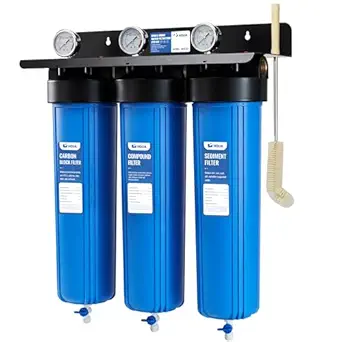 | Best for Maintenance Tracking | Stages: 3 (sediment, carbon block, GAC+KDF) | Filter Size: 3 x 20″ x 5.5″ | Targets: Lead, mercury, arsenic, cadmium, chromium, chlorine, VOCs, sediment | VIEW ON AMAZON | See Our Full Breakdown |
| Express Water Whole House Water Filter System, Ultimate Protection, 3-Stage |  | Best for Scale and Heavy Metal Defense | Stages: 3 (sediment, carbon/KDF, polyphosphate) | Flow Rate: 17 GPM | Capacity: 100,000 gallons | VIEW ON AMAZON | See Our Full Breakdown |
| VEVOR Whole House Water Filter System, 3-Stage |  | Best Budget Big-Blue Setup | Stages: 3 (sediment PP, KDF, CTO carbon) | Flow Rate: 15 GPM | Capacity: 100,000 gallons | VIEW ON AMAZON | See Our Full Breakdown |
| Culligan Whole House Water Filter System, 3/4″ Standard, P5 Filter Included |  | Best Compact Starter Filter | Stages: 1 (sediment) | Flow Rate: 4 GPM | Capacity: 16,000 gallons | VIEW ON AMAZON | See Our Full Breakdown |
| iSpring WGB32BM Iron, Manganese Whole House Water Filter System |  | Best for Well Water Iron Removal | Stages: 3 (5-micron sediment, carbon block, FM25B iron/manganese) | Iron Removal: Up to 3.0 ppm | Manganese Removal: Up to 1.0 ppm | VIEW ON AMAZON | See Our Full Breakdown |
| Waterdrop WHF3T-PG 3-Stage Whole House Water Filter System, 5 Micron |  | Best for Chlorine and Odor Removal | Filtration Stages: 3 | Chlorine Reduction: 97.72% | Filter Life: Up to 12 months (varies with water quality) | VIEW ON AMAZON | See Our Full Breakdown |
| iSpring WGB21B 2-Stage Whole House Water Filtration System, 50,000 Gallons |  | Best Value Pick | Filtration Stages: 2 | Filter Size: 10″ x 4.5″ | Capacity: 50,000 gallons | VIEW ON AMAZON | See Our Full Breakdown |
| NU Aqua 4-Stage Salt Free Water Softener Whole House Water Filter System | 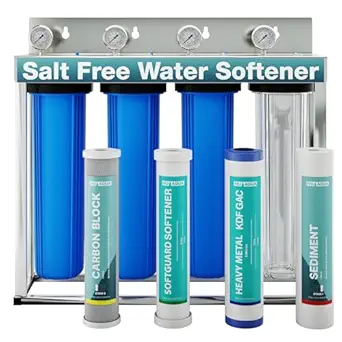 | Best for Hard Water Households | Filtration Stages: 4 (sediment, carbon, scale prevention media, final polish) | Softening Type: Salt-free scale prevention | Heavy Metal Reduction: Lead, mercury, arsenic | VIEW ON AMAZON | See Our Full Breakdown |
| iSpring WGB32B Commercial-Grade Whole House Water Filter System |  | Best Premium Filtration | Filtration Stages: 3 (5-micron sediment + two CTO carbon blocks) | Filter Size: 20″ x 4.5″ | Capacity: 100,000 gallons | VIEW ON AMAZON | See Our Full Breakdown |
| whole house water filter system | Stages | Flow rate | Filter life | Capacity |
|---|---|---|---|---|
| Waterdrop WHF21-PG 2-Stage Who | 2 (PP sediment + GAC carbon) | Up to 15 GPM | 3–6 months (PP), 6 months (GAC) | 50,000 gallons |
| Whole House Water Filter Syste | 3 (PP + GAC + CTO carbon block) | Up to 15 GPM | Approximately 6–8 months per set | — |
| Waterdrop WHF3T-FG 3-Stage Who | 3 (dual iron/manganese removal + carbon fiber) | 15 GPM | 6–12 months (iron/manganese), 12 months (GAC) | — |
| Express Water Whole House Wate | 3-stage plus spin-down sediment pre-filter | — | — | — |
| A. O. Smith Whole House Water | — | 7 GPM | 6 years / 600,000 gallons | — |
| WF3-01 3-Stage Whole House Wat | 3 (sediment, carbon block, GAC+KDF) | — | — | — |
| Express Water Whole House Wate | 3 (sediment, carbon/KDF, polyphosphate) | 17 GPM | 6-12 months | 100,000 gallons |
| VEVOR Whole House Water Filter | 3 (sediment PP, KDF, CTO carbon) | 15 GPM | 6-12 months | 100,000 gallons |
| Culligan Whole House Water Fil | 1 (sediment) | 4 GPM | — | 16,000 gallons |
| iSpring WGB32BM Iron | 3 (5-micron sediment, carbon block, FM25B iron/manganese) | 15 GPM | — | 100,000 gallons |
| Waterdrop WHF3T-PG 3-Stage Who | — | 15 GPM | Up to 12 months (varies with water quality) | — |
| iSpring WGB21B 2-Stage Whole H | — | — | 12 months | 50,000 gallons |
| NU Aqua 4-Stage Salt Free Wate | — | — | — | — |
| iSpring WGB32B Commercial-Grad | — | — | — | 100,000 gallons |
More Details on Our Top Picks
Waterdrop WHF21-PG 2-Stage Whole House Water Filter System, 5 Micron
The Waterdrop WHF21-PG earns its value slot by keeping things simple: a PP sediment filter plus a coconut-shell GAC carbon filter handle chlorine, taste, odor, lead, and rust without the cost and bulk of a third stage. Compared with the three-stage systems in this lineup like the Express Water Ultimate Protection, you give up the extra CTO polishing stage, but you also give up the more frequent cartridge-swapping schedule and the higher housing count. The 1-inch inlet/outlet is generous at this tier, and the housing survived 100,000+ water hammer tests, which matters if your plumbing is prone to pressure spikes. The tradeoff is honest: with a 5-micron rating, this filters coarser contaminants than sub-micron rivals, so it will not catch the finest particulates.
Pros:- Large 1-inch ports support strong whole-house flow without pressure loss
- Coconut-shell carbon improves taste and odor noticeably
- Durable housing rated for 25–90 psi and 100,000+ water hammer tests
- Simple two-cartridge design keeps replacement costs low
Cons:- 5-micron filtration is coarser than sub-micron competitors
- Sediment filter may need changing as often as every 3 months
Best for: Budget-conscious homeowners on municipal water who want basic chlorine and sediment reduction without paying for a third stage
Not ideal for: Households with fine sediment problems or well water — the 5-micron rating and two-stage design leave gaps that a 3-stage system covers better
- Stages:2 (PP sediment + GAC carbon)
- Filter size:10″ x 4.5″
- Flow rate:Up to 15 GPM
- Operating pressure:25–90 psi
- Filter life:3–6 months (PP), 6 months (GAC)
- Capacity:50,000 gallons
- Connection size:1″ inlet/outlet
Our verdict“This pick makes the most sense for city-water households that want affordable chlorine and sediment protection with minimal maintenance overhead.”
Whole House Water Filter System with 9 Filters, 0.5 Micron Filtration, 3-Stage
This unbranded-looking 3-stage system stands out for one practical reason: it ships with three full filter sets — nine cartridges total — which covers roughly 1.5 to 2 years of use before you buy a single replacement. For a first-time buyer, that removes the most common headache of cartridge-based systems, where the hidden cost is the refills. The 0.5-micron CTO carbon block is finer than the Waterdrop WHF21-PG’s 5-micron rating, so it catches what that value pick lets through. The dual valve design lets you swap filters without shutting off the main, and the clear housings mean you judge replacement time by sight rather than memory. The catch: 3/4-inch connections and a 15 GPM ceiling make it better suited to small and medium homes than large households running multiple showers at once.
Pros:- Includes 9 filters for 1.5–2 years of use with no immediate refill purchases
- 0.5-micron filtration is far finer than typical 5-micron entry systems
- Dual valves allow filter changes without shutting off the main supply
- Transparent housings make visual monitoring simple
Cons:- 3/4″ connections are smaller than the 1″ ports on the Waterdrop WHF21-PG
- Less established brand means less certainty about long-term cartridge availability
Best for: First-time buyers in small-to-medium homes who want everything in the box and years of filters before spending again
Not ideal for: Larger households with high simultaneous water demand — the 3/4″ connections and capacity may limit flow
- Stages:3 (PP + GAC + CTO carbon block)
- Included filters:9 cartridges (3 full sets)
- Flow rate:Up to 15 GPM
- Connection size:3/4″ inlet/outlet
- Water sources:Well and municipal
- Filter life:Approximately 6–8 months per set
Our verdict“The right choice if you want a complete 3-stage setup with years of included filters and the finest filtration in the entry tier.”
Waterdrop WHF3T-FG 3-Stage Whole House Water Filter System for Well Water
Where most systems in this roundup treat well water as an afterthought, the Waterdrop WHF3T-FG is built around it. SGS testing shows reduction of 95.9% of iron and 99.7% of manganese — the two contaminants that stain fixtures, discolor laundry, and corrode pipes in well-fed homes. That focus separates it from generalists like the A. O. Smith AO-WH-Filter, which explicitly does not reduce iron or sulfur. The dedicated iron and manganese cartridges last 6–12 months, and the carbon fiber stage handles chlorine and odor for homes that blend sources. The tradeoff is maintenance intensity: compared with A. O. Smith’s six-year set-and-forget tank, this system demands regular cartridge changes, and heavy iron loads can shorten those cycles. NSF/ANSI 372 lead-free certification and the same 100,000+ water hammer testing as the WHF21-PG round out a durable, purpose-built package.
Pros:- SGS-tested reduction of 95.9% iron and 99.7% manganese
- NSF/ANSI 372 lead-free certified components
- Handles both well and municipal sources at 15 GPM
- Durable housing passed 100,000+ water hammer tests
Cons:- Requires periodic cartridge replacement unlike tank-style systems
- Heavy iron contamination can shorten the 6–12 month cartridge life
Best for: Well water owners battling iron and manganese staining, metallic taste, and appliance damage
Not ideal for: City-water households with no iron issues — the dedicated iron cartridges add cost without benefit here
- Stages:3 (dual iron/manganese removal + carbon fiber)
- Iron reduction:95.9% (SGS tested)
- Manganese reduction:99.7% (SGS tested)
- Flow rate:15 GPM
- Certifications:NSF/ANSI 372 lead-free
- Filter life:6–12 months (iron/manganese), 12 months (GAC)
- Water sources:Well and municipal
Our verdict“If your water comes from a well with iron or manganese problems, this is the most directly targeted option in the lineup.”
Express Water Whole House Water Filter System, Ultimate Protection, 3-Stage
What distinguishes the Express Water Ultimate Protection from every other cartridge system here is the spin-down 50-micron pre-filter — a reusable mesh screen that catches sand and grit before it ever reaches the carbon stages. If your supply carries heavy sediment, that first line of defense stretches the life of the downstream cartridges and protects flow rate, something the three-stage VEVOR and generic systems can’t match without adding parts. The pressure gauges on the housings let you watch for clogs instead of guessing, and the 1-inch standard connections match the Waterdrop WHF21-PG for throughput. The compromise is maintenance style: that spin-down filter needs periodic manual flushing, and the quick-change cartridges, while easy, still put you on a replacement cycle that tank-style systems like the A. O. Smith avoid entirely.
Pros:- Reusable 50-micron spin-down pre-filter extends downstream cartridge life
- Built-in pressure gauges reveal clogs before flow suffers
- 1″ standard connections with quick-change cartridges
- Transparent sediment housing for at-a-glance monitoring
Cons:- Spin-down pre-filter adds a manual flushing routine
- Three-stage cartridge system demands more upkeep than tank-style filters
Best for: Homes with sandy, gritty, or high-sediment supply water who want to protect downstream filters and appliances
Not ideal for: Buyers who want zero maintenance — the spin-down pre-filter requires regular manual flushing on top of cartridge changes
- Stages:3-stage plus spin-down sediment pre-filter
- Total capacity:Up to 100,000 gallons
- Connection size:1″ standard
- Monitoring:Pressure gauges and transparent sediment housing
- Wastewater:None
Our verdict“The strongest option when sediment is your main enemy, thanks to a pre-filter stage the other cartridge systems lack.”
A. O. Smith Whole House Water Filter System | 600K Gal | AO-WH-Filter
The A. O. Smith AO-WH-Filter takes the opposite philosophy from every cartridge system in this roundup: instead of three housings you service twice a year, it’s a single sealed tank rated for 6 years or 600,000 gallons. For anyone who dreads crawling to the basement to swap filters, that alone justifies its place. It’s NSF/ANSI 42 certified and reduces 96.9% of chlorine taste and odor — but it’s honest about its limits: no TDS, sulfur, or iron reduction, which puts it behind the Waterdrop WHF3T-FG for well users. The 7 GPM flow rate is also the lowest in this batch; the Waterdrop WHF21-PG doubles it, so large households running simultaneous showers may notice. A. O. Smith recommends adding a pre-filter, which adds cost but protects that six-year investment. Fiberglass construction and a 6-year warranty back the longevity claim.
Pros:- 6-year / 600,000-gallon filter life with no cartridge changes
- NSF/ANSI 42 certified, reduces 96.9% of chlorine taste and odor
- No drainage, backwashing, or wastewater
- 6-year limited warranty from an established brand
Cons:- 7 GPM flow rate is the lowest among comparable systems here
- Requires a separate pre-filter (sold separately) for best performance
Best for: Homeowners of four or more who want chlorine reduction from every tap with essentially no maintenance for six years
Not ideal for: Well water users or high-demand households — no iron or sulfur reduction, and the 7 GPM flow rate limits simultaneous use
- Type:Single sealed tank whole house filter
- Certification:NSF/ANSI 42
- Chlorine reduction:96.9% taste and odor
- Filter life:6 years / 600,000 gallons
- Flow rate:7 GPM
- Operating pressure:20–100 psi
- Connection size:3/4″ inlet/outlet
- Tank material:Fiberglass
Our verdict“The clear pick if maintenance is your dealbreaker — one tank, six years, zero cartridge swaps.”
WF3-01 3-Stage Whole House Water Filtration System
Most three-stage systems leave you guessing when a cartridge is done, and that is exactly the gap this option targets. The built-in 180-day countdown timers and multiple pressure gauges turn filter replacement from guesswork into a scheduled chore, something the VEVOR 3-Stage (with a single gauge) can’t match. Its GAC+KDF stage handles lead, mercury, and arsenic, while the included housing brush and pre-installed relief and drain valves make cartridge changes genuinely cleaner. The tradeoff is size: at 31 inches high and 23 inches wide, it demands more wall or floor space than the compact Culligan single-housing unit, and the shorter 5.5-inch cartridges mean more frequent swaps than big 4.5 x 20-inch systems like the iSpring WGB32BM. Compared with similar tri-stage rigs, this pick makes the most sense for homeowners who want the monitoring tools that keep performance from quietly degrading.
Pros:- Dual pressure gauges reveal clogging stage by stage
- 180-day filter life timers remove replacement guesswork
- Relief and drain valves simplify messy cartridge swaps
- Adapters included for both 3/4-inch and 1-inch NPT plumbing
Cons:- Smaller 5.5-inch cartridges need replacing more often than 20-inch alternatives
- Large footprint requires serious installation space
Best for: Homeowners who forget filter changes and want timers, gauges, and records doing the reminding
Not ideal for: Tight utility closets or small mechanical rooms — the 23-inch-wide footprint is one of the largest here
- Stages:3 (sediment, carbon block, GAC+KDF)
- Filter Size:3 x 20″ x 5.5″
- Targets:Lead, mercury, arsenic, cadmium, chromium, chlorine, VOCs, sediment
- Dimensions:31″ H x 23″ W x 8″ D
- Monitoring:Multiple pressure gauges, 180-day countdown timers
- Fittings:3/4″ or 1″ NPT adapters included
- Install Options:Bracket-mounted or free-standing
Our verdict“Choose this if staying on top of filter maintenance without guesswork matters more than maximum cartridge life.”
Express Water Whole House Water Filter System, Ultimate Protection, 3-Stage
What separates this Express Water rig from the VEVOR and WF3-01 tri-stage systems is its polyphosphate anti-scale stage, which treats hard-water scale before it coats your pipes, water heater, and appliances. That makes it a rare three-in-one play: sediment, heavy metals like lead and arsenic via KDF, and scale inhibition in a single pass. Build quality leans commercial, with a stainless steel bracket and free-stand frame, pressure release buttons on every housing, and a 100,000-gallon capacity rating. The compromises are real, though — it weighs 63 pounds, the heaviest in this batch, and polyphosphate only inhibits scale rather than softening, so genuinely hard water may still need the NU Aqua salt-free system downstream. It also does nothing for TDS, which Express Water itself flags. This model is better suited to buyers whose priority is protecting plumbing infrastructure, not polishing drinking-water taste.
Pros:- Anti-scale polyphosphate stage protects pipes and appliances
- 17 GPM flow rate handles large households easily
- Stainless steel bracket and free-standing frame built for durability
- Pressure release buttons on each housing ease filter changes
Cons:- 63-pound system is heavy to maneuver during installation
- Scale inhibition is not true softening — very hard water still needs extra treatment
Best for: Homeowners with moderately hard water and heavy-metal concerns who want whole-house protection in one purchase
Not ideal for: Buyers chasing better taste or TDS reduction — the scale-focused design does neither
- Stages:3 (sediment, carbon/KDF, polyphosphate)
- Flow Rate:17 GPM
- Capacity:100,000 gallons
- Filter Life:6-12 months
- Connection:1″ NPT
- Operating Pressure:20-80 psi
- Dimensions:29″ L x 8.5″ W x 30″ H
- Weight:63 lb
Our verdict“The pick when scale buildup and heavy metals are your primary enemies and single-pass coverage is the goal.”
VEVOR Whole House Water Filter System, 3-Stage
If the Express Water Ultimate Protection feels like more system than you need, this VEVOR covers the same core ground — sediment, KDF for chlorine and heavy metals, and CTO carbon for taste and odor — at a more accessible level. The real advantage is universal 4.5 x 20-inch big-blue cartridges: unlike proprietary designs, replacement filters are cheap and available from any brand, which keeps long-term costs down the way few competitors can. The painted iron frame offers wall-mount or floor-standing flexibility, and at 48.9 pounds it’s lighter than the Express Water while still moving a healthy 15 GPM. The compromises: a single pressure gauge gives you less diagnostic insight than the WF3-01’s multi-gauge setup, the frame coating is more utilitarian than stainless, and the TDS ceiling of 300 PPM limits it on poorer-quality source water. For a straightforward, budget-conscious whole-house upgrade, this pick makes the most sense.
Pros:- Universal 4.5 x 20″ cartridges work with most brands
- Wall-mount or free-standing iron frame
- 15 GPM flow rate with 1″ NPT connection
- 100,000-gallon capacity rating
Cons:- Single pressure gauge gives limited clogging insight
- Painted iron frame is less corrosion-resistant than stainless alternatives
Best for: Cost-conscious homeowners who want standard big-blue cartridges and low replacement costs
Not ideal for: Very high-sediment or high-TDS source water — the 300 PPM ceiling and single gauge limit its diagnostic range
- Stages:3 (sediment PP, KDF, CTO carbon)
- Flow Rate:15 GPM
- Capacity:100,000 gallons
- Filter Life:6-12 months
- Connection:1″ NPT
- Cartridge Size:4.5″ x 20″ (universal big-blue)
- Dimensions:22.6″ L x 9.8″ W x 31.5″ H
- Weight:48.9 lb
Our verdict“A sensible value play for standard municipal water where cheap, universal replacement cartridges matter most.”
Culligan Whole House Water Filter System, 3/4″ Standard, P5 Filter Included
Not every home needs a three-housing tower, and this Culligan single-stage unit is the honest entry point of the group. It does one job — sediment removal — and does it with rare credibility: the housing is WQA tested and certified against NSF/ANSI standards, a distinction most budget systems here can’t claim. The clear housing lets you see the cartridge dirty in real time, and the valve-in-head bypass plus pressure relief button make swaps a five-minute job without shutting down the house. That said, the limits are structural: a 4 GPM flow rate makes it unsuitable for whole-home simultaneous use in larger houses, and it won’t touch chlorine, heavy metals, or taste the way the VEVOR or Express Water systems do. Compared with everything else in this lineup, this option stands out as the low-commitment first step rather than the destination.
Pros:- WQA-certified to NSF/ANSI 372, 61, and CSA B483.1
- Clear housing makes cartridge condition visible at a glance
- Valve-in-head bypass simplifies cartridge changes
- Compact 3-pound housing fits almost anywhere
Cons:- 4 GPM flow rate restricts simultaneous whole-house use
- Sediment only — no chlorine, metal, or taste treatment
Best for: Small homes, cabins, or first-time buyers who mainly need sediment and rust protection
Not ideal for: Larger households or anyone needing chemical and heavy-metal reduction — the flow rate and single stage won’t keep up
- Stages:1 (sediment)
- Flow Rate:4 GPM
- Capacity:16,000 gallons
- Connection:3/4″ inlet/outlet
- Compatible Cartridges:P5, CW-F, CW-MF, S1A-D
- Operating Pressure:30-100 psi
- Dimensions:6.57″ L x 6.18″ W x 15.94″ H
- Certification:WQA tested to NSF/ANSI 372, NSF/ANSI 61, CSA B483.1
Our verdict“A certified, low-effort starting point for sediment problems — plan to upgrade if your water needs go beyond dirt and rust.”
iSpring WGB32BM Iron, Manganese Whole House Water Filter System
Well water brings problems municipal systems rarely see, and this iSpring is the only pick in this batch engineered specifically for them. Its third-stage FM25B catalytic media targets up to 3.0 ppm iron and 1.0 ppm manganese — the orange stains and metallic taste that ruin fixtures and laundry — while lasting up to three times longer than greensand because the media isn’t consumed. Sitting ahead of it are a 5-micron sediment filter and coconut-shell carbon block, both third-party tested to NSF/ANSI standards, giving a 100,000-gallon capacity for a family of four. Compared with the Waterdrop WHF3T-FG well-water system, the iSpring’s dedicated iron stage and lifetime US-based tech support give it an edge for tough wells. The honest tradeoffs: it does nothing for TDS or hardness, so heavily mineralized wells may still want the NU Aqua salt-free system downstream, and DIY installation on a 1-inch main line is a bigger plumbing job than the Culligan’s simple splice-in.
Pros:- Dedicated iron/manganese stage rated to 3.0 ppm and 1.0 ppm
- Catalytic media lasts up to 3x longer than greensand
- Filters independently tested to meet NSF/ANSI standards
- Lifetime free US-based tech support with 1-year warranty
Cons:- No effect on hardness or TDS — very mineralized wells need additional treatment
- Main-line 1″ installation is a more involved DIY project
Best for: Well-water owners battling iron staining, manganese, and metallic taste across the whole house
Not ideal for: City-water households — the iron-specific stage is wasted capacity if your supply is already treated
- Stages:3 (5-micron sediment, carbon block, FM25B iron/manganese)
- Iron Removal:Up to 3.0 ppm
- Manganese Removal:Up to 1.0 ppm
- Flow Rate:15 GPM
- Capacity:100,000 gallons
- Connection:1″ NPT
- Cartridge Size:20″ x 4.5″
- Certifications:Third-party tested to NSF/ANSI standards
Our verdict“The clear choice for well owners whose water problems start with iron, and overkill for nearly everyone else.”
Waterdrop WHF3T-PG 3-Stage Whole House Water Filter System, 5 Micron
This option stands out for one specific strength: dual chlorine removal through a KDF composite filter paired with a carbon fiber-wrapped GAC filter, reaching a 97.72% chlorine reduction rate. Compared with the iSpring WGB21B, which relies on a single CTO carbon stage, this Waterdrop takes a more aggressive approach to taste and odor, making it the stronger pick where municipal chlorine is the dominant complaint. The NSF/ANSI 372 lead-free certification and housing that passed 100,000+ water hammer tests add durability confidence that cheaper housings lack.
The tradeoff is that the seven-stage filtration language mostly describes particles down to 5 microns — it does not tackle heavy metals or hardness the way the NU Aqua 4-Stage does. Filter life is quoted at 12 months but varies heavily with source water quality, so replacement costs can climb on sediment-heavy supplies.
Pros:- 97.72% chlorine reduction from dual KDF plus GAC carbon filtration
- NSF/ANSI 372 certified lead-free materials
- Housing tested against 100,000+ water hammer cycles for durability
- 15 GPM steady flow rate supports whole-home demand
Cons:- Filter lifespan shortens considerably on sediment-heavy or poor-quality source water
- No heavy metal or hardness reduction despite the multi-stage framing
- Three housings mean three cartridges to replace, raising ongoing costs versus two-stage rivals
Best for: Homeowners on municipal water whose main frustration is chlorine taste and smell at every tap
Not ideal for: Well water users or anyone dealing with iron, manganese, or hardness — this system is not built for those problems
- Filtration Stages:3
- Chlorine Reduction:97.72%
- Filter Life:Up to 12 months (varies with water quality)
- Flow Rate:15 GPM
- Certification:NSF/ANSI 372 (lead-free materials)
- Water Sources:Municipal and well water
Our verdict“This system makes the most sense for city-water households prioritizing chlorine and odor removal above all else.”
iSpring WGB21B 2-Stage Whole House Water Filtration System, 50,000 Gallons
For buyers who want dependable whole-house filtration without paying for stages they don’t need, this two-stage iSpring is the smartest value in the lineup. A 5-micron sediment filter plus a CTO carbon block removes over 90% of chlorine, sediment, rust, VOCs, and odors — most of what the Waterdrop WHF3T-PG targets, with one fewer housing to maintain. The 50,000-gallon capacity roughly translates to a full year for a family of four, and the pre-assembled bracket, included filter wrench, and pressure release valve make DIY swaps genuinely painless.
The honest tradeoff: 10-inch filters clog faster than the 20-inch cartridges in the iSpring WGB32B when flow demands are high, and it does nothing for TDS, hardness, or heavy metals. It also needs a real chunk of wall space at the main supply line. Still, for straightforward municipal water problems, this model covers the essentials at a lower total cost of ownership than most three-stage rivals.
Pros:- Removes over 90% of chlorine, sediment, rust, and VOCs in a simple two-stage design
- Up to 50,000 gallons or 12 months of filter life for a family of four
- Pre-assembled with filter wrench and pressure release valve for easy DIY maintenance
- Retains healthy minerals and needs no electricity
Cons:- 10-inch filters require more frequent replacement than 20-inch systems under heavy use
- Does not reduce TDS, hardness, or dissolved heavy metals
- Bulky footprint requires dedicated installation space at the main supply
Best for: Budget-conscious families of four on municipal water who want chlorine, sediment, and VOC reduction with minimal fuss
Not ideal for: Large households with simultaneous high water demand, or buyers needing heavy metal or hardness treatment
- Filtration Stages:2
- Filter Size:10″ x 4.5″
- Capacity:50,000 gallons
- Filter Life:12 months
- Max Flow Rate:15 gpm
- Inlet/Outlet Size:1 inch
- Dimensions:26″L x 19″W x 11″H
- Warranty:1-year (extendable); 30-day money-back guarantee
Our verdict“This pick makes the most sense for buyers who want proven chlorine and sediment filtration at the lowest sensible long-term cost.”
NU Aqua 4-Stage Salt Free Water Softener Whole House Water Filter System
This is the only system in this batch that addresses hard water scale buildup, and that alone justifies its place. Using salt-free scale prevention media, it conditions water without electricity, backflushing, or brine discharge — a genuine advantage over traditional softeners for buyers who don’t want to haul salt bags. Unlike the iSpring WGB21B or Waterdrop WHF3T-PG, which purely filter, this NU Aqua combines sediment and carbon stages with heavy metal reduction (lead, mercury, arsenic) plus scale control, protecting plumbing and appliances in a way standard filters can’t.
Buyers should understand the tradeoff: salt-free systems prevent new scale rather than removing existing hardness, so expectations need to be set correctly — water will still test as hard. Chlorine and VOC performance also won’t match the dedicated dual-carbon design of the Waterdrop. It’s a four-stage system, so cartridge and media costs run higher than two-stage alternatives.
Pros:- Salt-free scale prevention with no electricity, backflushing, or brine discharge
- Reduces heavy metals including lead, mercury, and arsenic
- Combines softening media with sediment and carbon filtration in one point-of-entry unit
- Preserves beneficial calcium and magnesium minerals
Cons:- Conditions rather than softens — water still registers as hard on a test
- Four stages mean higher replacement costs than two- or three-stage rivals
- Chlorine and taste/odor performance trails dedicated dual-carbon systems like the Waterdrop WHF3T-PG
Best for: Homeowners battling scale buildup on fixtures and appliances who want softening benefits without salt, electricity, or brine tanks
Not ideal for: Buyers who need true soft water (zero hardness grains) or whose only concern is chlorine taste — a dedicated carbon system costs less
- Filtration Stages:4 (sediment, carbon, scale prevention media, final polish)
- Softening Type:Salt-free scale prevention
- Heavy Metal Reduction:Lead, mercury, arsenic
- Also Reduces:Chlorine, VOCs, odor, sediment
- Installation:Point-of-entry, whole home
- Power Required:None
- Maintenance:No salt, no backflushing, no brine discharge
Our verdict“This model is better suited to scale-plagued households wanting salt-free protection and filtration in a single system than to buyers chasing pure filtration performance.”
iSpring WGB32B Commercial-Grade Whole House Water Filter System
When filtration capacity matters most, this three-stage iSpring is the heavyweight of the batch. Its 20-inch x 4.5-inch big-blue housings hold a 5-micron sediment filter followed by two coconut-shell carbon block stages, pushing chlorine removal up to 99% — beyond what the 90% figure of its smaller sibling, the WGB21B, can manage. The 100,000-gallon capacity doubles the WGB21B’s rating, and larger cartridges mean slower clogging and less frequent changes, which matters for big households or light commercial use.
The dual carbon stages attack herbicides, tastes, and odors more thoroughly than single-carbon designs like the Waterdrop WHF3T-PG, though neither handles TDS or hardness — iSpring itself points RO-curious buyers elsewhere. The downsides are real: this is a physically large, heavy unit that demands serious installation space, and the three oversized cartridges make each replacement cycle the most expensive in this group.
Pros:- Up to 99% chlorine reduction from dual coconut-shell carbon block stages
- 100,000-gallon capacity — roughly a year of whole-home water
- 20-inch big-blue filters resist clogging under high flow demand (up to 15 GPM)
- Lifelong tech support and extendable warranty after registration
Cons:- Very large and heavy — requires substantial wall space at the main supply
- Three oversized cartridges make replacements the priciest in this lineup
- No TDS, hardness, or heavy-metal-specific treatment
Best for: Large households or small commercial properties wanting maximum chlorine and chemical reduction with the longest filter intervals
Not ideal for: Tight installation spaces or budget-focused buyers — the size and three big-blue cartridge costs add up quickly
- Filtration Stages:3 (5-micron sediment + two CTO carbon blocks)
- Filter Size:20″ x 4.5″
- Capacity:100,000 gallons
- Chlorine Reduction:Up to 99%
- Max Flow Rate:15 GPM
- Inlet/Outlet:1″ NPT
- Carbon Type:Coconut shell carbon block, third-party tested to NSF/ANSI standards
- Warranty:Extendable with online registration; lifelong tech support
Our verdict“This pick makes the most sense for buyers who want maximum-capacity, commercial-grade filtration and have the space and budget to support it.”

How We Picked
I evaluated each system against the factors that actually determine long-term satisfaction with a whole house water filter system: filtration performance (stages, micron rating, and contaminant specificity), flow rate and whether it can supply multiple bathrooms without pressure drops, housing and fitting build quality, filter capacity and replacement cost, and installation complexity. Because a system that filters well but costs a fortune to maintain is a bad buy, I weighed ongoing ownership costs alongside initial quality. I also separated products by intended water source, since a well water system solving iron and manganese is a fundamentally different product than a city water chlorine and sediment filter.
The ranking logic favors versatility first: systems that handle a broad contaminant range across multiple water conditions placed highest, led by the Waterdrop WHF3T-FG. Specialized systems like the iSpring WGB32BM and NU Aqua earned their positions on contaminant-specific excellence rather than all-around performance. Simple, affordable single-stage units rank lower not because they are poorly made, but because they solve narrower problems — a fair warning for buyers who might overbuy or underbuy relative to what their water actually contains.
Factors to Consider When Choosing Whole House Water Filter Systems
Before settling on a system from the lineup above, it pays to understand the broader landscape of whole house filtration — including the mistakes that send buyers back to the store within a year.Test Your Water Before You Buy Anything
The single most common mistake in this category is buying a filter before knowing what needs filtering. A municipal water report tells you about chlorine, chloramine, and disinfection byproducts, while a well water test — which you should order from an accredited lab, not a strip kit — reveals iron, manganese, hardness, bacteria, and pH. This matters because the right pick in the lineup above changes completely based on results: heavy iron points toward the iSpring WGB32BM, scale problems toward the NU Aqua, and simple chlorine taste toward almost any carbon-based two-stage system. Buyers who skip testing frequently overbuy a complex three-stage rack for a chlorine-only problem, or worse, underbuy and keep seeing rust stains. A sixty-dollar water test is the highest-leverage purchase in this entire process.
Stage Count vs. What Each Stage Actually Does
Marketing has trained buyers to equate more stages with better filtration, but a stage is only as good as the media inside it. A well-designed two-stage system pairing a sediment prefilter with a carbon block often outperforms a three-stage system with redundant cartridges. The real function of multiple stages is sequential protection: a cheap sediment filter upfront extends the life of expensive carbon or specialty media downstream. If your water has one dominant contaminant, one well-chigned specialty cartridge beats three generic ones. The three-stage systems in this lineup justify their design through genuinely different media per housing — that is the pattern worth paying for, not the number itself.
Flow Rate and Household Size
A whole house system sits on the main line, so every shower, faucet, and appliance draws through it at once. If the system’s rated flow rate is below your household’s peak demand — think two showers plus a dishwasher running simultaneously — you will notice pressure drops that no plumber can fix. A practical rule is 15 gallons per minute minimum for a household with three or more bathrooms, and more if you have high-flow fixtures. Larger 4.5-inch big blue housings like the iSpring and VEVOR systems maintain pressure better than compact housings because water passes through more media area with less resistance. Undersizing here is a mistake that only shows up after installation, when returning a plumbed-in system is no longer simple.
Cartridge Size, Capacity, and the Real Cost of Ownership
The purchase price of the housing is a fraction of what you will spend on filters over five years, and cartridge economics vary enormously across this category. Larger cartridges cost more per unit but hold more media, filter more gallons, and resist clogging, which usually wins on cost per gallon. Slim systems with inexpensive cartridges can quietly cost more over time despite the attractive upfront price. Check the rated gallon capacity against your household usage: a family of four using roughly 300 gallons a day will drain a 50,000-gallon system in under six months, not the year the marketing implies. Also confirm cartridge availability — a system whose replacement filters are hard to source becomes a liability the day you need a change.
Installation Reality: DIY vs. Calling a Plumber
Most systems in this roundup are marketed as DIY-friendly, but the honest picture depends on your plumbing. If your main line is accessible PEX or copper with room to spare, a kit with a bracket, wrench, and fittings can be an afternoon project. Older homes with galvanized pipe, tight crawlspaces, or no existing shutoff bypass will need a plumber, which adds real cost you should budget upfront. A bypass valve is the feature most often overlooked by first-time buyers — it lets you swap filters or service the housing without shutting off water to the entire house. Systems missing a bypass deserve a discount in your mental math, because retrofitting one is an extra plumbing job.
Know the Limits: What These Systems Do Not Do
Whole house filters excel at sediment, chlorine, taste, odor, and — with specialty media — heavy metals and iron. What most of them cannot do is soften water, kill bacteria, or remove dissolved minerals causing scale. The NU Aqua salt-free system partially bridges that gap but works differently from a true softener, and buyers with severe hardness may still need a dedicated unit. Bacteria and viruses require UV sterilization, which is a separate add-on no cartridge in this lineup replaces. The mistake to avoid is expecting one product to solve every water problem; the strongest setups pair a whole house filter for general treatment with a point-of-use drinking filter for final polish.
Frequently Asked Questions
Do I need a 2-stage, 3-stage, or 4-stage system for my home?
The right stage count depends on your water problem, not ambition. If a water test shows only sediment and chlorine taste from municipal supply, a quality 2-stage system like the iSpring WGB21B or Waterdrop WHF21-PG handles it cleanly and saves you money on replacement cartridges. Three-stage systems earn their keep when you add a third problem — well water iron, heavy metals, or fine sediment below 5 microns — because each housing can carry different media. Four-stage setups like the NU Aqua make sense when scale control joins the list. Buying more stages than your water requires just means buying and changing more cartridges for contaminants you do not have.
Can a whole house filter system replace a water softener?
No, and this trips up a lot of buyers. Filtration physically captures or adsorbs contaminants, while softening chemically exchanges calcium and magnesium — the minerals causing hardness, scale buildup, and soap scum. Standard carbon and sediment cartridges in this lineup do nothing to hardness. The closest hybrid is the NU Aqua 4-stage salt-free system, which conditions water to reduce scale without salt or electricity, but salt-free conditioning performs differently from true ion-exchange softening and will not deliver the same slippery feel or complete scale prevention in very hard water. If your test shows hardness above about 10 grains per gallon, plan on a dedicated softener alongside your filter rather than expecting one box to do both jobs.
How often do I actually need to replace the filters?
Sediment prefilters are the workhorse and typically need replacement every 3 to 6 months, sooner on well water with heavy particulate load. Carbon cartridges last 6 to 12 months depending on chlorine levels and water volume, while specialty media for iron and manganese usually runs 6 to 12 months before performance drops. Rated capacities like 50,000 or 100,000 gallons are ceilings, not schedules — a household of four often reaches them months before the calendar suggests. The practical approach is to watch for the telltale signs: dropping water pressure signals a clogged sediment filter, and returning chlorine taste or odor means the carbon is exhausted. Systems with clear housings or pressure gauges make this monitoring far easier than opaque steel housings.
Will a whole house system reduce my water pressure?
Every filter adds some resistance, but a properly sized system keeps the drop imperceptible — typically under 5 to 10 psi at normal flow. Problems arise from undersizing: a system rated at 8 gallons per minute feeding a house where two showers and a washing machine run simultaneously will produce noticeable pressure drops. Larger big blue housings with 4.5-inch by 20-inch cartridges resist clogging longer and maintain flow better over the filter’s life, which is why systems like the iSpring WGB32B and VEVOR suit larger homes. If your home already starts with marginal incoming pressure, measure it before buying and choose a system with headroom, or plan to install a pressure booster downstream. A clogged filter is also the most common cause of sudden pressure loss, so declining flow usually means a cartridge change, not a broken system.
Is a whole house filter worth it if I already have a drinking water filter?
The two solve different problems, and most homes benefit from both. A point-of-use drinking filter gives you purified water at one tap but does nothing about the chlorine your skin absorbs in the shower, the sediment wearing on appliance valves, or rust staining in toilets and laundry. Whole house treatment protects the entire plumbing infrastructure — water heaters, dishwashers, washing machines — which is where much of its financial value comes from in extended appliance life. That said, if your water test shows only minor chlorine taste and your appliances are already aging gracefully, starting with just the drinking filter is a reasonable budget move. Think of the whole house system as the foundation and the drinking filter as the final polish; one does not replace the other.
Conclusion
The right choice here depends almost entirely on your water source and how much maintenance you will tolerate. For best overall, the Waterdrop WHF3T-FG 3-Stage hits the sweet spot of broad contaminant coverage, solid build, and reasonable upkeep for most homes. Best value goes to the iSpring WGB21B 2-Stage, which delivers big blue capacity and reliable carbon filtration at a price that leaves room in the budget for years of cartridges. If you want the best premium, lowest-hassle option, the A. O. Smith 600K-gallon system and the iSpring WGB32B commercial-grade rack reward buyers who would rather pay once than fiddle with filters every season.
Beginners with a simple sediment or chlorine problem should start with the Culligan P5 — inexpensive, forgiving, and a low-commitment way to learn the maintenance routine. For specific needs: well water owners battling rust stains should go straight to the iSpring WGB32BM for iron and manganese, scale-plagued homes should look at the NU Aqua 4-stage salt-free system, and buyers chasing maximum clarity on fine sediment should compare the 0.5-micron 3-stage system against the Waterdrop WHF3T-PG. Whatever you pick, get your water tested first — it is the one step that guarantees you buy the right system the first time.
Halloween Picks
halloween
As an affiliate, we earn on qualifying purchases.