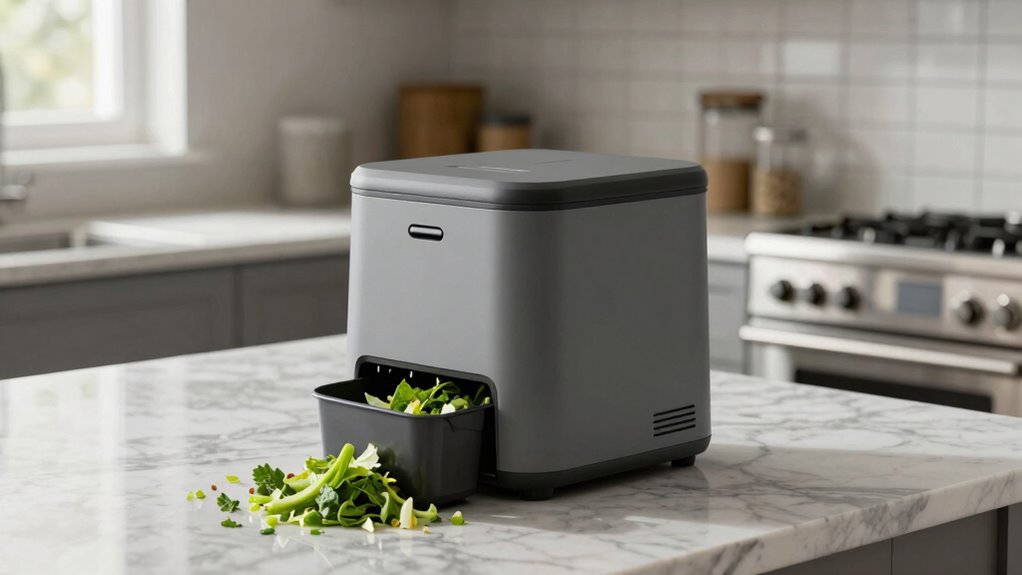

Searching for countertop composter claims means sorting out a basic choice: a passive bin for collecting scraps or an electric unit that processes them on your counter. My best overall pick is the Growell 3.2L Electric Composter, a balanced-size electric option, while the Utopia Kitchen 1.3-gallon bin is a straightforward choice for buyers who want a simple stainless-steel caddy. The 4L Electric Composter is another standout for households prioritizing more capacity in an electric format. The main tradeoffs are countertop space, how much processing you want the appliance to do, and the cleaning and filter upkeep that come with odor control. Read on for the full breakdown of how the ten options differ and which type best suits your kitchen.
Complete the kit


Key Takeaways
- The lineup divides into two distinct jobs: five electric models process food waste, while the 1.3-gallon, 1-gallon, and 1.3-gallon passive caddies mainly collect scraps for later disposal or composting.
- The Growell 3.2L is the balanced electric pick: its listed capacity sits between the smaller 2.5L Airthereal R500-V and larger 4L and 5.5L models.
- The largest capacity is not automatically the best fit: the OK-255’s 5.5L format may suit heavier scrap loads, but it asks for more counter space than compact electric options.
- Simple bins bring fewer appliance demands: the Utopia Kitchen and Perfnique caddies avoid electric processing, while the AIRNEX adds a collapsible design and includes bags and carbon filters.
- Electric features can add care as well as convenience: carbon filtration, auto-clean claims, and smart controls should be weighed against routine cleaning, filter replacement, and available counter space.
- Because the product list provides limited comparable performance and material details, I rank by stated format, capacity, and listed features rather than assuming unverified processing speed or odor performance.


| countertop composter claim | Capacity | Color | Dimensions | Shape |
|---|---|---|---|---|
| 1.3 Gallon Kitchen Countertop | 1.3 gallons | Silver | 7.3 inches diameter x 11 inches height | Round |
| AIRNEX Collapsible Compost Bin | 1 gallon | Gray | 8.27 x 8.27 x 7.68 inches | Square |
| Growell 3.2L Electric Composte | 3.2 L | — | — | — |
| Utopia Kitchen Countertop Comp | 1.3 gallons | Silver | 8.4 x 7 x 11 inches | Cylindrical |
| 4L Electric Composter for Kitc | 4 L | — | — | — |
| Airthereal R500-V Electric Com | 2.5 liters | Gray | 12.5 × 10 × 12.5 inches | Rectangular |
| Perfnique 1.3 Gal Kitchen Comp | 1.3 gallons | Cream beige | — | — |
| Electric Composter 3L Kitchen | 3L | — | — | — |
| OK-255 Electric Composter for | 5.5L | — | — | — |
| 3L Compact Electric Composter | 3 liters | Beige | 16.54 × 8.27 × 13.39 inches | Rectangular |
More Details on Our Top Picks
1.3 Gallon Kitchen Countertop Compost Bin
The Veinvify makes the most sense for kitchens that need a simple, space-conscious scrap collector, not an appliance that processes waste. Its 1.3-gallon stainless-steel body is the same listed capacity as the Utopia Kitchen bin, but the 7.3-inch diameter gives a clear footprint reference for a counter where width matters. The airtight lid and replaceable charcoal filter are designed to contain odors, while the seamless, leak-proof construction should make routine rinsing easier than managing a more elaborate electric unit such as the Growell.
The tradeoff is capacity: households cooking often may need to empty it frequently, and the filter is a recurring maintenance item. Unlike the Growell, it does not dry or grind scraps; it simply stores them until the next trip to an outdoor compost setup.
Pros:- Compact 7.3-inch diameter helps limit counter footprint
- Airtight lid and replaceable charcoal filter target odor control
- Seamless stainless-steel construction is described as leak-proof and rust-resistant
- Straightforward container design is easy to clean and maintain
Cons:- 1.3-gallon capacity can mean frequent emptying for regular cooking
- Activated charcoal filter requires periodic replacement
Best for: Apartment cooks who want a compact stainless-steel container for collecting scraps between trips to an outdoor compost bin.
Not ideal for: Larger households or anyone seeking an appliance that dries and reduces food scraps rather than storing them.
- Capacity:1.3 gallons
- Dimensions:7.3 inches diameter x 11 inches height
- Material:Stainless steel
- Color:Silver
- Shape:Round
- Brand:Veinvify
- Model number:Vein-Compost001-US
Our verdict“Choose the Veinvify if you want a small, durable passive bin; choose the Growell instead if you want scraps processed on the counter.”
AIRNEX Collapsible Compost Bin Kitchen Counter Caddy – 1 Gallon Wheat Straw Odorless Food Waste Container with Lid, 20 Compost Bags, 2 Carbon Filters
The AIRNEX is the most ready-to-use option among the passive bins here: it includes 20 compost bags and two carbon filters, so a new scrap-collection routine starts with fewer separate purchases. Its 1-gallon capacity is smaller than the Veinvify and Utopia Kitchen 1.3-gallon bins, making it better suited to modest daily scraps than batch cooking or a busy family kitchen. The tight-seal lid and dual filters are intended to trap odors, while the square, lightweight body fits neatly on a counter.
Wheat straw gives this caddy a different feel from the steel alternatives, but the supplied information does not establish dishwasher safety, and the material may feel less robust than metal. It is still only a storage bin: unlike the electric Ouaken, it does not process scraps, and its smaller capacity may mean more frequent emptying.
Pros:- Includes 20 compost bags and two carbon filters
- Tight-seal lid and dual filters are designed to contain odors
- Lightweight 1.2-pound construction is easy to move
- Square footprint suits compact counter spaces
Cons:- One-gallon capacity may require frequent emptying
- Wheat straw may feel less sturdy than the stainless-steel Veinvify or Utopia Kitchen bins
- Dishwasher safety is not specified
Best for: First-time composters in small households who want a lightweight counter caddy with bags and replacement filters included.
Not ideal for: Frequent cooks who need more than a gallon of holding capacity, or buyers who prefer the sturdier feel and easy-care profile of stainless steel.
- Capacity:1 gallon
- Dimensions:8.27 x 8.27 x 7.68 inches
- Weight:1.2 pounds
- Material:Wheat straw
- Color:Gray
- Shape:Square
- Included supplies:20 compost bags and 2 carbon filters
Our verdict“Pick the AIRNEX for an all-in-one starter caddy for light daily scraps, but choose a larger steel bin if capacity and sturdiness matter more.”
Growell 3.2L Electric Composter, Countertop Food Waste Indoor Compost Bin
Growell earns its place for buyers who want more control over countertop processing: its AUTO and Manual modes let users choose a preset cycle or set a run from one to ten hours. The appliance grinds, dries, and cools scraps, so it serves a different purpose from the Veinvify and Utopia Kitchen bins, which only hold waste for later disposal. Its 3.2-liter capacity is compact enough for indoor kitchens, though it is not a high-volume answer for a large household.
The listed cycle can take up to eight hours on AUTO, and processing time may vary with food moisture. At 50 decibels, it is described as low-noise, but it is not silent; the Ouaken claims a lower operating level and a three-hour cycle. Growell’s three-year warranty is a useful ownership detail, while its filter replacement schedule adds ongoing maintenance.
Pros:- AUTO and Manual modes provide more cycle control than a basic scrap bin
- Grinding, drying, and cooling process scraps on the counter
- Compact design is intended for apartments, dorms, and small spaces
- Three-year warranty is specified
Cons:- AUTO processing can take up to eight hours
- 3.2-liter capacity may be limiting for larger households
- Filter replacement is required every 300 hours of use
Best for: Apartment and dorm residents who want adjustable countertop processing and can manage smaller batches over longer cycles.
Not ideal for: Large households needing high daily throughput, or buyers who prioritize the faster, quieter claims listed for the Ouaken.
- Capacity:3.2 L
- Modes:AUTO and Manual
- AUTO processing time:Up to 8 hours
- Manual processing time:1–10 hours
- Noise level:50 decibels
- Motor:Brushless
- Warranty:3 years
- Filter replacement interval:Every 300 hours of use
Our verdict“Choose Growell if adjustable modes and a stated three-year warranty matter more than the Ouaken’s faster cycle and lower listed noise level.”
Utopia Kitchen Countertop Compost Bin 1.3 Gallon, Stainless Steel, Silver
The Utopia Kitchen is a straightforward pick for buyers who want a traditional stainless-steel countertop bin with charcoal filtration and no electronic parts. Its 1.3-gallon capacity matches the Veinvify, so both hold more than the one-gallon AIRNEX; the main distinction is the Utopia’s stated 8.4 x 7 x 11-inch footprint and 2-pound weight. The steel construction is described as resistant to scratches and chipping, making it a sensible fit for a kitchen where the bin stays visible and gets handled daily.
This is still a passive collector, not a processor: unlike Growell or Ouaken, it does not dry or reduce scraps. Charcoal filters need replacement, and regular cleaning is needed to prevent odors. The product details do not specify a seamless body or leak-proof construction as they do for the Veinvify, so buyers who value those explicit claims may prefer that alternative.
Pros:- Stainless-steel body offers a durable, classic countertop appearance
- Charcoal filters are included as the odor-control approach
- 1.3-gallon capacity exceeds the AIRNEX’s one-gallon capacity
- Compact dimensions suit countertop use
Cons:- Capacity may require frequent emptying in a busy kitchen
- Regular cleaning is needed to prevent odors
- Charcoal filters need replacement over time
Best for: Home cooks who want a visible, durable-looking steel container for collecting scraps and prefer a simple bin over an electric appliance.
Not ideal for: Buyers who want electric processing, a specified leak-proof seamless build, or a bin with more capacity than 1.3 gallons.
- Capacity:1.3 gallons
- Dimensions:8.4 x 7 x 11 inches
- Weight:2 pounds
- Material:Stainless steel
- Color:Silver
- Shape:Cylindrical
- Odor control:Charcoal filters
Our verdict“Choose the Utopia Kitchen for a simple steel scrap bin, while the Veinvify is the clearer pick if explicit leak-proof construction is your priority.”
4L Electric Composter for Kitchen, Smart Countertop Compost Bin
The Ouaken is the strongest fit here for buyers who value a short cycle and quiet operation: it claims to process scraps in as little as three hours while running below 40 dB(A). Its 4-liter capacity is larger than the Growell’s 3.2 liters, though still a modest batch size for a large household. Touch controls offer crush, ferment, and auto-clean modes, and the detachable bucket is dishwasher-safe—practical details that distinguish it from both the Growell and the passive steel bins.
The product description says the process can reduce food waste by up to 90% and calls the output nutrient-rich fertilizer; those are product claims, not a guarantee that the result replaces finished garden compost. The carbon filter is listed for up to five months, but the 4-liter chamber may still fill quickly during heavy cooking. Compared with the Growell, Ouaken favors speed and lower listed noise over a stated three-year warranty and manual cycle range.
Pros:- Claims processing in as little as three hours
- Listed noise level is below 40 dB(A)
- Detachable bucket is dishwasher-safe and includes an auto-clean mode
- Carbon filter is specified to last up to five months
Cons:- Four-liter capacity may require frequent emptying in larger households
- Up-to-90% waste reduction and fertilizer descriptions are product claims, not a stated guarantee of finished compost
- The supplied details do not list a warranty
Best for: Small households seeking a countertop electric processor with a short claimed cycle, quiet operation, and a dishwasher-safe removable bucket.
Not ideal for: Large families generating substantial daily scraps, or buyers who want a simple passive bin without an appliance or processing-cycle claims.
- Brand:Ouaken
- Capacity:4 L
- Model number:JF6001A
- Noise level:<40 dB(A)
- Carbon filter life:Up to 5 months
- Processing time claim:As little as 3 hours
- Modes:Crush, ferment, and auto-clean
- Removable bucket:Dishwasher-safe
Our verdict“Choose the Ouaken if you want the roundup’s clearest speed and quiet-operation claims, but look to Growell for a stated warranty and more explicit manual timing controls.”
Airthereal R500-V Electric Composter, 2.5L, Gray
The Airthereal R500-V stands apart from the more enclosed electric options here by giving you a transparent glass cover to watch the cycle. Its scraps are reduced to powder in a stated 2–5 hours, with volume reduction of up to 90%, while the serrated tri-blades handle grinding. That makes it a good fit if you want a visible process rather than the OK-255’s larger 5.5L capacity or the 3L models’ extra room. The tradeoff is its 2.5L capacity, which can mean more frequent batches for a busy household. Odor control relies on biodegradable carbon filters, so I would not treat “minimize odors” as a promise of an entirely odor-free kitchen. Its one-button operation and three-year warranty add practical reassurance, but it still needs electricity.
Pros:- Transparent glass cover makes the processing cycle visible.
- Stated 2–5-hour processing time and up to 90% waste-volume reduction.
- Tri-blade design is intended to grind scraps efficiently.
- One-button operation and a three-year warranty.
Cons:- At 2.5L, capacity is smaller than the 3L countertop electric models and the 5.5L OK-255.
- Biodegradable filter odor control does not guarantee an odor-free room.
- Requires electricity, unlike a passive countertop caddy.
Best for: People who want to monitor a countertop composter’s cycle and typically collect modest amounts of food scraps.
Not ideal for: Larger households that need fewer, bigger batches, or buyers who want a non-electric bin or guaranteed odor-free operation.
- Capacity:2.5 liters
- Dimensions:12.5 × 10 × 12.5 inches
- Color:Gray
- Shape:Rectangular
- Cover:Transparent glass
- Blades:Upgraded SHARKSDEN tri-blade
- Warranty:3 years
Our verdict“Choose the R500-V if seeing the process and having a simple control matter more than capacity or fully passive operation.”
Perfnique 1.3 Gal Kitchen Compost Bin with Lid, Countertop Compost Caddy
The Perfnique 1.3-gallon caddy is the straightforward, non-electric choice in this group: it holds scraps for later composting rather than processing them on the counter. Its metal outer bucket gives it a farmhouse look, while a removable plastic inner pail makes carrying and cleaning easier than dealing with scraps in a fixed container. Compared with the Airthereal R500-V or the OK-255, it avoids powered cycles and blade mechanisms, but it also does not reduce waste volume or turn scraps into powder. The lid’s carbon filters are intended to control odors, and the listed filter lifespan is 4–6 months; they still need replacement. At 1.3 gallons, it offers more holding capacity than the electric models listed by liter, though it can fill quickly in a larger household. It is not dishwasher safe.
Pros:- 1.3-gallon capacity for collecting scraps between trips to a composting destination.
- Removable plastic inner pail with a handle helps with carrying and washing.
- Metal outer bucket is described as rust-resistant.
- Includes two carbon filters for lid-based odor control.
Cons:- Stores scraps rather than processing or reducing their volume.
- Not dishwasher safe, so cleaning requires hand washing.
- Filters need replacement every 4–6 months, and capacity may be limiting for larger households.
Best for: Households that want a farmhouse-style counter bin to collect fruit and vegetable scraps before taking them to an outdoor compost pile or municipal program.
Not ideal for: Buyers who expect countertop processing, reduced scrap volume, or dishwasher-safe cleanup.
- Capacity:1.3 gallons
- Inner pail:Plastic with handle
- Outer bucket:Metal
- Color:Cream beige
- Included filters:2 carbon filters
- Filter lifespan:4–6 months
- Dishwasher safe:No
Our verdict“Pick the Perfnique if you want a decorative, electricity-free collection bin and already have a plan for composting scraps elsewhere.”
Electric Composter 3L Kitchen Compost Bin with Odorless Carbon Filter and Auto Clean
This 3L electric composter is aimed at buyers who want an automated routine without the larger footprint of the OK-255. Its stated under-40dB noise level, automatic operation and storage mode make it a practical fit for kitchens where a loud cycle would be unwelcome or scraps need to wait before processing. The product claims to turn waste into fertilizer in 4–6 hours and reduce volume by 90%; those are product claims, not a substitute for checking what the resulting material can be used for. A removable bucket and auto-clean function simplify upkeep compared with a basic manual caddy such as the Perfnique, but this machine adds powered components and filter maintenance. The activated carbon filter is listed for replacement every three months, a more frequent schedule than the OK-255’s five-month interval. Its 3L capacity may also require regular batches in a busy home.
Pros:- Listed noise level is under 40dB.
- Three modes include storage, giving scraps a holding option before processing.
- Removable bucket and auto-clean feature support easier maintenance.
- Stated 4–6-hour cycle and 90% volume reduction claim.
Cons:- 3L capacity may require frequent cycles for larger households.
- Activated carbon filter replacement is listed every three months.
- More involved and electricity-dependent than the Perfnique’s manual collection-bin approach.
Best for: Apartment dwellers and noise-conscious cooks who want automatic processing, a storage mode and easier cleanup in a compact-capacity machine.
Not ideal for: Large households seeking fewer processing cycles, or buyers who prefer a passive bin with no powered parts or recurring filter schedule.
- Capacity:3L
- Noise level:Under 40dB
- Modes:3, including Storage
- Filter:Activated carbon
- Filter replacement interval:Every 3 months
- Auto clean:Yes
- Removable bucket:Yes
- Reminder indicator:Yes
Our verdict“Choose this model if quiet operation, storage mode and assisted cleanup matter more than large capacity or minimal upkeep.”
OK-255 Electric Composter for Kitchen 5.5L
The OK-255 earns its place through capacity: at 5.5L, it holds substantially more than the 2.5L Airthereal R500-V and the 3L electric models in this lineup. That difference can reduce how often a household needs to run a batch, especially when several people cook at home. Its five modes—Standard, Quick, Crush, Clean and Store—also offer more control than the simpler one-touch approach of the Airthereal. The listed operating noise is below 45dB, and the filter replacement interval is five months. The larger capacity and mode selection come with compromises: it may cost more than a manual bin, still needs regular filter changes, and its flatter oval profile may not suit every counter layout. The supplied product information gives fewer processing details than some alternatives, so buyers have less to compare about cycle outcomes.
Pros:- 5.5L capacity is the largest among the electric composters in this batch.
- Five modes cover standard, quick, crush, clean and storage tasks.
- Listed noise level is below 45dB.
- Activated carbon filter has a stated five-month replacement interval.
Cons:- Larger capacity may take more counter space than the 2.5L and 3L alternatives.
- Filter replacement remains part of ongoing maintenance.
- The product information provided has limited detail about processing time and waste-reduction results.
Best for: Families and frequent home cooks who generate enough scraps to benefit from a larger electric composter and multiple processing modes.
Not ideal for: Solo cooks with limited counter space, or buyers who want a simpler, non-electric collection bin or more detailed cycle information.
- Capacity:5.5L
- Modes:Standard, Quick, Crush, Clean, Store
- Noise level:Below 45dB
- Odor control:Activated carbon filter
- Filter replacement interval:5 months
- Coating:Reinforced 9H hardness non-stick
- Profile:Flatter oval
Our verdict“The OK-255 is the strongest fit here for households that prioritize fewer, larger batches over a smaller countertop footprint.”
3L Compact Electric Composter, Kitchen Smart Countertop Compost Bin
With a listed footprint of 16.54 inches long by 8.27 inches wide, this 3L composter is unusually narrow, which may help it fit a slim strip of counter even though it is not especially short. Its quick and standard modes give buyers a choice of cycle approach, while one-touch operation and auto-cleaning reduce hands-on steps. Compared with the Airthereal R500-V, it offers a larger stated capacity and auto-cleaning, but lacks the R500-V’s transparent cover for watching the process. Its capacity matches the 3L model with under-40dB operation, while this unit is listed at up to 42dB, so noise-sensitive buyers may prefer that quieter alternative. The activated carbon filter supports odor control but requires replacement, and “odorless” should be treated as a product claim rather than a guarantee. At 3L, it is still a small-batch option.
Pros:- Narrow 8.27-inch width may suit counters with limited depth or side-to-side room.
- Quick and standard modes allow different processing choices.
- Auto-cleaning reduces manual cleanup steps.
- Stainless steel and metal construction with a 3L capacity.
Cons:- 3L capacity may not keep pace with a larger household’s scraps.
- Activated carbon filters require replacement for continued odor control.
- Listed noise level of up to 42dB is higher than the under-40dB 3L alternative.
Best for: People with narrow counter space who want a 3L electric composter with two cycle modes and auto-cleaning.
Not ideal for: Large households needing high batch capacity, or noise-sensitive buyers who prefer the listed under-40dB alternative.
- Capacity:3 liters
- Dimensions:16.54 × 8.27 × 13.39 inches
- Material:Metal and stainless steel
- Color:Beige
- Shape:Rectangular
- Noise level:≤42dB
- Modes:Quick and Standard
- Auto cleaning:Yes
Our verdict“Choose this composter if its narrow footprint and auto-cleaning fit your kitchen better than quieter operation or larger capacity.”

How We Picked
I compared each product by the job it appears designed to do: collect scraps in a passive caddy or process them in an electric appliance. I weighed stated capacity against likely kitchen footprint, then considered the practical value of listed features such as carbon filters, included bags, collapsible construction, and auto-clean functionality. I also separated features that change daily use from claims that need careful verification, since product names alone cannot establish processing results or odor control.
The ranking favors options with a clear fit for common household needs and a capacity that seems proportionate to the format. The Growell 3.2L leads the electric choices as a middle-capacity option; the Utopia Kitchen bin ranks well for buyers who want a simple stainless-steel collector; and larger or more feature-specific electric models suit narrower needs rather than every kitchen. I do not treat capacity or a feature label as proof of better performance, so buyers should check current manufacturer details for cycle time, acceptable scraps, noise, cleaning steps, and filter availability before choosing.
| countertop composter claim | Color | Shape |
|---|---|---|
| 1.3 Gallon Kitchen Countertop | Silver | Round |
| AIRNEX Collapsible Compost Bin | Gray | Square |
| Growell 3.2L Electric Composte | — | — |
| Utopia Kitchen Countertop Comp | Silver | Cylindrical |
| 4L Electric Composter for Kitc | — | — |
| Airthereal R500-V Electric Com | Gray | Rectangular |
| Perfnique 1.3 Gal Kitchen Comp | Cream beige | — |
| Electric Composter 3L Kitchen | — | — |
| OK-255 Electric Composter for | — | — |
| 3L Compact Electric Composter | Beige | Rectangular |
Factors to Consider When Choosing Countertop Composter Claims
Before choosing among these countertop composter claims, decide what you need the product to do after scraps leave the plate. That single choice—holding waste for later or processing it on the counter—shapes the space, upkeep, and expectations involved.
Choose Between Collection and Electric Processing
A passive caddy stores food scraps until you carry them to an outdoor compost pile, municipal collection point, or other disposal route. An electric composter is an appliance, and its processing cycle does not necessarily produce finished, garden-ready compost. Check the manufacturer’s guidance on what the output is and how it should be used; confusing dried or reduced scraps with mature compost can lead to disappointing results. If you already have a reliable collection route, a simple bin may do the job with less setup. If you want fewer trips with wet scraps, an electric model may be a better match. Buy for the next step in your waste routine, not just the promise on the product label.
Match Capacity to Your Scrap Routine
Capacity figures are useful for comparison, but they do not tell you how many days of scraps a container will hold in your household. A vegetable-heavy kitchen may fill a bin differently from one that produces mostly coffee grounds and occasional peelings. Think about whether you prefer to empty often or save scraps for a larger batch, and account for the room a full unit takes up. Larger electric models such as a 5.5L format can reduce how often you load scraps, but require more counter space. A smaller unit may suit a compact kitchen, though frequent use can mean more cycles or more trips to empty it. Avoid choosing by capacity alone without checking the appliance’s usable fill guidance.
Treat Odor Control as a Maintenance Routine
A lid and carbon filter can help manage smells, but odor control depends on use, cleaning, and replacing filters when needed. Before buying, check whether replacement filters are easy to obtain and whether the maker gives a replacement schedule. Included filters, as on the AIRNEX caddy, offer a starting supply; they do not remove future upkeep. Electric models with carbon filters also need regular attention, even when they advertise odorless operation. Keep scraps from sitting longer than the product guidance recommends, and clean residue before it builds up. If you are sensitive to kitchen smells, favor a clear maintenance plan over an unqualified odor claim.
Check Cleanup Before Paying for Convenience
Food residue can collect around lids, seals, paddles, and removable containers, so cleanup design matters as much as the advertised cycle. Look for clear instructions on which parts come out, which surfaces can be washed, and whether the unit needs to cool before cleaning. An auto-clean feature may reduce some effort, but it does not automatically mean every part is maintenance-free. For passive bins, check whether the inner container can be lifted out and washed without awkward handling. A collapsible caddy can be easier to store, but its folds may need attention after messy scraps. If you dislike appliance maintenance, a washable, simple bin may be the more comfortable choice.
Measure the Counter and Check the Operating Details
Measure the intended spot, including clearance above the unit if the lid opens upward, and leave room to remove a container or filter. Electric models also need a nearby outlet and a location where routine noise or warmth will not bother you. Product names rarely answer practical questions about cycle duration, operating sound, accepted food types, or whether the appliance can run overnight. Check those details in the manufacturer’s current instructions before treating an electric composter as a fit for a small or open-plan kitchen. A compact 2.5L model may be easier to place than a 5.5L unit, but capacity and footprint should be checked together. A measured fit is more useful than assuming every countertop appliance will tuck away neatly.
Pay More Only for Features You Will Use
Extra capacity, smart controls, carbon filtration, and auto-clean functions matter only when they solve a problem in your routine. A larger electric unit may be useful for a busy household, while a compact unit could be less intrusive for one or two people. Included bags and filters can make a passive caddy easier to start using, but check whether the bags fit and whether ongoing supplies are needed. Do not assume a higher feature count means better processing or less work; verify the maintenance steps and output guidance. If you mainly need a place to hold scraps, an electric appliance can add cost and care without adding value. Spend on the feature that removes your biggest friction, not the longest feature list.
Frequently Asked Questions
Does an electric countertop composter make finished compost?
Not necessarily. Electric units may reduce and dry food scraps, but that output is not automatically mature compost ready to use in a garden. Check the manufacturer’s instructions for the specific model and its recommended use for processed material. If your goal is finished compost, you may still need a separate composting or curing step. A passive caddy, by comparison, only collects scraps and relies on your next disposal or composting route.
Should I choose a 1.3-gallon caddy or a 3L electric model?
Choose based on the task, not the numbers alone: the caddy is a holding container, while the 3L electric option is an appliance intended to process scraps. A passive bin suits buyers who already take waste to a collection point or compost pile and want a simple place to store it. A 3L electric model may suit someone who wants an on-counter processing step and accepts the associated cleaning and filter care. Capacity units also describe different products and do not directly predict how many meals’ scraps will fit. Check usable fill instructions and your normal waste volume before deciding.
Will a carbon filter stop all kitchen odors?
No product feature can guarantee that odors will never occur. A carbon filter can help manage smells, but its effectiveness depends on filter condition, how long scraps sit, and whether the container is cleaned as directed. Ask how filters are replaced and whether compatible replacements are available. The AIRNEX includes carbon filters, while several electric models list filtration features; included or advertised filters still need ongoing care. If odor control is your main concern, compare maintenance instructions rather than relying on an odorless claim alone.
Is a larger electric composter worth the counter space?
It can be if your household produces enough scraps to use the added capacity and you prefer fewer loads. The OK-255’s listed 5.5L capacity is notably larger than the 2.5L Airthereal R500-V, but the larger format may be harder to place in a compact kitchen. Capacity does not tell you how long a cycle takes or how much usable space remains after loading, so check both points in the product instructions. Measure the footprint and lid clearance before choosing. For lighter scrap volumes, a smaller model may leave more usable counter space without sacrificing a useful routine.
What should I verify before buying a model described as auto-clean or smart?
Check exactly what the feature does and which cleaning tasks remain for you. Auto-clean may address part of the chamber but not necessarily the lid, seals, filter housing, or removable container. For smart controls, confirm whether the appliance can run its core cycle without an app and whether any connectivity is needed for routine use. Read the accepted-food list, cycle guidance, and care instructions rather than assuming the feature label explains them. If you want low-effort cleanup, prioritize removable, washable parts and straightforward instructions over a broad automation claim.
Conclusion
For the broadest balance among the listed electric options, I’d start with the Growell 3.2L; its middle capacity makes it a sensible point of comparison, though buyers should verify cycle and care details. For best value in simplicity, the Utopia Kitchen stainless-steel bin suits people who only need to collect scraps, while the AIRNEX collapsible caddy fits shoppers who want included bags and filters plus a storable design. The Growell is also my best starting point for beginners exploring electric processing, while the 4L Electric Composter is a stronger candidate for households seeking more capacity. For heavier scrap loads, compare the OK-255 5.5L with the smaller units and confirm its footprint first. My premium pick is the larger-capacity electric format, provided its features and upkeep justify the space; if you want no powered processing, choose a passive caddy instead. The right choice depends less on the word “composter” and more on whether you want a collector or an appliance.