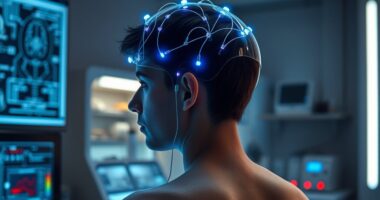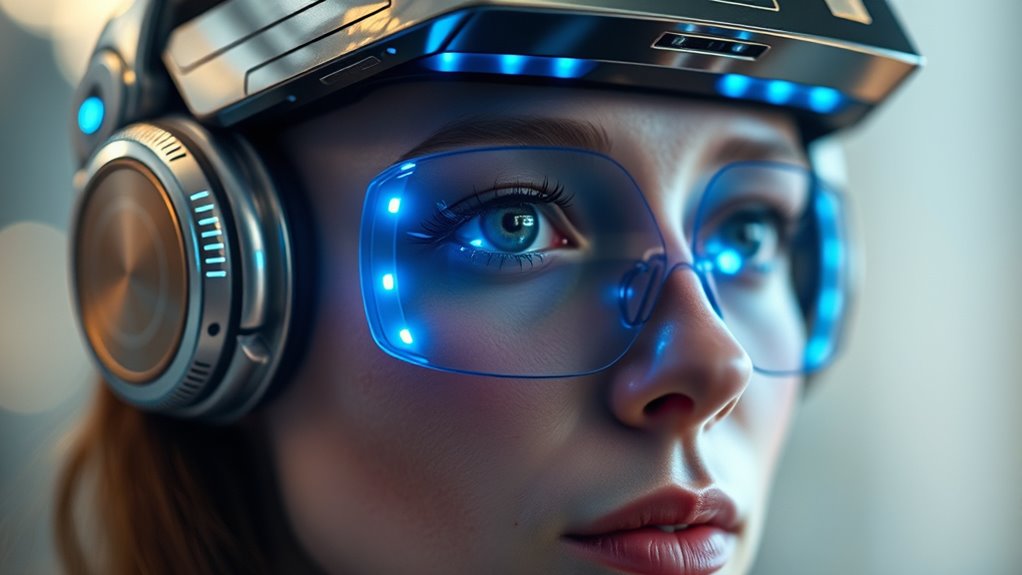

Emotion AI can analyze your facial expressions to interpret your feelings with impressive accuracy. It detects subtle cues like smiles, frowns, or widened eyes to gauge emotions such as happiness, frustration, or stress. This technology adapts responses in real-time, creating more personalized interactions. While it’s advancing rapidly, challenges remain, like cultural differences and disguised emotions. To understand how this innovative tool works and its limitations, keep exploring the fascinating ways technology is getting smarter about human feelings.
Key Takeaways
- Emotion AI uses facial expression recognition to interpret feelings, but accuracy varies across individuals and cultures.
- It detects microexpressions and subtle facial cues to infer emotional states in real-time interactions.
- Advances in algorithms and large datasets improve emotion detection, enabling personalized responses in applications like customer service.
- Challenges include distinguishing genuine emotions from masking and ensuring contextual understanding for accurate readings.
- Ethical considerations are vital, as emotion AI’s ability to read feelings raises privacy and responsible use concerns.
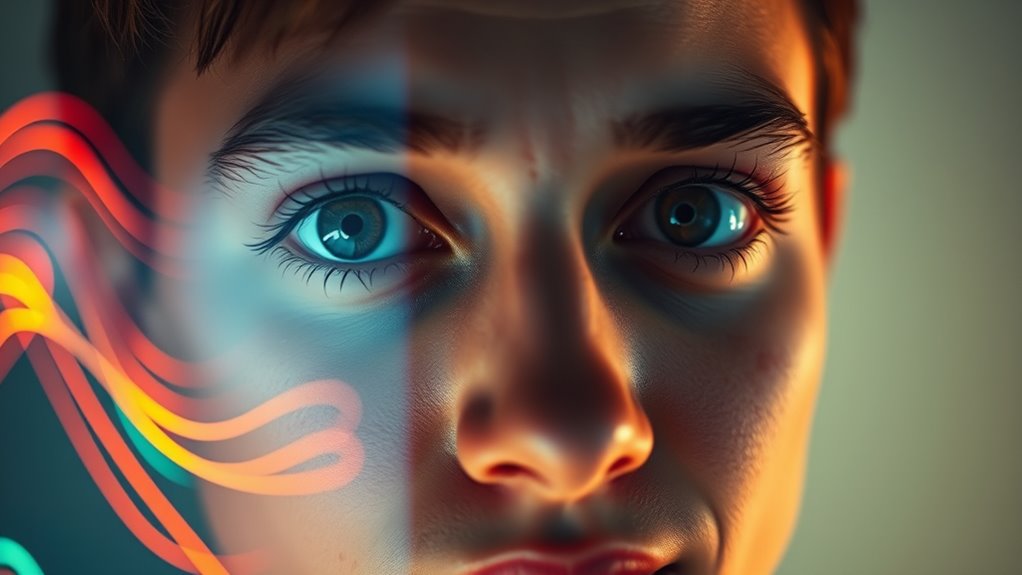
Emotion AI is transforming the way machines understand and respond to human feelings. You might wonder if technology can truly grasp what you’re feeling just by analyzing your expressions. Well, it all starts with facial expression recognition. When you interact with a device, it can observe subtle changes in your face—such as a smile, frown, or raised eyebrows—and interpret what these signals might mean. This process is part of sentiment analysis, where algorithms sift through visual cues to determine your emotional state. By doing so, machines can go beyond simple commands and begin to understand the context behind your responses.
Imagine you’re in a customer service chat or using a mental health app, and the system detects your frustration or happiness through your facial expressions. It can then adapt its responses accordingly, offering a more personalized experience. This reliance on facial expression analysis is a significant leap forward because it allows machines to read emotions in real-time, without needing you to explicitly state how you feel. Instead, they infer your sentiment based on the tiny movements and microexpressions that are often unconscious but revealing.
Facial expression analysis enables real-time emotion detection for personalized, intuitive interactions.
Advances in automation technology are also facilitating more sophisticated emotion recognition capabilities, further expanding the potential applications of Emotion AI. The core of this technology lies in sentiment analysis, which involves breaking down visual data into quantifiable metrics. These algorithms have been trained on vast datasets of facial expressions linked to specific emotions. They learn to recognize patterns—such as tightened lips indicating displeasure or widened eyes signaling surprise. As a result, the system can gauge whether you’re feeling happy, anxious, bored, or upset, often with impressive accuracy. This capability opens up numerous possibilities, from enhancing virtual assistants to improving security systems that detect stress or deception.
However, while it’s exciting to think about machines reading your feelings, there are limits. Facial expressions can vary widely across cultures, individuals, and situations. Sometimes, a smile might be genuine, and other times it might be polite or masking discomfort. Sentiment analysis algorithms are improving, but they’re not foolproof. They depend heavily on the quality of data they are trained on and the context in which expressions occur. Still, the ongoing advancements suggest that, in the near future, your devices might become better at understanding the nuanced emotions behind your expressions, making interactions more intuitive and human-like.
Ultimately, the fusion of facial expression analysis and sentiment analysis marks a new era where machines could become more empathetic, or at least more responsive to human feelings. Whether that’s a good thing or not depends on how ethically and responsibly this technology is used. But for now, know that every smile, frown, or glint in your eye could be silently interpreted by a machine trying to understand what you’re truly feeling.
Frequently Asked Questions
How Accurate Is Emotion AI in Identifying Genuine Emotions?
You might wonder how accurate emotion AI is at identifying genuine emotions. It analyzes facial expressions and physiological signals, but these cues can be misleading or affected by context. While it can often detect surface-level feelings, it struggles with deeper or mixed emotions. So, don’t rely solely on emotion AI for true emotional understanding—it’s a helpful tool but not infallible in capturing the complexity of human feelings.
What Are the Privacy Implications of Emotion Data Collection?
When it comes to collecting emotion data, you face significant privacy implications. Data security is vital to protect your sensitive information from breaches. Consent challenges arise because you might not fully understand how your emotional data is used or shared, risking your privacy. It’s essential for companies to obtain clear consent and implement strong data security measures, so you retain control over your personal feelings and avoid misuse or unauthorized access.
Can Emotion AI Detect Complex or Mixed Feelings Reliably?
You might wonder if emotion AI can reliably detect complex or mixed feelings. It analyzes facial expressions and physiological signals, but these cues often overlap or vary between individuals. While it can identify basic emotions, recognizing nuanced or conflicting feelings remains challenging. Factors like context and personal differences affect accuracy, so you shouldn’t assume the technology perfectly interprets your true emotional state, especially when feelings are complex or mixed.
How Is Emotion AI Used in Mental Health Treatment?
In mental health treatment, emotion AI boosts emotional awareness by analyzing your facial expressions, voice tone, and physiological signals. This helps therapists understand your feelings more precisely, leading to therapy personalization. You might use emotion AI to monitor your progress between sessions or to identify early signs of distress. By providing real-time insights, this technology supports more tailored interventions, making your mental health journey more effective and responsive to your emotional needs.
What Are the Ethical Concerns Surrounding Emotion Recognition Technology?
You should be aware that ethical concerns surround emotion recognition technology, especially regarding consent issues and bias concerns. You might worry about your data being used without your permission or misinterpreted due to biases in the algorithms. These technologies could unfairly target or misjudge your feelings, raising questions about privacy and fairness. It’s crucial to address these concerns to guarantee you’re protected and your emotional data is handled responsibly.
Conclusion
Emotion AI promises to understand your feelings, to read your emotions, and to enhance your experiences. But remember, it’s not perfect, it’s not infallible, and it’s not a substitute for genuine human connection. While it may analyze your expressions and detect your moods, it can’t truly feel or empathize. So, stay cautious, stay curious, and stay aware—because technology might read your feelings, but it can never replace the depth of your human heart.