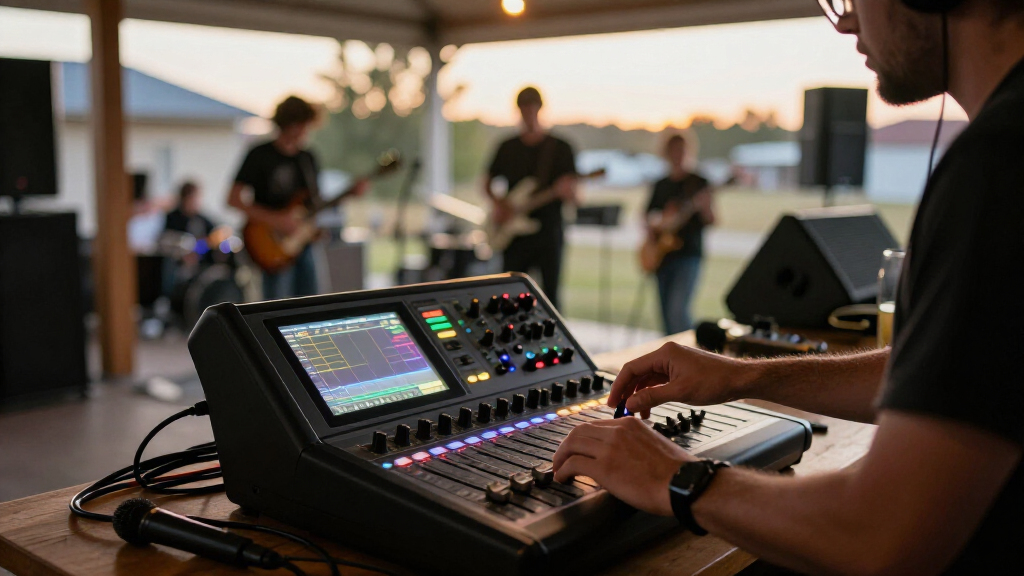

For a flexible live setup, I’d start with the Soundcraft Ui16: its browser-based remote control and broad input selection make it a strong all-rounder. The Behringer X AIR XR18 suits larger bands that need more channels and routing, while the Zoom LiveTrak L6max stands out for portable recording. The main tradeoff is between hands-on controls and app-based operation, with channel count, recording needs, and setup complexity shaping the choice. Some mixers here are full digital systems; others are simpler analog-style boards with built-in effects or USB features. Read on for how I’d match each option to a different kind of rig.

Get audio and creator gear delivered free with Prime
- Fast, free delivery on millions of items
- Prime Video, Amazon Music and more included
- Member-only deals all year
Complete the kit


Key Takeaways
- The Soundcraft Ui16 leads this group for flexible live mixing, pairing broad input capacity with browser control; users who require physical faders should look elsewhere.
- The Behringer XR18 offers a stronger fit for larger ensembles and complex routing than compact mixers, but relies on a tablet or computer for control.
- The Zoom LiveTrak L6max is the clearest recording-focused choice, while the Behringer FLOW 8 better suits compact setups that prioritize app control and Bluetooth.
- The Allen & Heath CQ-12T separates itself with a touchscreen workflow, a useful middle ground for buyers wary of tablet-only operation.
- Several low-cost compact models emphasize DSP effects, Bluetooth, and USB features; buyers should check whether those conveniences meet their routing, recording, and input needs before choosing one over a purpose-built digital mixer.
| Soundcraft Ui16 16-Input Remote-Controlled Digital Mixer |  | Best for Multi-Operator Control | Inputs: 8 XLR combo mic/line, 4 XLR mic, 2 instrument, stereo RCA line | Aux Outputs: 4 balanced XLR | Main Outputs: Balanced stereo XLR and 1/4-inch | VIEW LATEST PRICE | See Our Full Breakdown |
| Behringer X AIR XR16 16-Input Digital Mixer for iPad/Android Tablets |  | Best Value Digital Stage Mixer | Channels: 16 | Mic Preamps: 8 programmable MIDAS-designed | Connectivity: USB, XLR outputs | VIEW LATEST PRICE | See Our Full Breakdown |
| Yamnweo MW-6 6-Channel Professional DJ Audio Mixer with DSP 99 Preset Effects (White) |  | Best Compact Streaming Mixer | Channels: 6 | Connectivity: Bluetooth, USB, U-disk | Outputs: RCA, XLR | VIEW LATEST PRICE | See Our Full Breakdown |
| 8-Channel Audio Mixer with 99 DSP Effects, 7-Band EQ, USB, Bluetooth, and 48V Phantom Power |  | Best Budget Band Mixer | Channels: 8 | Phantom Power: 48V | DSP Effects: 99 presets | VIEW LATEST PRICE | See Our Full Breakdown |
| GF12 PRO Multi-Function 12-Channel Audio Mixer with LCD Color Screen, 7-Stage Equalizer and 99 DSP Effects |  | Best for Live Event Flexibility | Channels: 12 | Display: Large LCD color screen | Equalizer: 7-stage | VIEW LATEST PRICE | See Our Full Breakdown |
| Allen & Heath CQ-12T Digital Mixer with 7-Inch Touchscreen and Bluetooth |  | Best Premium Compact Pick | Mic or line inputs: 10 (5 combination inputs) | Additional input: Stereo line input | Bluetooth: Stereo Bluetooth input | VIEW LATEST PRICE | See Our Full Breakdown |
| 8-Channel Professional Audio Mixer with 48V Phantom Power and USB Audio Interface |  | Best Value Analog-Style Workhorse | Channels: 8 | Phantom power: 48V | Inputs: XLR and unbalanced 1/4″ (6.35mm) on all channels | VIEW LATEST PRICE | See Our Full Breakdown |
| Aveek 5-Channel Audio Mixer with Built-in PC Recording Interface |  | Best Budget Starter Mixer | Channels: 5 | Inputs: 3 XLR, 1 pair L/R 6.35mm, 1 pair L/R RCA, USB, Bluetooth | Outputs: 1 pair L/R RCA, 1 pair L/R 6.35mm main, 3.5mm headphone | VIEW LATEST PRICE | See Our Full Breakdown |
| Zoom LiveTrak L6max Digital Mixer and Recorder |  | Best for Portable Multitrack Recording | Channels: 12 | Simultaneous tracks: Up to 14 | Inputs: 4 combo inputs and 8 line inputs | VIEW LATEST PRICE | See Our Full Breakdown |
| Behringer FLOW 8 8-Input Digital Mixer with Bluetooth and App Control |  | Best App-Controlled Mixer | Channels: 8 | Microphone preamps: 2 Midas preamps with 48V phantom power | Channel faders: 60 mm | VIEW LATEST PRICE | See Our Full Breakdown |
| Yamaha MG10XU 10-Input Stereo Mixer with Effects |  | Best Analog-Style Reliability in a Digital Package | Channels: 10 | Connectivity: USB | Effects: SPX digital effects | VIEW LATEST PRICE | See Our Full Breakdown |
| Pyle PMXU63BT 6-Channel Bluetooth Audio Mixer |  | Best Budget Bluetooth Workhorse | Channels: 6 | Bluetooth: Version 4.0, 15+ ft range | Phantom Power: +48V | VIEW LATEST PRICE | See Our Full Breakdown |
| Behringer X AIR XR18 18-Channel, 12-Bus Digital Mixer |  | Best Rack-Mount Digital Mixer for Tablet Control | Channels: 18 | Buses: 12 | Microphone preamps: 16 programmable MIDAS-designed | VIEW LATEST PRICE | See Our Full Breakdown |
| Behringer X32 40-Input, 25-Bus Digital Mixing Console |  | Best Full-Size Console for Serious Live and Studio Work | Input channels: 40 | Buses: 25 | Microphone preamps: 32 MIDAS-designed, fully programmable | VIEW LATEST PRICE | See Our Full Breakdown |
| FULUODE CT-80S 8-Channel Audio Mixer with Bluetooth and USB Recording |  | Best Slim Pick for Karaoke and Small Events | Channels: 8 | Phantom power: 48V | Bluetooth: Version 5.0 | VIEW LATEST PRICE | See Our Full Breakdown |
More Details on Our Top Picks
Soundcraft Ui16 16-Input Remote-Controlled Digital Mixer
The Ui16 stands out for a capability almost nothing else in this lineup offers: control from up to 10 simultaneous devices across iOS, Android, Windows, macOS, and Linux. That matters if you mix front-of-house while a second engineer dials in monitors from the stage — the Behringer X AIR XR16 is tablet-first and far less flexible on platform support. The inclusion of dbx, DigiTech, and Lexicon processing means the outboard gear most small venues rent separately is already inside, including a 31-band graphic EQ on outputs. Tradeoffs are real, though: there is no physical fader surface at all, so if Wi-Fi drops mid-show, you are troubleshooting a network instead of mixing, and the warranty only covers authorized North American dealers.
Pros:- Up to 10 simultaneous control devices across five operating systems
- Built-in dbx, DigiTech, and Lexicon processing and effects
- Broad input selection including instrument channels and RCA line
- USB playback plus 2-channel direct recording
Cons:- Operation depends entirely on Wi-Fi or Ethernet connectivity
- Warranty limited to authorized North American dealers
Best for: Bands and small venues that need multiple people mixing from phones, tablets, and laptops at the same time
Not ideal for: Solo operators who want physical faders in reach — this mixer has no hardware control surface whatsoever
- Inputs:8 XLR combo mic/line, 4 XLR mic, 2 instrument, stereo RCA line
- Aux Outputs:4 balanced XLR
- Main Outputs:Balanced stereo XLR and 1/4-inch
- Remote Control:Up to 10 devices via Wi-Fi and Ethernet
- Effects:3 Lexicon FX buses: Reverb, Delay, Chorus
- Output Processing:31-band graphic EQ, noise gate, compressor
- USB Recording:2-channel direct-to-memory (MP3, WAV, AIFF playback)
Our verdict“This pick makes the most sense for collaborative live mixing where multiple operators need independent control from their own devices.”
Behringer X AIR XR16 16-Input Digital Mixer for iPad/Android Tablets
Compared with the Soundcraft Ui16, the XR16 wins on simplicity: its built-in tri-mode Wi-Fi router means you connect a tablet directly with zero networking setup, where the Ui16 often needs an external router for reliable multi-user use. The MIDAS-designed programmable preamps are the standout sonic feature — eight of them, fully recallable, which is why this model suits both studio tracking and live work. Dugan-style auto-mixing automatically manages gain sharing across mics, a genuine lifesaver for panel discussions and theater work. The obvious tradeoff is that a tablet is mandatory; lose the tablet and you lose the mixer, since there is no hardware fallback, and long-term firmware support is uncertain.
Pros:- Built-in Wi-Fi router eliminates external networking hardware
- 8 fully programmable MIDAS-designed preamps
- Dugan-style auto-mixing for automatic gain management
- USB stereo WAV recording and playback
Cons:- Tablet required for all operation
- Software update support status unclear
Best for: Working musicians and small venues that want big-console sound quality and recall without a big console
Not ideal for: Anyone uncomfortable with tablet-only mixing — there is no dedicated control surface if the tablet dies
- Channels:16
- Mic Preamps:8 programmable MIDAS-designed
- Connectivity:USB, XLR outputs
- WiFi:Built-in tri-mode router
- Recording:USB stereo WAV record/playback
- Weight:6.6 lbs
Our verdict“The strongest value here goes to tablet-comfortable live acts who want premium preamps and auto-mixing at a compact stage-box size.”
Yamnweo MW-6 6-Channel Professional DJ Audio Mixer with DSP 99 Preset Effects (White)
At 4 pounds and roughly the footprint of a large laptop, the MW-6 is the most portable option in this batch — a category the rack-mount Ui16 and stage-box XR16 simply do not compete in. Its pitch is clearly the streaming and podcasting desk: a built-in sound card with USB-B lets a phone or computer record directly, and Bluetooth plus U-disk playback covers nearly any source a home broadcaster reaches for. The 99 DSP presets are fun for karaoke and party effects, though they are preset-only, not editable like the Lexicon buses on the Soundcraft. Compared with the 8-Channel mixer later in this list, you give up phantom power and per-channel EQ depth in exchange for the smaller footprint and Bluetooth input flexibility.
Pros:- Compact and lightweight at 4 lbs
- 99 built-in DSP preset effects
- Bluetooth, USB, and U-disk playback flexibility
- Built-in sound card for direct computer or phone recording
Cons:- Corded power limits true portability
- Warranty details unclear or unavailable
Best for: Streamers, podcasters, and home karaoke hosts who need one small desk that records straight to a computer
Not ideal for: Anyone miking condenser mics or a full band — six channels, no phantom power spec, and preset-only effects limit pro use
- Channels:6
- Connectivity:Bluetooth, USB, U-disk
- Outputs:RCA, XLR
- Effects:99 DSP preset modes
- Dimensions:10.31 x 1.65 x 8.66 inches
- Weight:4 lbs
Our verdict“This model is better suited to a streaming corner or party cart than a stage rack — buy it for convenience, not for pro live sound.”
8-Channel Audio Mixer with 99 DSP Effects, 7-Band EQ, USB, Bluetooth, and 48V Phantom Power
This 8-channel workhorse occupies the middle ground between the toy-adjacent MW-6 and the remote-controlled digital mixers: it has real XLR mic inputs with 48V phantom power, so condenser microphones actually work, plus per-channel gain, EQ, and mute controls for hands-on band mixing. The 7-band main output EQ gives you room-shaping capability that smaller six-channel units skip entirely. Compared with the Behringer FLOW 8 elsewhere in this roundup, you lose app control and motorized recallability, but you gain a straightforward knobs-and-buttons workflow that never needs a firmware update to keep working. The tradeoffs: it is corded only, and Bluetooth reach is capped at about 33 feet — fine for a phone in the room, not for wandering performers.
Pros:- 8 channels with XLR and stereo line inputs
- 48V phantom power for condenser microphones
- 99 DSP effects plus 7-band main output EQ
- Bluetooth playback and USB recording (MP3, WAV, WMA)
Cons:- Corded electric power only
- Bluetooth range limited to about 33 feet
Best for: Rehearsal rooms and small gigging bands that want physical faders, condenser mic support, and simple USB recording
Not ideal for: Tech-forward users wanting app control, scene recall, or remote mixing — this is strictly a hands-on analog-style desk
- Channels:8
- Phantom Power:48V
- DSP Effects:99 presets
- Main Output EQ:7-band
- Connectivity:Bluetooth (33 ft), USB
- Outputs:TRS, XLR
- Weight:7.7 lbs
Our verdict“The sensible pick for a band that wants dependable physical controls and condenser support without paying for digital-network features.”
GF12 PRO Multi-Function 12-Channel Audio Mixer with LCD Color Screen, 7-Stage Equalizer and 99 DSP Effects
The GF12 PRO is built for the person running sound at gigs, karaoke nights, and small broadcasts from one desk — its full per-channel control set (gain, balance, EQ, send effects, volume) gives hands-on flexibility that the tablet-only X AIR XR16 cannot match when you need to grab a knob instantly. The large LCD color screen is a genuine usability win over the button-and-LED approach of most mixers in this price class, making effect selection and status checks readable on a dark stage. Twelve channels sit comfortably between the 8-channel budget mixer and full consoles like the X32. The cost of that ambition: it is more mixer than a podcast or two-mic setup needs, and its 99-effect DSP is broad rather than refined — presets, not studio-grade processing.
Pros:- Full gain, balance, EQ, send, and volume control on every channel
- 99 DSP effects covering reverb, delay, and more
- USB playback plus Bluetooth wireless streaming
- Large LCD color screen for easy operation in low light
Cons:- Overkill for very small setups
- DSP effects are broad presets rather than refined processing
Best for: Live event operators and mobile entertainers juggling many sources who need visible status and instant physical control
Not ideal for: Podcasters and streamers with two or three mics — 12 channels and stage-oriented effects are wasted capacity
- Channels:12
- Display:Large LCD color screen
- Equalizer:7-stage
- DSP Effects:99 presets with reverb and delay
- Connectivity:USB, Bluetooth
- Applications:Stage, live shows, karaoke, studios, radio broadcasting
Our verdict“A solid stage-first choice for entertainers who need many channels under direct fingertip control with an easy-to-read display.”
Allen & Heath CQ-12T Digital Mixer with 7-Inch Touchscreen and Bluetooth
The CQ-12T is the most refined small-format option in this lineup, and it shows in the details: a 7-inch capacitive touchscreen with a rotary encoder, a 16×16 USB interface, and full 16×16 SD recording and playback. Compared with the Zoom LiveTrak L6max, the Allen & Heath trades battery-powered portability for a more polished control surface and deeper routing flexibility. The three customizable SoftKeys let you put your most-used functions one press away, which matters when you’re mixing alone at a small gig. The main tradeoff is capacity: only five of its ten inputs are combination jacks, so a band with lots of mic sources may feel squeezed. You’re also paying a premium for the Allen & Heath name and build, which is hard to justify if you only need basic podcast routing.
Pros:- 10 mic/line inputs with flexible routing
- 16×16 USB interface plus SD multitrack recording and playback
- 7-inch capacitive touchscreen with rotary control for fast navigation
- Three customizable SoftKeys for one-press access to key functions
Cons:- Only five of the ten inputs are combination jacks
- Premium price point puts it out of reach for hobbyists
Best for: Solo performers, small bands, and content creators who want touchscreen-driven control and multitrack recording in one compact unit
Not ideal for: Budget-conscious buyers or bands needing more than five XLR mic inputs at once
- Mic or line inputs:10 (5 combination inputs)
- Additional input:Stereo line input
- Bluetooth:Stereo Bluetooth input
- USB interface:16×16
- Recording:16×16 SD recording and playback
- Display:7-inch capacitive touchscreen with rotary control
- Custom controls:3 SoftKeys
Our verdict“This pick makes the most sense for someone who wants near-flagship digital mixing intelligence in a compact, touchscreen-driven chassis.”
8-Channel Professional Audio Mixer with 48V Phantom Power and USB Audio Interface
This 8-channel console takes a traditional knob-per-function approach, and that simplicity is its strongest asset. Where the Behringer FLOW 8 asks you to layer app control over a compact surface, this mixer puts every channel’s 3-band EQ, gain, and FX send under your fingers with no menus to dig through. Phantom power and both XLR and 1/4-inch inputs on all channels mean condenser mics and instruments plug straight in. The built-in USB audio interface and Bluetooth streaming cover recording and casual playback without extra gear. The honest tradeoff: it’s an analog-style design dressed up with digital conveniences, so there are no scenes, recall, or remote control. Effects are limited to reverb and delay only, which will frustrate anyone used to the DSP preset libraries on mixers like the GF12 PRO.
Pros:- All 8 channels accept both XLR and 1/4-inch inputs
- Built-in USB recording and Bluetooth streaming
- Per-channel 3-band EQ, gain, and effects controls
- Ultra-thin chassis with dust-resistant sealed rotary controls
Cons:- Too basic for advanced professional mixing workflows
- Effects limited to reverb and delay only
Best for: Podcasters, karaoke hosts, and small venues that want hands-on mixing with basic recording at a low cost
Not ideal for: Engineers who need recallable scenes, remote mixing, or a wide effects palette
- Channels:8
- Phantom power:48V
- Inputs:XLR and unbalanced 1/4″ (6.35mm) on all channels
- EQ:3-band (high, mid, low) per channel
- Effects:Reverb and delay
- Connectivity:USB, Bluetooth, REC & TAPE input/output
- Chassis:Ultra-thin with sealed dust-resistant rotary controls
Our verdict“A straightforward, no-menus choice for buyers who value physical controls and low cost over digital flexibility.”
Aveek 5-Channel Audio Mixer with Built-in PC Recording Interface
The Aveek is the entry point of this lineup, and it earns that spot by covering the fundamentals: three XLR inputs with 48V phantom power, a plug-and-play USB-B recording interface, and Bluetooth streaming for backing tracks. Next to the 8-channel professional console above, it gives up channels, a full EQ band, and build heft — but for a two-person podcast or solo streamer, five channels is genuinely enough, and the smaller footprint frees up desk space. Onboard 2-band EQ and echo/delay effects are serviceable rather than inspiring. The real constraints are operational: Bluetooth, USB, and channels 4/5 can’t run simultaneously, there’s no Bluetooth output, and it only drives active speakers. Learn those limits before buying and it’s an easy recommendation; ignore them and you’ll hit a wall mid-session.
Pros:- Versatile inputs including XLR, 6.35mm, RCA, USB, and Bluetooth
- Plug-and-play USB recording interface for PC
- 48V phantom power supports condenser microphones
- Headphone monitoring with EQ, gain, and echo/delay effects
Cons:- Bluetooth, USB, and channel 4/5 cannot be used simultaneously
- No Bluetooth output and compatible only with active speakers
Best for: First-time podcasters and live streamers who need basic multi-mic mixing with simple PC recording
Not ideal for: Anyone routing multiple playback sources at once, or users with passive speakers and external amplification
- Channels:5
- Inputs:3 XLR, 1 pair L/R 6.35mm, 1 pair L/R RCA, USB, Bluetooth
- Outputs:1 pair L/R RCA, 1 pair L/R 6.35mm main, 3.5mm headphone
- Phantom power:48V
- Power source:Corded electric (AC adapter)
- Bluetooth range:15 ft
- Dimensions:8.27″D x 8.27″W x 2.56″H
Our verdict“A sensible first mixer for solo creators, provided you can live within its one-source-at-a-time limitations.”
Zoom LiveTrak L6max Digital Mixer and Recorder
Nothing else in this batch mixes and records like the L6max. Its standout trick is 32-bit float recording with dual AD converters on channels 1–4, which means clipped takes are effectively a thing of the past — a safety net neither the CQ-12T nor any analog console here can match. With up to 14 simultaneous tracks onto SD cards up to 2TB, it doubles as a serious field recorder for band sessions. The power story is equally unusual: AA batteries, USB bus power, or a mobile power bank keep it running anywhere, where the corded-only Behringer FLOW 8 ties you to an outlet. The tradeoffs are workflow-related. Four combo inputs means heavy mic-count setups need creative routing, and at 2.2 lb with a 14-inch footprint, it’s less desk-friendly than the compact Aveek. Long-term software support is also an open question.
Pros:- Records up to 14 tracks simultaneously to SD cards up to 2TB
- Multiple power options including AA batteries and power banks
- Dual AD converters deliver clip-free recording on channels 1–4
- Built-in MIDI-synced sound pads and AI noise reduction
Cons:- Only four combo inputs limits larger mic-heavy sessions
- Long-term software update support is unconfirmed
Best for: Field recordists, mobile podcasters, and musicians capturing multitrack sessions away from mains power
Not ideal for: Stationary desktop setups that prioritize touchscreen control or more XLR mic inputs
- Channels:12
- Simultaneous tracks:Up to 14
- Inputs:4 combo inputs and 8 line inputs
- Recording format:32-bit float, 48 kHz
- Supported SD card capacity:Up to 2TB
- Power source:AA batteries, USB bus power, or mobile battery pack
- Weight:2.2 lb
Our verdict“The clear choice for anyone whose mixing happens on location and who can’t afford to lose a take to clipping.”
Behringer FLOW 8 8-Input Digital Mixer with Bluetooth and App Control
The FLOW 8’s defining feature is its FLOW app control over Bluetooth, letting you walk the room and mix from your phone — a trick the smaller Aveek and the 8-channel analog console simply can’t offer. Its two Midas preamps with 48V phantom power give the first two channels a quality edge for vocals, and EZ-Gain automatically sets input levels, which spares beginners the most error-prone step of setup. Two onboard FX processors plus proper 60 mm channel faders make it feel closer to a real console than its footprint suggests. The compromises are real, though: only two channels get the premium preamps, the surface itself is compact enough that app control is close to mandatory for deep edits, and the product listing oddly specifies an HDMI output connector — verify your cabling before purchase.
Pros:- Wireless control via the FLOW app on iOS and Android
- EZ-Gain automatically sets input gain levels
- Two Midas microphone preamps with 48V phantom power
- Two FX processors and full-size 60 mm channel faders
Cons:- Only two channels feature the Midas preamps
- Compact surface makes deeper editing app-dependent; listed HDMI output connector is unusual and worth verifying
Best for: Beginners and small-venue mixers who want wireless phone control and automated gain setup
Not ideal for: Buyers who dislike app-dependent workflows or need premium preamps on every channel
- Channels:8
- Microphone preamps:2 Midas preamps with 48V phantom power
- Channel faders:60 mm
- Effects processors:2 FX processors
- Control:Bluetooth via FLOW app (iOS and Android), EZ-Gain
- Power source:Corded electric
- Weight:1400 g
Our verdict“The best fit for hands-off-the-desk mixing, as long as you’re comfortable reaching for your phone.”
Yamaha MG10XU 10-Input Stereo Mixer with Effects
The MG10XU earns its place as the pick for buyers who want digital effects and USB recording without a screen or app. Every control sits on a physical knob or fader, which makes it far more approachable than the tablet-driven Behringer X AIR XR18 or the touchscreen-based Allen & Heath CQ-12T. Yamaha’s D-PRE Class A preamps and a −128 dBu noise floor put it a step above budget analog boards like the Pyle PMXU63BT in raw sound quality, and the one-knob compressors solve the most common beginner mistake — over-compressed vocals — with a single dial. The tradeoff is capacity: ten channels and SPX effects are modest next to the XR18’s sixteen programmable preamps, and there’s no Bluetooth streaming at all.
Pros:- Discrete Class A D-PRE preamps with very low noise for the price class
- One-knob compressors and high-pass filters make dialing in vocals fast
- Rugged powder-coated metal chassis built for gig transport
- USB connectivity plus SPX effects in a truly compact footprint
Cons:- Only 10 channels and a fixed effects set limit expansion for growing bands
- No Bluetooth or wireless control — less flexible than app-based rivals like the XR18
Best for: Podcasters, small venues, and home recordists who want hands-on faders with clean preamps and simple USB capture
Not ideal for: Wireless-first users — there is no Bluetooth, so phone-based streaming requires a cable or adapter
- Channels:10
- Connectivity:USB
- Effects:SPX digital effects
- Preamps:Discrete Class A D-PRE
- Equalizer:3-band EQ
- Compressors:One-knob compressors
- Chassis:Impact-resistant, powder-coated metal
- Equivalent input noise:−128 dBu
Our verdict“If you want dependable, knob-per-function mixing with genuinely clean preamps and no app dependencies, this is the safest small-format choice in the lineup.”
Pyle PMXU63BT 6-Channel Bluetooth Audio Mixer
Where the Yamaha MG10XU prioritizes preamp quality, the PMXU63BT prioritizes wireless convenience at a low cost. Its built-in Bluetooth streaming is the headline: pair a phone and you have backing tracks or break music without touching a cable, something neither the Yamaha nor the Behringer X32 offers natively. The four XLR/combo inputs with +48V phantom power mean condenser mics are covered, and the 16-bit DSP effects add basic reverb for vocals. Compared with the six-channel Yamnweo MW-6, Pyle’s steel chassis and multi-voltage 100/240V supply make it the more road-ready choice. The compromises are real, though — the 15-foot Bluetooth range is short, six channels fill up quickly, and the effects quality won’t rival dedicated processors.
Pros:- Built-in Bluetooth streaming from phones and tablets with no extra hardware
- +48V phantom power supports condenser microphones on all combo inputs
- USB/flash drive playback and recording adds flexibility
- Rugged steel chassis with sealed controls and multi-voltage power supply for travel
Cons:- Bluetooth range of roughly 15 feet is easy to exceed on stage
- Only 6 channels with modest preamp and effect quality compared with Yamaha’s MG10XU
Best for: DJs, small karaoke setups, and presenters who need cheap wireless playback plus a few mic channels
Not ideal for: Bands or producers who need more than four mic inputs or low-latency recording — the channel count and 16-bit DSP will hold you back
- Channels:6
- Bluetooth:Version 4.0, 15+ ft range
- Phantom Power:+48V
- DSP:16-bit effects
- EQ:3-band (High 12kHz, Mid 2.5kHz, Low 80Hz), ±15dB
- Inputs:4 × XLR/1/4″ combo, 1/4″ send/return
- Power Supply:100/240V multi-voltage adapter
- Dimensions:9.3 × 9.7 × 2.6 inches
Our verdict“A practical entry point if wireless streaming and phantom power matter more to you than pristine preamps or channel count.”
Behringer X AIR XR18 18-Channel, 12-Bus Digital Mixer
The XR18 occupies a unique slot: full digital mixing power in a rack-mount box with zero physical faders. Everything happens on an iPad or Android tablet over the built-in tri-mode Wi-Fi router, so the engineer can walk the venue and mix from anywhere — a trick the Soundcraft Ui16 also plays, but the XR18 counters with sixteen programmable MIDAS preamps and an 18 × 18 bidirectional USB interface that turns it into a serious multitrack recording rig. That recording depth is something the Yamaha MG10XU’s stereo USB simply can’t match. The obvious tradeoff: no tablet, no mixer. If your tablet dies mid-show, you’re stuck, and anyone who prefers physical faders should step up to the Behringer X32 instead. Some advanced features, like the Dugan-style automixing, have depended on firmware updates rather than shipping complete.
Pros:- 16 programmable MIDAS-designed preamps rival consoles costing far more
- Built-in tri-mode Wi-Fi router enables walk-the-room mixing with no extra hardware
- 18 × 18 bidirectional USB interface supports full multitrack recording and playback
- Compact rack-mount form factor at just 7.1 pounds
Cons:- Entirely dependent on tablet apps — no physical controls as a fallback
- Advanced features like Dugan-style automixing have relied on future firmware updates
Best for: Mobile engineers and home studios who want deep digital mixing and multitrack recording without a console-sized footprint
Not ideal for: Fader-first operators and venues without a reliable dedicated tablet — the app-only workflow leaves you blind if Wi-Fi or battery fails
- Channels:18
- Buses:12
- Microphone preamps:16 programmable MIDAS-designed
- Wi-Fi:Built-in tri-mode router
- USB audio interface:18 × 18 bidirectional
- Main outputs:2 × XLR
- Output connectors:XLR, TRS
- Weight:7.1 pounds
Our verdict“The strongest value in remote-controlled digital mixing here, provided you’re comfortable running your entire show from a tablet.”
Behringer X32 40-Input, 25-Bus Digital Mixing Console
The X32 is the ceiling of this roundup — a true 40-input, 25-bus console aimed at bands, houses of worship, and production studios that have outgrown compact gear. Its 25 motorized 100mm faders and LCD scribble strips give it what the rack-mount Behringer XR18 fundamentally lacks: immediate, physical control with scene recall that moves faders for you. With 32 MIDAS programmable preamps and 16 XLR outputs, it handles stage plots that would swallow the Yamaha MG10XU three times over. The price of that capability is literal — size and weight. This is a console you case up and rack into a venue, not something you tuck into a backpack like the Zoom LiveTrak L6max. Learning its routing architecture also takes real time compared with knob-per-function analog boards.
Pros:- 40 input channels and 25 buses handle full bands and complex productions
- 32 fully programmable MIDAS-designed preamps across every mic input
- Motorized faders make scene recall hands-free and show-ready
- LCD scribble strips on channels and buses keep large mixes legible
Cons:- Large, heavy console that demands dedicated transport and desk space
- Deep routing and configuration carry a real learning curve compared with simple analog mixers
Best for: Working engineers, mid-size venues, and churches that need dozens of channels, scene recall, and professional routing
Not ideal for: Solo podcasters and bedroom musicians — the footprint, cost, and learning curve massively outweigh the needs of a two-mic setup
- Input channels:40
- Buses:25
- Microphone preamps:32 MIDAS-designed, fully programmable
- Faders:25 motorized 100 mm
- Outputs:16 XLR outputs
- Additional connections:6 line in/outs, 2 headphone connectors, talkback section
- Power source:Corded electric
Our verdict“When your channel count and recall needs have outgrown every compact option here, this is the console that ends your upgrade cycle.”
FULUODE CT-80S 8-Channel Audio Mixer with Bluetooth and USB Recording
The CT-80S targets a different buyer than everything else here: the karaoke host, small performer, or conference room who wants wireless music, USB recording, and enough channels for a few mics — all in a chassis barely over an inch and a half thick. Its Bluetooth 5.0 is newer than the Pyle PMXU63BT’s version 4.0, and the LED display showing track information is a genuinely handy touch when you’re queuing songs mid-event. With 48V phantom power and eight channels, it covers modest live setups. But the spec sheet is thin where it counts: recording features are lightly documented, and the fixed 110V American plug rules out international use that the multi-voltage Pyle handles easily. Sound quality and effect depth also trail the Yamaha MG10XU.
Pros:- Bluetooth 5.0 wireless streaming for backing tracks and event music
- USB recording plus MP3/USB playback with an LED track display
- 48V phantom power supports condenser microphones
- Slim 1.57-inch profile fits easily on a table or crowded cart
Cons:- 110V-only American power supply limits international use
- Sparse documentation on recording quality and effects leaves buyers guessing
Best for: Karaoke hosts, mobile entertainers, and meeting-room operators who want Bluetooth playback and simple USB recording in a slim unit
Not ideal for: Traveling performers outside North America — the fixed 110V power supply won’t work abroad without a converter
- Channels:8
- Phantom power:48V
- Bluetooth:Version 5.0
- Inputs:Microphone and instrument
- Connectivity:Bluetooth, MP3/USB
- Display:LED track display
- Voltage:110V, American plug
- Thickness:1.57 inches
Our verdict“A reasonable budget pick for casual performance and karaoke duty, as long as you stay on North American power and keep expectations modest.”
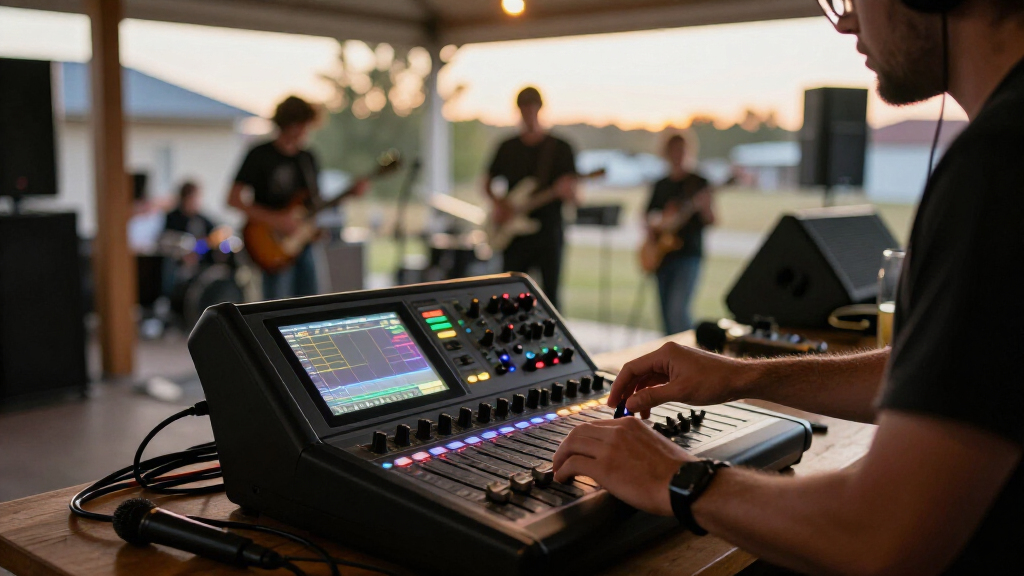
How We Picked
I ranked these mixers by how well their controls, input capacity, routing, and recording features match real use cases. For live sound, I gave weight to remote or onboard control, channel flexibility, and the ability to manage a changing mix. For recording and streaming, I considered whether the mixer offers practical USB or recorder functions rather than treating Bluetooth playback as a substitute for multitrack capture.
The order reflects fit and capability, not a claim that every model serves the same job. The Ui16 and XR18 rank highly for adaptable live mixing, while the LiveTrak L6max earns distinction for recording and portability. Touchscreen control, compact size, and simpler operation raise other picks for narrower needs; models with less clearly established digital routing or recording depth rank lower for buyers seeking a full digital mixer. I also considered the tradeoffs each product presents, including tablet dependence, limited channels, and feature sets centered on effects or convenience.
Factors to Consider When Choosing Digital Audio Mixers
I’d choose a digital mixer by mapping the actual signal path first: what needs to connect, what needs separate control, and where the mix will be adjusted. These questions help separate a capable digital console from a compact mixer whose main appeal is built-in effects or wireless playback.
Count Sources and Separate Mixes
Count microphones, instruments, playback devices, and any spare inputs you may need during a typical session. Then count the outputs: a main pair alone may be enough for a home stream, while performers often need separate monitor mixes. A mixer’s headline channel number can include stereo returns or other inputs that do not behave like full mono mic channels. Check how many independent buses and physical outputs it provides before assuming it can feed every destination. Leaving room for one or two extra sources can prevent an early replacement. For a small setup, a high channel count is less useful than clear control over the inputs you actually use.
Choose a Control Method You Can Use Under Pressure
Remote mixing keeps the operator close to the audience or lets performers adjust their own monitor mixes, but it adds dependence on a network and a compatible device. A built-in touchscreen offers direct access without needing a separate tablet, while physical faders can be easier to grab during fast changes. Think about who will run the mixer and whether they can configure wireless access before an event. For a venue with unreliable wireless conditions, test the control setup and have a fallback plan. Buyers often focus on the app’s feature list and overlook the practical question of how quickly they can reach a mute, level, or monitor send.
Match Recording Features to the Deliverable
USB audio can mean stereo playback, a two-channel computer feed, or multitrack recording, and those are different capabilities. If you need to edit each microphone later, confirm the mixer can send isolated channels to your computer or record them directly. A built-in recorder can simplify field capture, but check the supported media and track count. For a podcast or stream, a clean stereo mix may be all you need, making a simpler interface sufficient. Do not treat Bluetooth as a recording connection; it is generally aimed at receiving or sending audio wirelessly, not preserving separate source tracks. Decide what files you need at the end before paying for recording features.
Separate DSP Effects from Mixing Depth
Built-in reverbs, delays, and EQ can save setup time, especially for singers or small events without external processors. Yet a long effects list does not tell you how flexible the mixer is when balancing many sources or sending different mixes to monitors. Check whether EQ and dynamics are available per channel, and whether effects can be routed independently. A compact board with many presets may be convenient for basic vocals but restrictive for a band that needs detailed control. Consider the quality and adjustability of the processing, not just the number of presets advertised. Choose effects as a workflow aid, rather than as a substitute for the routing you need.
Plan for Setup, Support, and Expansion
A mixer that lives in a rack, travels weekly, or stays on a desk faces different demands. Check enclosure construction, connector access, power requirements, and how quickly the unit can be packed and deployed. Also consider whether the control app and firmware have a clear update path, since a remote-dependent workflow relies on software as well as hardware. If your setup may grow, examine expansion options and whether the mixer can integrate with stage boxes or other gear. Buyers can save effort by choosing a unit that fits their current needs, but a little extra routing capacity may be more useful than a collection of unused presets. For an occasional simple setup, ease of transport and fast setup may matter more than expansion.
Frequently Asked Questions
Can I use a tablet-controlled mixer if the venue’s Wi-Fi is unreliable?
Often, yes, but the control method matters: some mixers create their own wireless access point, while others depend on a separate router or network. A crowded venue can still interfere with the connection, so test the setup in the intended space when possible. Keep the mixer’s control device charged and know how to reconnect if the link drops. If you need direct physical access during a show, a touchscreen or surface controls may be a better fit. The key is to treat wireless control as part of the system setup, not an automatic guarantee.
Is a USB port enough to record every input separately?
No. USB may support only stereo playback and recording, or it may provide multichannel audio to a computer; the product’s documentation should state which. If you plan to mix or edit each source later, verify the number of independent channels sent over USB. Also check whether the mixer records directly to storage or needs recording software on a connected computer. A stereo mix is simpler to manage, but it limits changes after the session. Confirm the workflow before buying if isolated tracks are a requirement.
Should I choose a digital mixer or an analog-style mixer with effects?
Choose based on the control and routing you need, not the label alone. A digital mixer can offer stored scenes, detailed processing, remote operation, or multiple buses, while an analog-style compact model may provide a quicker and more familiar layout. For simple playback and a few microphones, built-in effects and straightforward controls may be enough. For separate monitor mixes, repeatable event settings, or multitrack recording, look for those specific digital capabilities. Compare the signal path and control options rather than assuming that DSP effects alone make a mixer a full digital console.
How many inputs should I leave available for future use?
Start with the largest setup you expect to run, then add a small buffer for guest microphones, extra playback, or a new instrument. The right margin depends on how often your rig changes; a fixed podcast setup may need little spare capacity, while a live band benefits from more room. Check whether stereo sources consume one or two input channels and whether returns count toward the advertised total. Also account for monitor and output needs, since more inputs do not automatically provide more independent mixes. A modest reserve can save a replacement when the setup grows.
What should I prioritize for a portable recording rig?
Look first at the recorder or computer connection, the number of isolated tracks, and whether the controls remain practical when the mixer is packed with other gear. Battery or power options, connector placement, and storage support can matter as much as channel count on location. A compact mixer that captures only a stereo mix may be enough for documentation but less useful for later editing. Think about how you will monitor and adjust levels while recording, too. For portable work, a focused recording workflow can be more valuable than a larger console designed mainly for live production.
Conclusion
I’d choose the Soundcraft Ui16 as the best overall option for buyers who want flexible remote live mixing and can work without onboard faders. For larger productions, the Behringer XR18 is the stronger fit when extra channels and bus routing matter; its tablet-led control is the tradeoff. The Zoom LiveTrak L6max is my pick for compact recording, while the Behringer FLOW 8 makes more sense for a small setup built around app control and wireless playback. Beginners who want a more direct control surface can look to the Allen & Heath CQ-12T and its touchscreen workflow. For a simpler, effects-led setup, consider compact models such as the Yamnweo MW-6 or Pyle PMXU63BT, but verify that their routing and recording functions match your needs before choosing them as a full digital mixer.
Fall Picks
fall essentials
As an affiliate, we earn on qualifying purchases.