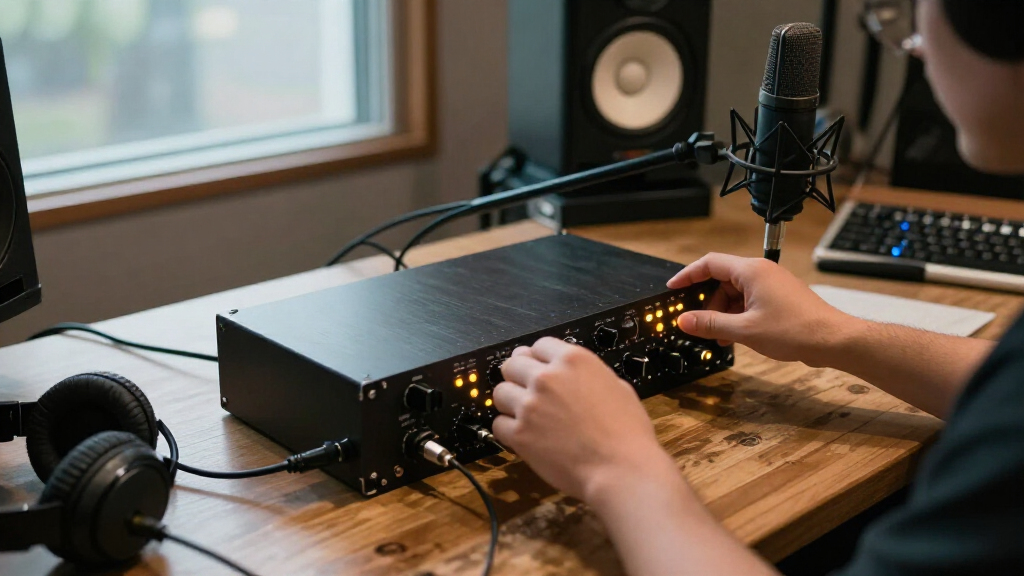
Studio microphone preamps range from simple gain boosters to full recording interfaces, and the best overall choice in this lineup is the Focusrite Scarlett 2i2 4th Gen for its combination of two mic inputs, onboard preamps, and direct computer recording. The dbx 286s stands out for vocal shaping without separate processors, while the Cloudlifter CL-1 is a focused option for adding clean gain to compatible low-output microphones. The main tradeoff is whether you need a complete recording setup, extra gain for one mic, or hands-on tone and dynamics control. Channel count, phantom-power requirements, connectivity, and the intended microphone all affect the choice. Continue reading for the full breakdown, selection criteria, and advice on matching a preamp to your studio.

Get audio and creator gear delivered free with Prime
- Fast, free delivery on millions of items
- Prime Video, Amazon Music and more included
- Member-only deals all year
Complete the kit

Key Takeaways
- The Scarlett 2i2 4th Gen is the strongest all-around fit for a small studio that needs two mic inputs and a computer-ready recording path, while standalone boosters cannot replace its interface functions.
- The Cloudlifter CL-1 solves a narrower problem than an interface. It can add gain for compatible passive ribbon and dynamic mics, but it needs phantom power and does not itself connect to a computer.
- The dbx 286s is the most processing-focused pick because it combines a mic preamp with vocal-oriented dynamics and tone controls; that flexibility brings more setup decisions than a basic gain booster.
- Many products in this lineup are complete USB interfaces, not standalone preamps. Scarlett Solo models and the Solo Studio bundle suit recording workflows, while the ADA8200 targets users expanding an ADAT-equipped system.
- Check power and compatibility before choosing a compact booster. Some models require phantom power from another device, and a 48V supply requirement is not the same as a preamp generating phantom power for a condenser mic.
| Focusrite Scarlett 2i2 4th Gen USB-C Audio Interface |  | Best Overall Studio Interface with Built-In Preamps | Connectivity: USB-C | Channels: 2 | Microphone preamps: 2 | VIEW LATEST PRICE | See Our Full Breakdown |
| Cloud Microphones Cloudlifter CL-1 Mic Activator |  | Best for Quiet Dynamic and Passive Ribbon Mics | Gain: Up to +25 dB | Channels: 1 | Connectors: XLR | VIEW LATEST PRICE | See Our Full Breakdown |
| PreSonus BlueTube DP v2 2-Channel Microphone and Instrument Tube Preamp |  | Best for Two-Channel Tube Color | Inputs: 2 combo microphone/instrument inputs | Gain stages: Class A solid-state and 12AX7 vacuum tube | Phantom power: 48V | VIEW LATEST PRICE | See Our Full Breakdown |
| ART Tube MP Studio V3 |  | Best Single-Channel Voicing Options | Channel quantity: 1 | Preamp type: Tube microphone/instrument preamplifier | Voicing feature: V3 Variable Valve Voicing presets | VIEW LATEST PRICE | See Our Full Breakdown |
| StudioMan CL-100 XLR Preamp for Dynamic and Passive Ribbon Microphones |  | Best Compact Inline Gain Booster | Gain: Up to +25 dB | Microphone compatibility: Dynamic microphones and passive ribbon microphones | Connectors: Balanced XLR input and output | VIEW LATEST PRICE | See Our Full Breakdown |
| StudioMan DPM1 XLR Dynamic Microphones Preamp, 29dB Gain & Low-Noise Signal Boost |  | Best Compact Booster for Dynamic Mics | Gain: 29 dB | Microphone compatibility: Dynamic and passive ribbon microphones; not condenser microphones | Power requirement: 48V phantom power from connected audio equipment | VIEW LATEST PRICE | See Our Full Breakdown |
| JCANOL MIC-1 Microphone Preamp with Up to 75 dB Gain |  | Best for Flexible Input and Output Options | Maximum gain: 75 dB | Equivalent input noise: -120 dB | Inputs: 2; cannot be used simultaneously | VIEW LATEST PRICE | See Our Full Breakdown |
| FOSA Microphone Preamplifier with 48V Phantom Power |  | Best Battery-Powered Portable Preamp | Gain: 20 dB | Microphone compatibility: Dynamic and condenser microphones | Power: Built-in 800 mAh lithium-ion battery; supports 5V and 48V | VIEW LATEST PRICE | See Our Full Breakdown |
| StudioMan CL-200 Dual-Channel XLR Microphone Preamp for Dynamic and Passive Ribbon Microphones |  | Best Two-Channel Inline Booster | Channels: 2 | Gain: 25 dB | Frequency response: 10 Hz–20 kHz (±1 dB) | VIEW LATEST PRICE | See Our Full Breakdown |
| dbx DBX286SV Instrument, Microphone Preamp & Channel Strip Processor |  | Best Full Channel Strip for Vocal Processing | Channels: 1 | Processing: Compression, de-esser, enhancer, and expander/gate | Inputs: XLR microphone and ¼-inch TRS line | VIEW LATEST PRICE | See Our Full Breakdown |
| RO03 Mic Preamp, 1 Input & 3 Outputs |  | Best Standalone Preamp for Flexible Routing | Inputs: 1 active input | Outputs: 3 simultaneous outputs | Variable gain: 19–66 dB | VIEW LATEST PRICE | See Our Full Breakdown |
| Focusrite Scarlett Solo Studio 4th Gen USB-C Audio Interface Bundle |  | Best Complete Recording Starter Kit | Connectivity: USB-C | Channels: 2 | Inputs: 1 XLR microphone preamp and 1 Hi-Z instrument input | VIEW LATEST PRICE | See Our Full Breakdown |
| Focusrite Scarlett Solo 4th Gen USB-C Audio Interface |  | Best Modern Single-Channel Interface | Connectivity: USB | Channels: 2 | Microphone inputs: 1 XLR mic preamp | VIEW LATEST PRICE | See Our Full Breakdown |
| Behringer ADA8200 8-Channel ADAT Audio Interface with Midas Microphone Preamplifiers |  | Best for Expanding Mic Inputs | Channels: 8 | Preamplifiers: Midas microphone preamplifiers | Conversion: 24-bit A/D and D/A | VIEW LATEST PRICE | See Our Full Breakdown |
| Focusrite Scarlett Solo 3rd Gen USB-C Audio Interface |  | Best Straightforward Previous-Generation Pick | Generation: 3rd Gen | Channels: 2 | Microphone inputs: 1 XLR mic preamp | VIEW LATEST PRICE | See Our Full Breakdown |
| studio microphone preamp | Dimensions | Channels |
|---|---|---|
| Focusrite Scarlett 2i2 4th Gen | 4.61 × 7.09 × 1.87 in | 2 |
| Cloud Microphones Cloudlifter | 1.93 × 1.93 × 4.72 in | 1 |
| PreSonus BlueTube DP v2 2-Chan | 1.75 × 9.5 × 5.5 in | — |
| ART Tube MP Studio V3 | 5 × 5.5 × 2 in | — |
| StudioMan CL-100 XLR Preamp fo | 5.8 × 2.5 × 2.5 in | — |
| StudioMan DPM1 XLR Dynamic Mic | — | — |
| JCANOL MIC-1 Microphone Preamp | — | — |
| FOSA Microphone Preamplifier w | — | — |
| StudioMan CL-200 Dual-Channel | — | 2 |
| dbx DBX286SV Instrument | — | 1 |
| RO03 Mic Preamp | — | — |
| Focusrite Scarlett Solo Studio | 3.78 × 5.63 × 1.83 in | 2 |
| Focusrite Scarlett Solo 4th Ge | 3.78 × 5.63 × 1.83 in | 2 |
| Behringer ADA8200 8-Channel AD | 12.35 × 21 × 4.4 in (D × W × H) | 8 |
| Focusrite Scarlett Solo 3rd Ge | 1.71 × 5.65 × 3.77 in (D × W × H) | 2 |
More Details on Our Top Picks
Focusrite Scarlett 2i2 4th Gen USB-C Audio Interface
The Scarlett 2i2 4th Gen is my strongest all-around choice for a small studio because its two low-noise mic preamps sit inside a complete USB recording interface. That means you can record two microphones or combine a mic with an instrument without adding a separate preamp, while Auto Gain and Clip Safe help keep takes usable when input levels change. Its 120 dB converter dynamic range and 192 kHz maximum sample rate make it a more capable recording hub than the standalone Cloudlifter CL-1 or StudioMan CL-100, which only boost a microphone signal and still require an interface or mixer. The tradeoff is that this is not a dedicated character preamp: Air mode offers a tonal option, but there is no tube-drive control like the PreSonus BlueTube DP v2. Two channels also limit larger sessions.
Pros:- Two low-noise microphone preamps and two instrument inputs support flexible small-session recording.
- Auto Gain and Clip Safe help manage changing input levels and reduce clipping risk.
- 120 dB dynamic range and a maximum 192 kHz sample rate support detailed digital recording.
- Independent headphone control and included software make it a practical recording hub.
Cons:- Limited to two channels, so it cannot handle larger microphone setups on its own.
- Air mode does not offer the adjustable tube coloration found on the PreSonus BlueTube DP v2.
Best for: Home-studio musicians and podcasters who need two mic inputs, instrument recording, and computer connectivity in one unit.
Not ideal for: Engineers who need more than two simultaneous recording channels or a dedicated tube-saturation preamp.
- Connectivity:USB-C
- Channels:2
- Microphone preamps:2
- Instrument inputs:2
- Dynamic range:120 dB
- Maximum sample rate:192 kHz
- Dimensions:4.61 × 7.09 × 1.87 in
- Weight:0.6 kg
Our verdict“Choose the Scarlett 2i2 if you want a two-channel recording interface with capable built-in preamps rather than a standalone gain booster or dedicated tube unit.”
Cloud Microphones Cloudlifter CL-1 Mic Activator
The Cloudlifter CL-1 is a focused fix for low-output passive microphones, not a replacement for a full studio preamp or audio interface. It uses phantom power from a connected preamp to provide up to +25 dB of clean gain, helping bring quiet dynamic and passive ribbon mic signals up before they reach a noisier gain stage. Compared with the Scarlett 2i2, it adds no recording inputs, conversion, or computer connection; it improves the signal path you already have. The same distinction applies against the StudioMan CL-100, which also offers up to 25 dB of gain in a compact inline format. The CL-1 is a useful specialist, but it adds another box and XLR connection, and its benefit is limited when a mic already produces a healthy signal. It also depends on a phantom-powered host.
Pros:- Adds up to 25 dB of gain for quiet passive ribbon and dynamic microphones.
- Uses host phantom power without passing phantom power through to passive microphones.
- XLR connections make it easy to place between a microphone and a compatible preamp.
- Designed to boost the signal while retaining the microphone’s natural character.
Cons:- Does not provide an interface, recording conversion, or additional input channels.
- Requires a phantom-powered preamp or mixer to operate.
- Adds little value when the microphone already delivers an adequate signal level.
Best for: Recording engineers and podcasters using passive ribbon or low-output dynamic microphones with an existing interface, mixer, or preamp.
Not ideal for: Buyers seeking a standalone USB recording interface, or users whose microphone does not need extra inline gain.
- Gain:Up to +25 dB
- Channels:1
- Connectors:XLR
- Power source:48V phantom power from a connected preamp
- Frequency range:5 Hz–80 kHz
- Input impedance:3 kΩ
- Enclosure material:Stainless steel
- Dimensions:1.93 × 1.93 × 4.72 in
Our verdict“Choose the CL-1 to add clean inline gain to a quiet passive mic, but choose the Scarlett 2i2 if you need the recording interface itself.”
PreSonus BlueTube DP v2 2-Channel Microphone and Instrument Tube Preamp
The BlueTube DP v2 suits recordists who want two channels of preamp tone shaping before their interface, rather than another computer-connected recording hub. Each input combines Class A solid-state and 12AX7 tube gain stages, so the tube drive control can add saturation when a clean path is not the desired sound. That makes it more flexible for tonal shaping than the Cloudlifter CL-1, which is built to raise a mic signal without adding deliberate coloration. It also handles two mic or instrument sources, unlike the single-channel ART Tube MP Studio V3. The tradeoff is that its tube character takes adjustment: driven too hard, it can become edgy, and it needs an external DC supply. It also does not replace the Scarlett 2i2 as a USB interface, so recording still requires downstream equipment.
Pros:- Two combo inputs handle microphone and instrument sources.
- Solid-state and 12AX7 tube gain stages allow both cleaner and more saturated sounds.
- Tube drive, high-pass filter, pad, and polarity reverse give useful recording controls.
- Half-rack format provides two channels in a compact chassis.
Cons:- Requires a separate DC power supply and downstream recording equipment.
- Tube saturation can become edgy when driven hard.
- Offers tone shaping rather than the computer connectivity and converters built into the Scarlett 2i2.
Best for: Home-studio musicians and engineers who want two mic or instrument preamp channels with selectable solid-state and tube coloration.
Not ideal for: Buyers who need a USB interface, a simple clean gain boost, or a unit without a separate power supply.
- Inputs:2 combo microphone/instrument inputs
- Gain stages:Class A solid-state and 12AX7 vacuum tube
- Phantom power:48V
- Controls:Tube drive, 80 Hz high-pass filter, -20 dB pad, polarity reverse
- Output channels:2
- Connectors:XLR and 6.35 mm jack
- Dimensions:1.75 × 9.5 × 5.5 in
- Weight:4 lb
Our verdict“Pick the BlueTube DP v2 when two-channel tube coloration matters more than having an all-in-one USB recording interface.”
ART Tube MP Studio V3
The ART Tube MP Studio V3 is the single-channel pick for buyers who want a compact tube preamp with starting-point voicings for different sources. Its Variable Valve Voicing presets give users options for vocals, guitars, bass, drums, and keyboards, making it less hands-on at the outset than the BlueTube DP v2, which uses a tube-drive control to shape saturation. The ART also includes an output protection limiter designed to help manage peaks before the next device in the chain. Those features make it a flexible tone-shaping stage, but the listed product data does not establish detailed connection or phantom-power specifications, so I would check compatibility with the intended setup before buying. Its one-channel design is also a clear step down from the PreSonus’s two inputs for stereo or dual-mic sessions.
Pros:- Variable Valve Voicing offers preset starting points for several instrument and vocal types.
- Output Protection Limiter is intended to control peaks reaching downstream equipment.
- Compact metal enclosure fits small recording setups.
- Single-channel design can suit a dedicated voice or instrument signal chain.
Cons:- One output channel cannot cover two-mic sessions like the PreSonus BlueTube DP v2.
- Preset voicings may offer less direct control than the BlueTube’s tube-drive adjustment.
- Available product details do not specify key connection and phantom-power requirements.
Best for: Solo musicians and vocal recordists who want one tube-preamp channel with preset voicing choices for different sources.
Not ideal for: People recording two microphones at once or buyers who need a fully specified USB interface and multiple inputs.
- Channel quantity:1
- Preamp type:Tube microphone/instrument preamplifier
- Voicing feature:V3 Variable Valve Voicing presets
- Output protection:OPL Output Protection Limiter
- Compatible sources:Electric and acoustic guitar, keyboard, bass, drums, vocals
- Connector:XLR
- Enclosure material:Metal
- Dimensions:5 × 5.5 × 2 in
Our verdict“Choose the ART Tube MP Studio V3 for one-channel tube voicing presets, but favor the BlueTube DP v2 if you need two inputs and more explicit control details.”
StudioMan CL-100 XLR Preamp for Dynamic and Passive Ribbon Microphones
The StudioMan CL-100 is a compact inline gain booster for users who want extra level from a dynamic or passive ribbon microphone without adding a two-channel preamp. It supplies up to 25 dB of gain through balanced XLR connections and is compatible with 48V phantom power, making it similar in purpose to the Cloudlifter CL-1. The listed specs give the CL-100 a 7 kΩ input impedance and a 10 Hz–20 kHz frequency response, details that help define its place in a signal chain; they do not make it a recording interface. Compared with the Scarlett 2i2, this is a much narrower tool: it needs a separate preamp or mixer and is designed for specific microphone types. Its metal housing is compact, but buyers should skip it if their mic does not need added gain.
Pros:- Provides up to 25 dB of gain for dynamic and passive ribbon microphones.
- Balanced XLR input and output integrate with compatible preamps and mixers.
- Compact metal housing is suited to space-limited signal chains.
- Designed to operate with 48V phantom power from the connected equipment.
Cons:- Requires 48V phantom power and cannot operate as a standalone preamp.
- Its stated microphone compatibility excludes general-purpose use with all mic types.
- Adds no recording channels or USB connection, unlike the Scarlett 2i2.
Best for: Podcasters, streamers, and live or studio engineers using low-output dynamic or passive ribbon mics with a phantom-powered XLR input.
Not ideal for: Owners of condenser microphones seeking a general-purpose preamp, or anyone who needs computer recording connectivity in the same device.
- Gain:Up to +25 dB
- Microphone compatibility:Dynamic microphones and passive ribbon microphones
- Connectors:Balanced XLR input and output
- Phantom power:48V compatible
- Frequency response:10 Hz–20 kHz
- Input impedance:7 kΩ
- Housing:Metal
- Dimensions:5.8 × 2.5 × 2.5 in
Our verdict“Choose the CL-100 when a compatible low-output mic needs inline gain in a compact XLR path, not when you need an all-in-one recording interface.”
StudioMan DPM1 XLR Dynamic Microphones Preamp, 29dB Gain & Low-Noise Signal Boost
The StudioMan DPM1 is a straightforward inline booster for a low-output dynamic or passive ribbon mic when an interface needs extra gain. Its 29 dB boost can reduce how far you have to turn up a noisier built-in preamp, while the compact metal XLR body avoids adding a separate desktop box. Compared with the two-channel StudioMan CL-200, the DPM1 is simpler and lighter, but it serves only one microphone and offers less gain than the JCANOL MIC-1’s stated maximum. It needs 48V phantom power from the interface or mixer to operate, though the listing says that power does not reach the mic. Skip it for condenser microphones or setups without phantom power; it is a focused signal booster, not a full preamp with controls or multiple inputs.
Pros:- Adds up to 29 dB of gain for low-output dynamic and passive ribbon microphones
- Compact male-to-female XLR form fits directly into an existing mic connection
- Metal housing is described as shielding against interference and hum
- Does not pass phantom power through to the connected microphone
Cons:- Requires external 48V phantom power to operate
- Not compatible with condenser microphones
- Single inline booster offers no gain controls or additional inputs
Best for: Podcasters and vocalists using one low-output dynamic or passive ribbon microphone with an interface that supplies 48V phantom power.
Not ideal for: Condenser-mic users, multi-mic recording, or anyone whose interface or mixer cannot supply 48V phantom power.
- Gain:29 dB
- Microphone compatibility:Dynamic and passive ribbon microphones; not condenser microphones
- Power requirement:48V phantom power from connected audio equipment
- Connectors:3-pin XLR male-to-female
- Housing:Metal
- Weight:0.06 kg
Our verdict“Choose the DPM1 for a compact, one-mic gain boost with a phantom-powered interface, but choose the CL-200 if you need two channels.”
JCANOL MIC-1 Microphone Preamp with Up to 75 dB Gain
The JCANOL MIC-1 stands apart from the inline StudioMan DPM1 and CL-200 by combining a high stated gain ceiling with both microphone and instrument input options. Up to 75 dB of gain gives users room to work with low-output mics, while the 1 MΩ instrument input suits a guitar or bass routed through a DI box. Its balanced XLR output fits studio routing, and separate 3.5 mm microphone and line outputs can help with less conventional computer or speaker connections. That flexibility comes with a catch: the two inputs cannot operate at the same time, and the mini-jack outputs may be awkward in an all-XLR studio. The listed EIN is -120 dB, so buyers comparing noise performance should check their intended gain range and setup rather than relying on the maximum-gain figure alone.
Pros:- Up to 75 dB of stated gain for low-output microphone signals
- 1 MΩ instrument input supports use with a DI-fed instrument
- Provides balanced XLR plus separate 3.5 mm microphone and line outputs
- Includes 48V phantom power and a black metal housing
Cons:- Microphone and instrument inputs cannot be used simultaneously
- 3.5 mm outputs may not integrate neatly with professional balanced connections
- The high maximum gain figure does not by itself describe noise performance across the full range
Best for: Home-recording musicians who want one compact unit for a microphone or DI-fed instrument and need both XLR and 3.5 mm output choices.
Not ideal for: Engineers recording multiple sources at once or building a studio chain that uses balanced XLR connections exclusively.
- Maximum gain:75 dB
- Equivalent input noise:-120 dB
- Inputs:2; cannot be used simultaneously
- Instrument input impedance:1 MΩ
- Phantom power:48 V
- Outputs:Balanced XLR, 3.5 mm microphone, and 3.5 mm line
- Housing:Black metal
- Warranty:3 years
Our verdict“Pick the MIC-1 if you need a versatile single-source preamp with instrument input and mixed output formats, rather than a simple inline booster like the DPM1.”
FOSA Microphone Preamplifier with 48V Phantom Power
The FOSA preamplifier is the portable choice here: unlike the phantom-powered StudioMan DPM1 and CL-200, it has a built-in rechargeable battery and supports dynamic as well as condenser microphones. Its 20 dB of balanced gain is a more modest boost than the DPM1’s 29 dB or the JCANOL MIC-1’s stated 75 dB maximum, so it is better suited to moderate signal support than rescuing an exceptionally quiet mic through a low-gain interface. Multiple 3.5 mm, 6.35 mm, and XLR connections make it adaptable outside a conventional studio chain, and the aluminum case is designed to limit electromagnetic interference. The tradeoff is runtime: with 48V enabled for a condenser mic, the listed battery life falls to about 3–5 hours. This is a useful mobile option, but less compelling for long sessions without access to power.
Pros:- Built-in rechargeable battery allows use away from a mains-powered setup
- Supports both dynamic and condenser microphones, with 48V power available
- Offers 20 dB of balanced gain
- Aluminum alloy housing and several connection formats support portable setups
Cons:- Battery life is listed at about 3–5 hours with 48V enabled
- 20 dB of gain is less than the DPM1’s 29 dB and may not suit very low-output sources
- Multiple 3.5 mm and 6.35 mm interfaces may be less convenient in an XLR-only studio
Best for: Mobile creators and small recording setups that need a battery-powered preamp for dynamic or condenser microphones and varied connection types.
Not ideal for: Users who need very high clean gain, record long condenser-mic sessions away from power, or want a dedicated professional XLR-only preamp.
- Gain:20 dB
- Microphone compatibility:Dynamic and condenser microphones
- Power:Built-in 800 mAh lithium-ion battery; supports 5V and 48V
- Battery life:Over 10 hours with dynamic microphones; about 3–5 hours with 48V enabled
- Interfaces:3.5 mm, 6.35 mm, and XLR
- Housing:Black aluminum alloy
- Weight:8.8 ounces
- Included accessories:Sound cable and USB power cable
Our verdict“Choose the FOSA when battery operation and broad mic compatibility matter more than maximum gain or long phantom-powered sessions.”
StudioMan CL-200 Dual-Channel XLR Microphone Preamp for Dynamic and Passive Ribbon Microphones
For recording two low-output mics through one interface or mixer, the StudioMan CL-200 offers a more studio-oriented fit than the single-channel DPM1. It supplies 25 dB of gain across two balanced XLR channels, making matched dynamic or passive ribbon sources easier to connect without adding a separate powered preamp for each mic. Its frequency response is specified from 10 Hz to 20 kHz, and the unit draws 48V phantom power from the connected equipment. Unlike the FOSA, it is not designed for condenser microphones, and it does not pass phantom power through to them. The stated mic-to-booster cable recommendation of under 30 feet also limits placement flexibility. Choose it over the DPM1 when you need two channels; for a single microphone, the smaller inline option is the simpler fit.
Pros:- Provides up to 25 dB of gain on two channels
- Balanced XLR inputs and outputs suit standard studio and live-sound routing
- Runs on 48V phantom power supplied by compatible audio equipment
- Specified frequency response and THD+N provide useful performance references
Cons:- Does not support condenser microphones or pass phantom power through
- Recommends keeping the microphone-to-booster cable under 30 feet
- Heavier and larger than a single inline booster such as the DPM1
Best for: Small studios and interview or podcast setups recording two dynamic or passive ribbon microphones into XLR-equipped audio gear.
Not ideal for: Condenser-mic users, single-mic setups seeking the smallest possible inline adapter, or rigs needing a mic-to-booster cable longer than the listed recommendation.
- Channels:2
- Gain:25 dB
- Frequency response:10 Hz–20 kHz (±1 dB)
- THD+N:<0.02% at 1 kHz
- Power:48V phantom power from compatible equipment
- Connectors:Balanced XLR input and output
- Microphone compatibility:Dynamic and passive ribbon; not compatible with condenser microphones
- Recommended mic-to-booster cable length:<30 ft
Our verdict“Choose the CL-200 over the DPM1 when two dynamic or passive ribbon microphones need inline gain, and skip it for condenser-mic recording.”
dbx DBX286SV Instrument, Microphone Preamp & Channel Strip Processor
The dbx 286s is the most complete studio-focused option in this group: rather than adding gain alone like the StudioMan DPM1 or CL-200, it combines a microphone preamp with compression, de-essing, enhancement, and expander/gate processing. That lets a vocal chain control peaks, soften sibilance, shape presence, and reduce background noise before the signal reaches the next stage. The XLR mic input, 48V phantom power, ¼-inch line input, insert, and loop-out also make it more adaptable for instruments and external processors. The tradeoff is a larger, mains-powered 1U rack unit with more controls to set up; it is not a plug-in inline fix for a single low-output mic. Compared with the JCANOL MIC-1, the dbx prioritizes onboard processing and rack integration over portability and multiple compact output formats.
Pros:- Combines mic preamp with compression, de-esser, enhancer, and expander/gate
- 48V phantom power supports condenser microphones
- XLR mic input, ¼-inch TRS line input, insert, and loop-out support varied routing
- Metering LEDs provide visual feedback on levels and processor status
Cons:- Rack-mounted 1U format is less portable than the inline DPM1 or compact MIC-1
- Requires corded power rather than operating as a passive inline booster
- Several processor sections add setup decisions that may be unnecessary for users who only need more gain
Best for: Vocalists, podcasters, and home-studio engineers who want a rack-mounted mic preamp with hands-on dynamics and tone processing in the signal path.
Not ideal for: Users seeking a compact inline gain booster, a battery-powered unit, or a simple preamp with minimal setup and no processing controls.
- Channels:1
- Processing:Compression, de-esser, enhancer, and expander/gate
- Inputs:XLR microphone and ¼-inch TRS line
- Output:¼-inch TRS
- Phantom power:+48V
- Power source:Corded electric
- Format:1U rack-mountable
- Weight:2.3 kg
Our verdict“Choose the dbx 286s when you want preamp gain plus hands-on vocal processing in a rack, not just a compact signal boost.”
RO03 Mic Preamp, 1 Input & 3 Outputs
The RO03 is the most specialized pick here: it adds gain and routing flexibility without being a USB interface. Its stated 19–66 dB variable gain and three simultaneous outputs can help send one microphone signal to multiple destinations, while USB-C power suits a mobile setup. Compared with the Focusrite Scarlett Solo 4th Gen, it does not provide computer connectivity, recording conversion, or bundled software; it is a front-end component for a separate interface, mixer, or PA system. The upgraded approximately 1 MΩ TS input also makes it more useful with high-impedance instruments than a basic mic-only booster. The tradeoff is a single active input, so it cannot handle two microphones at once, and its compact feature set depends on correctly matching cables and downstream gear.
Pros:- Variable gain range is specified at 19–66 dB.
- Three outputs can feed multiple compatible destinations simultaneously.
- Approximately 1 MΩ TS input supports high-impedance instrument pickups.
- USB-C 5 V power can come from common USB power sources.
Cons:- Provides no USB audio interface or analog-to-digital conversion for computer recording.
- Only one input can be active at a time.
- Requires compatible cables and downstream equipment to use its outputs effectively.
Best for: Creators who already own an interface or mixer and need added gain, three-way signal routing, or a high-impedance instrument input.
Not ideal for: First-time recording buyers who need a complete USB interface, bundled microphone, or multiple microphone inputs.
- Inputs:1 active input
- Outputs:3 simultaneous outputs
- Variable gain:19–66 dB
- EIN:-120 dB (as stated)
- Instrument input impedance:Approximately 1 MΩ
- Power input:USB Type-C, 5 V / 1 A
- Connectors:XLR, TRS, and TS
- Weight:400 g
Our verdict“Choose the RO03 when you need a separately powered gain and routing stage, not an all-in-one recording interface.”
Focusrite Scarlett Solo Studio 4th Gen USB-C Audio Interface Bundle
This bundle is the most ready-to-record option in this group: the Scarlett Solo 4th Gen interface comes with a CM25 MkIII condenser microphone, SH-450 headphones, and recording software. Its single XLR preamp is suited to a solo vocalist or instrumentalist, while the separate Hi-Z input lets a guitar or bass join the setup without another preamp. Compared with the standalone Scarlett Solo 4th Gen, this version supplies the basic recording accessories, saving a new creator from assembling a kit piece by piece. It also offers Air mode for added presence and character. The compromise is limited mic capacity: there is only one XLR preamp, so two-microphone sessions call for a different interface, such as the Scarlett 2i2 4th Gen. The included gear also makes less sense if you already own a mic and headphones.
Pros:- Includes a condenser microphone, headphones, and recording software.
- 120 dB dynamic range and recording support up to 24-bit/192 kHz.
- Air mode offers an alternate presence and harmonic character setting.
- Separate XLR microphone preamp and Hi-Z instrument input support a simple vocal-and-instrument setup.
Cons:- Only one XLR microphone preamp is available.
- Bundled accessories add little value for buyers who already own a microphone and headphones.
- Requires a compatible USB-C-connected host device for computer recording.
Best for: New solo podcasters, singers, and home-recording musicians who need an interface, condenser microphone, headphones, and starter software together.
Not ideal for: People with existing recording accessories or anyone recording two microphones at once.
- Connectivity:USB-C
- Channels:2
- Inputs:1 XLR microphone preamp and 1 Hi-Z instrument input
- Maximum sample rate:192 kHz
- Bit depth:24-bit
- Dynamic range:120 dB
- Included microphone:CM25 MkIII condenser microphone
- Included headphones:SH-450
- Dimensions:3.78 × 5.63 × 1.83 in
Our verdict“Pick this bundle if you are starting from scratch and want one XLR preamp plus the core tools for solo recording.”
Focusrite Scarlett Solo 4th Gen USB-C Audio Interface
For a buyer who wants one capable mic preamp rather than a pile of bundled gear, the Scarlett Solo 4th Gen is the cleaner fit. Its single XLR preamp, Hi-Z instrument input, and 120 dB dynamic range cover a straightforward vocal-and-instrument home setup, while recording reaches 24-bit/192 kHz. Air mode provides a selectable tonal option, and independent headphone volume control helps keep monitoring adjustments separate from the recording level. Compared with the Scarlett Solo Studio bundle, this version avoids duplicating a microphone and headphones you may already own. The tradeoff is that it remains a one-mic interface; the Scarlett 2i2 4th Gen is a better match when two mic inputs are needed. It also depends on a computer or compatible iOS device and does not work as a standalone preamp for a conventional analog chain.
Pros:- One XLR mic preamp plus a separate Hi-Z instrument input.
- 120 dB dynamic range with recording support up to 24-bit/192 kHz.
- Air mode adds an optional presence and harmonic character setting.
- Independent headphone volume control and included recording software.
Cons:- Only one microphone input, unlike the Scarlett 2i2 4th Gen.
- Requires a compatible computer or iOS device and USB connection.
- Does not include a microphone or headphones.
Best for: Home vocalists and singer-songwriters who already own a microphone and headphones and need one XLR preamp plus an instrument input.
Not ideal for: Two-person podcasts, multi-microphone tracking, or users seeking a standalone preamp without a computer-connected interface.
- Connectivity:USB
- Channels:2
- Microphone inputs:1 XLR mic preamp
- Instrument input:1 Hi-Z input
- Bit depth:24-bit
- Maximum sample rate:192 kHz
- Dynamic range:120 dB
- Compatible operating systems:Mac OS, Windows OS, iOS
- Dimensions:3.78 × 5.63 × 1.83 in
Our verdict“Choose this Solo when you want a current-generation single-mic interface and already have the rest of your recording kit.”
Behringer ADA8200 8-Channel ADAT Audio Interface with Midas Microphone Preamplifiers
The ADA8200 is built for a different job from the compact Scarlett Solo models: it adds eight microphone preamps to a digital recording system through ADAT optical connectivity. That makes it a practical expansion choice for tracking a drum kit, a small ensemble, or multiple room microphones when a compatible interface already provides ADAT. Its Midas preamps and 24-bit A/D and D/A conversion address channel count and conversion, rather than portable solo recording. Compared with the Focusrite Scarlett Solo 4th Gen, it offers far more mic inputs but is less suitable as a direct, compact USB interface for a beginner’s computer setup. The key limitations are its 44.1 or 48 kHz sample-rate ceiling and dependence on an ADAT-equipped host system; without that connection, its eight channels cannot simply be added to a computer.
Pros:- Provides eight microphone preamplifier channels in one unit.
- Midas microphone preamps support multi-mic recording setups.
- ADAT optical connectivity expands a compatible interface’s input count.
- Includes 24-bit A/D and D/A conversion.
Cons:- Maximum listed sample rate is 48 kHz.
- Requires a compatible ADAT-equipped interface or recording system.
- Less suited to a beginner seeking a direct, compact USB recording interface.
Best for: Recording engineers with an ADAT-equipped interface who need eight additional microphone channels for drums, ensembles, or live tracking.
Not ideal for: Solo creators seeking a simple USB interface, or studios that need sample rates above 48 kHz.
- Channels:8
- Preamplifiers:Midas microphone preamplifiers
- Conversion:24-bit A/D and D/A
- Sample rates:44.1 kHz and 48 kHz
- Connectivity:ADAT optical
- Audio input:XLR
- Dimensions:12.35 × 21 × 4.4 in (D × W × H)
- Item weight:2.1 kg
Our verdict“Choose the ADA8200 when an existing ADAT system needs eight more mic inputs and 48 kHz operation is sufficient.”
Focusrite Scarlett Solo 3rd Gen USB-C Audio Interface
The Scarlett Solo 3rd Gen remains a straightforward option for recording one microphone and one instrument, with a single XLR preamp, high-impedance instrument input, gain Halo metering, and switchable Air mode. Its 24-bit/192 kHz converters and balanced monitor outputs make it more than a basic mic booster: it is a complete computer-connected recording interface. Compared with the Scarlett Solo 4th Gen, the 3rd Gen is the earlier design, while still covering the core solo-recording workflow; the newer model is the more current choice for buyers prioritizing that generation’s updates. Unlike the Scarlett Solo Studio 4th Gen bundle, this listing does not include a microphone or headphones, so it suits people who already own recording essentials. The main constraint is capacity: one mic input rules out two-mic sessions, where a Scarlett 2i2 4th Gen is a better fit.
Pros:- One XLR mic preamp and a high-impedance instrument input cover a basic solo setup.
- Supports 24-bit/192 kHz recording.
- Air mode and gain Halo metering aid tonal shaping and input-level setup.
- Balanced outputs support monitor playback, and recording software is included.
Cons:- Only one microphone input, limiting interviews and multi-mic recording.
- Does not include a microphone or headphones.
- As a 3rd Gen model, it is an earlier-generation alternative to the Scarlett Solo 4th Gen.
Best for: Solo musicians and vocalists who want a simple interface with one mic preamp, one instrument input, and established recording software support.
Not ideal for: Two-mic recording, buyers who need a bundled microphone and headphones, or shoppers specifically seeking the latest Solo generation.
- Generation:3rd Gen
- Channels:2
- Microphone inputs:1 XLR mic preamp
- Instrument input:1 high-impedance input
- Bit depth:24-bit
- Maximum sample rate:192 kHz
- Gain range:56 dB
- Connectivity:USB
- Dimensions:1.71 × 5.65 × 3.77 in (D × W × H)
Our verdict“Pick the Scarlett Solo 3rd Gen for a simple one-mic-and-instrument setup if you do not need a bundle or multiple mic inputs.”
How We Picked
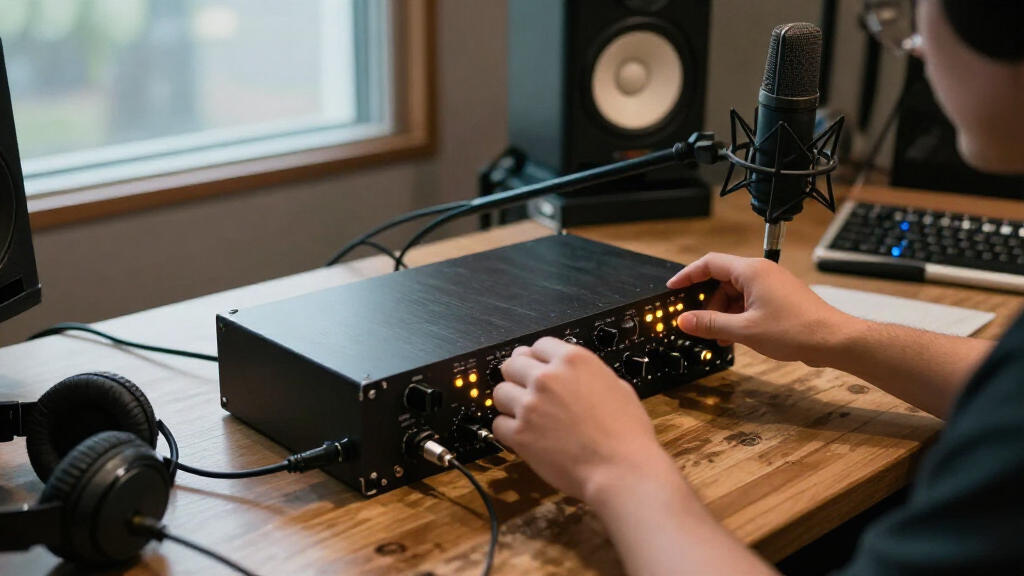
I compared the 15 options by the jobs buyers are trying to solve: recording through a computer, adding gain to a low-output microphone, expanding channel count, or shaping a vocal signal. I gave more weight to products that have a clear role, useful connectivity for that role, and a practical path from microphone to recording system. Channel count, stated gain, phantom-power needs, control layout, and whether processing is onboard all affect how easily a preamp fits into a working studio.
The ranking favors versatility and a clear recording workflow, which puts the Scarlett 2i2 4th Gen ahead of narrower one-mic boosters. The dbx 286s earns a distinct place for integrated vocal processing, while the Cloudlifter CL-1 is judged on its focused gain-boosting use rather than treated as a complete interface. Smaller or less fully documented models rank lower because buyers may have fewer connectivity details or less room to adapt them. I also distinguish interfaces, channel-strip processors, ADAT expanders, and inline boosters rather than comparing them as if they were interchangeable.
Factors to Consider When Choosing Studio Microphone Preamps
Before choosing a model, decide what part of your recording chain is missing. A preamp can raise a mic signal, but it may also be built into an audio interface, paired with processing, or designed to add channels to a larger system. These distinctions matter more than a headline gain figure when you are planning a reliable studio setup.
Decide Whether You Need a Preamp or an Interface
A standalone preamp raises a microphone signal, but it usually needs an interface or recorder afterward to convert that signal for a computer. A USB interface combines mic preamps with inputs, outputs, and computer connectivity, which makes it a more complete starting point for a home studio. Buying an inline booster when you lack an interface will not create a recording path. The reverse mistake is replacing a working interface with a second preamp without checking how they connect. If your system already has suitable inputs, a dedicated preamp or booster may fill a real gap; if not, prioritize the complete signal chain.
Match Gain to the Microphone and Recording Distance
Low-output dynamic and passive ribbon microphones can call for more clean gain, especially when recording quiet sources from farther away. A condenser mic often has its own active electronics and may need less preamp gain, though it does need phantom power from a compatible source. High stated gain alone does not tell you how quiet or suitable a preamp will be in your setup. Think about the microphone’s output, how loud the source is, and how close you can place the mic before selecting a booster. A model intended for dynamic microphones may not serve every mic type or studio task equally well.
Trace Phantom Power Through the Whole Signal Chain
Phantom power has two different jobs in this category: powering some condenser microphones and powering certain inline gain boosters. An inline booster that requires 48V may draw that power from the interface or mixer, while a passive dynamic mic typically does not need phantom power itself. Confirm which device supplies 48V and whether it reaches the relevant connection in the chain. Do not assume that a product mentioning phantom power necessarily provides it to a microphone. Mapping the mic, booster, preamp, and interface connections before buying can prevent a setup that powers the wrong device or leaves a component inactive.
Choose Channel Count for the Sessions You Actually Record
One channel can be enough for solo voice work, but two inputs give you room for stereo recording, a second performer, or a separate instrument mic. Larger channel counts make sense for ensembles and multi-mic sessions, yet they can add complexity if the rest of the system cannot accept them. An ADAT preamp expander, for example, needs a compatible interface with an ADAT input and suitable software routing. Count the sources you record at the same time rather than the number of microphones you own. If sessions are likely to grow, check whether the interface can expand before choosing a small fixed-input model.
Decide Whether Onboard Processing Helps or Gets in the Way
A channel strip can place compression, de-essing, tone shaping, and gating close to the input stage, which can help when you want a controlled vocal signal while recording. Those controls also create more ways to alter a take before you have edited it. A clean interface or simple booster leaves more decisions for recording software and can preserve flexibility for later mixing. Consider whether you want to commit processing during tracking or prefer to keep the recorded signal minimally treated. For a first studio setup, fewer controls can be easier to learn; for a repeatable vocal chain, integrated processing may save space and setup time.
Check Power, Connectors, and Expansion Before You Commit
Compact preamps and adapters can use different power sources, connector formats, and output arrangements, so check the full chain rather than the product name alone. Confirm whether a unit takes USB power, needs an external supply, or relies on phantom power from another component. Look at how its output connects to your interface and whether the required cable is balanced XLR, ¼-inch, or another format. For multi-channel setups, check available computer inputs and software routing as well as the preamp’s channel count. A modest feature set that fits your existing equipment is often more useful than extra gain or processing you cannot connect cleanly.
Frequently Asked Questions
Can I use a Cloudlifter or similar booster without an audio interface?
Usually, no: an inline booster raises a microphone signal but does not provide the analog-to-digital conversion and computer connection of a USB interface. It normally sits between the microphone and a mixer, recorder, or interface that can accept its output. The Cloudlifter CL-1 also needs phantom power from the downstream device to operate. If you do not already have a recording input, a USB interface such as a Scarlett model is the more complete purchase. Check the connection and power requirements of the exact booster before adding one to an existing chain.
Do I need an extra preamp if my interface already has mic inputs?
Not automatically. An interface already contains microphone preamps, and those may provide all the gain and connectivity your microphones require. An additional preamp or inline booster is useful when a specific mic needs more gain, when you want a different set of controls, or when you need more channels. Adding hardware without a defined need can make gain staging and cabling more complicated. Start by identifying whether the issue is insufficient gain, noise, channel count, or missing processing rather than assuming a second preamp will improve every recording.
Can I connect the Behringer ADA8200 directly to my computer?
The ADA8200 is designed as an ADAT-connected channel expander, not as a standalone USB recording interface. You generally need an audio interface or recording system with a compatible ADAT input to carry its channels into a computer. Check the host device’s digital inputs, supported channel count, and software routing before buying an expander. Also confirm that your setup supports the sample-rate and clocking arrangements you plan to use. If you need a direct computer connection without another interface, a USB model is a more straightforward fit.
Should I choose a channel strip or record clean and add processing later?
A channel strip is a good fit when you want hands-on control of dynamics and vocal tone during tracking, or when you need those tools available without relying on software. Recording clean gives you more freedom to revise compression, de-essing, and tonal choices after the performance. Processing on the way in can be harder to undo, so conservative settings matter when you are still learning the signal chain. The dbx 286s offers integrated vocal-oriented processing, while simpler interfaces leave more of that work for recording software. Choose based on whether a consistent live input sound matters more than editing flexibility.
Is a two-input interface worth choosing over a Solo model for a single vocalist?
A Solo interface can suit a single mic-based recording setup if you rarely need another input at the same time. Two mic inputs provide flexibility for interviews, guest vocals, stereo sources, or a vocal and instrument recorded together. The extra channel is useful only if your sessions can use it, so consider the performers and sources you expect to record simultaneously. Also distinguish the Solo Studio bundle, which includes additional recording equipment, from the Solo interface by itself. Choose the simpler model for a fixed one-mic workflow; choose two inputs if shared sessions or future expansion are likely.
Conclusion
For most small studios, I would start with the Focusrite Scarlett 2i2 4th Gen as the best overall pick: it combines two mic inputs with a direct computer-recording workflow. The best value for a focused gain problem is the Cloudlifter CL-1, provided you already have a compatible mic and a source of phantom power; it is not a substitute for an interface. For a best premium-style processing setup, the dbx 286s suits vocalists who want compression, de-essing, and other controls in one channel strip. Beginners are better served by the Scarlett Solo Studio 4th Gen bundle if they want a ready-to-start package, or the Solo interface if they already own a microphone and headphones. For specific needs, choose the ADA8200 to expand a compatible ADAT system, or a dedicated single-channel booster when a low-output dynamic or passive ribbon mic is the only gap to solve. Match the device to your existing signal chain first; that is the clearest way to avoid buying a preamp that cannot do the job you need.