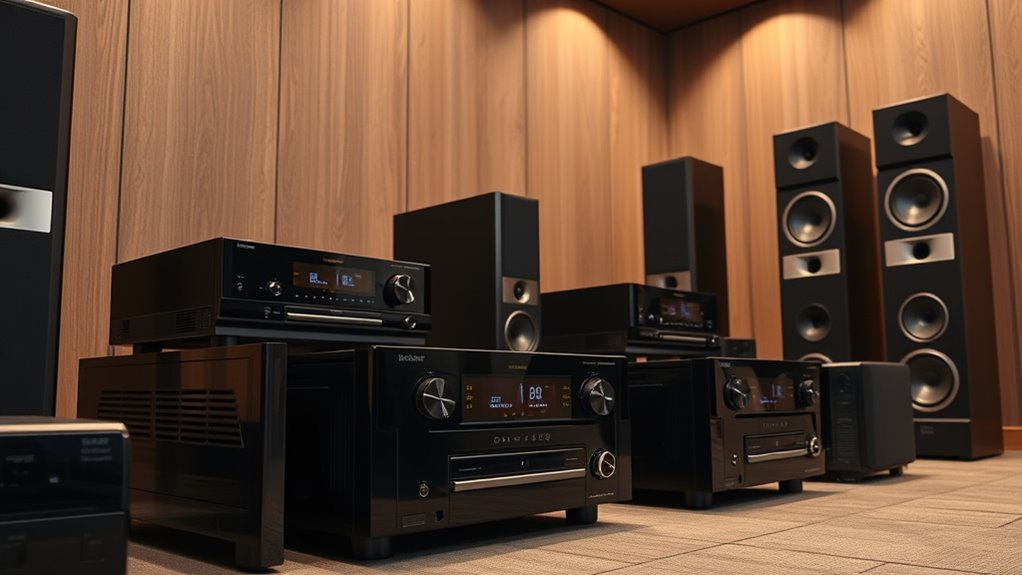

Choosing a high-end Dolby Atmos AV receiver in 2026 means balancing cutting-edge performance with versatile features and build quality. The Yamaha RX-A8A stands out as the best overall for its exceptional sound processing and future-proof 8K support, while the Denon AVR-S970H offers great value with solid 8K capabilities at a more accessible price. However, higher-end models like the Marantz Cinema 60 deliver premium audio refinement, often at a premium cost. Buyers face tradeoffs between raw power, feature sets, and price, especially when prioritizing immersive audio and high-resolution video handling. Keep reading for the detailed breakdown of these options and what makes each one unique.

Get audio and creator gear delivered free with Prime
- Fast, free delivery on millions of items
- Prime Video, Amazon Music and more included
- Member-only deals all year
Complete the kit



Key Takeaways
- The Yamaha RX-A8A leads for its combination of power, future-proofing, and audio quality, but it comes at a premium price.
- Most top-tier receivers support 8K video and Dolby Atmos, yet not all models handle the same number of channels or audio formats equally well.
- Value varies significantly; some models like the Denon AVR-S970H offer robust features at a more accessible price point, though they lack some premium build qualities.
- Build quality and brand reputation are key indicators of long-term reliability in high-end models, often justifying higher costs.
- Ease of setup and user interface can differ, with some premium models offering more intuitive controls or better app integration.


| high end dolby atmos av receiver buying guide | Channels |
|---|---|
| Yamaha RX-A8A AVENTAGE 11.2-Ch | 11.2 |
| Yamaha RX300A 5.2-Channel Home | 5.2 |
| Onkyo TX-NR6100 7.2 Channel TH | 7.2 |
| Sony STR-AN1000 7.2ch Home The | 7.2 |
| Cinema 50 Premium 9.4 Channel | 9.4 |
| TX-NR7100 9.2-Channel THX Cert | 9.2 |
| Yamaha RX300A 5.2-Ch 8K AV Rec | 5.2 |
| Denon AVR-S970H 7.2 Channel 8K | 7.2 |
| Denon AVR-X1800H 7.2 Channel A | 7.2 |
| Yamaha RX-A6A AVENTAGE 9.2-Cha | 9.2 |
| Marantz Cinema 60 Premium 7.2 | 7.2 |
More Details on Our Top Picks
Yamaha RX-A8A AVENTAGE 11.2-Channel AV Receiver with 8K/4K Support, Dolby Atmos, DTS:X, Auro-3D, Wi-Fi, Bluetooth, MusicCast
The Yamaha RX-A8A AVENTAGE stands out for its expansive 11.2-channel setup, delivering truly immersive Dolby Atmos, DTS:X, and Auro-3D sound that surpasses most 7.2 or 9.2 models like the Cinema 50. Its support for 8K and 4K high refresh rate video, combined with advanced HDMI features, makes it a future-proof choice for serious home theater enthusiasts. While its premium build quality and rich sound set it apart, the high price and complex setup are notable tradeoffs. This receiver is ideal for audiophiles or dedicated home theaters where maximum immersion and video quality matter, but less suited for users seeking a simpler, more affordable solution.
Pros:- Supports Dolby Atmos, DTS:X, and Auro-3D for immersive multi-dimensional sound
- Advanced HDMI support for 8K/4K with high refresh rates and HDR formats
- Multiple streaming options and voice control via Alexa, Siri, and Google Assistant
- Premium build quality and comprehensive room calibration
Cons:- High price point may be prohibitive for many buyers
- Setup complexity requires technical knowledge and patience
- Large size demands significant space and proper placement
Best for: High-end home theater enthusiasts who want the best possible audio and video support with room for expansion.
Not ideal for: Casual users or those with limited space who prefer a more straightforward or budget-friendly receiver.
- Channels:11.2
- HDMI Inputs:7-in/3-out
- HDMI Support:8K60 and 4K120
- Video Compatibility:Dolby Vision, HDR10+, HLG, BT.2020
- Room Calibration:YPAO R.S.C. with 3D, multipoint measurement
- Wireless Connectivity:Wi-Fi, Bluetooth, AirPlay 2, MusicCast
Our verdict“This pick makes the most sense for serious home theater fans who prioritize top-tier audio and future-proof video features and are willing to invest in setup and space.”
Yamaha RX300A 5.2-Channel Home Theater AV Receiver with Dolby Atmos, 4K120/8K HDMI, Bluetooth (Renewed)
The Yamaha RX300A offers a compelling balance between performance and affordability, supporting Dolby Atmos and DTS Virtual:X in a 5.2-channel configuration that suits smaller rooms or more modest setups. Compared with the Yamaha RX-A8A, it sacrifices channels for a more streamlined design, but still provides support for 8K/4K video and automatic room calibration, making it accessible for users seeking quality without the complexity or cost of higher-end models. Its Bluetooth Multipoint enhances wireless streaming, though being a renewed product could pose warranty concerns. This receiver is well-suited for users who want Dolby Atmos sound in a smaller space or with a tighter budget, but less ideal for those craving larger, more immersive setups.
Pros:- Supports Dolby Atmos and DTS Virtual:X for immersive sound
- Supports 8K/4K video with HDR and Dolby Vision
- Wireless streaming with Bluetooth Multipoint
- Automatic room calibration for easy setup
Cons:- Renewed condition may limit warranty or reliability
- Limited channels and power may not fill large rooms effectively
- Less future-proof for expanding multi-zone configurations
Best for: Homeowners with smaller rooms or budget-conscious buyers wanting Dolby Atmos without multi-zone complexity.
Not ideal for: Audiophiles or users wanting extensive multi-channel setups or the latest high-end features for large spaces.
- Channels:5.2
- Power Output:70W per channel
- HDMI Support:4K120/8K60, eARC/ARC, Dolby Vision
- Connectivity:Bluetooth, Coaxial, HDMI, Optical
- Room Correction:Yes
- Speaker Layouts:Including 3.1.2 with up-firing or in-ceiling heights
Our verdict“This receiver is a smart choice for smaller spaces or budget-conscious users seeking Dolby Atmos at a lower price point, with some tradeoffs in power and expandability.”
Onkyo TX-NR6100 7.2 Channel THX Certified Network AV Receiver – Black
The Onkyo TX-NR6100 earns its place with THX Certification, ensuring it meets rigorous standards for clarity, surround accuracy, and overall sound quality. Its 7.2 channels and Dolby Atmos support deliver engaging immersive audio, comparable to the more elaborate Yamaha RX-A8A, but with a focus on high-quality, certified sound performance. The 8K HDMI 2.1 support makes it well-suited for cutting-edge video, though its slightly lower channel count means it may not match the ultimate surround experience of larger systems like the Cinema 50 or Yamaha RX-A8A. Its complex setup might challenge less experienced users, but audiophiles and demanding home theater enthusiasts will appreciate its certified performance and robust amplification.
Pros:- THX Certified for superior sound quality and accuracy
- Supports Dolby Atmos and DTS:X with 8K HDMI 2.1
- Powerful 210W per channel amplification for dynamic sound
- Multi-zone audio and video capabilities
Cons:- No specific price info available, potentially expensive
- Setup complexity may deter less experienced users
- Limited to 7.2 channels, less immersive than 9.4 or 11.2 systems
Best for: Audiophiles or home theater aficionados who value certified high-fidelity sound and high-quality video support in a mid-sized system.
Not ideal for: Casual users or those seeking simple plug-and-play solutions without the need for technical setup.
- Power:210 W/Ch
- Channels:7.2
- Certification:THX Certified
- HDMI:8K with HDMI 2.1
- Zones:Discreet Zone 2
Our verdict“This receiver suits users who prioritize high-fidelity, certified audio performance along with robust video support, especially in mid-sized rooms.”
Sony STR-AN1000 7.2ch Home Theater 8K A/V Bluetooth Receiver
The Sony STR-AN1000 impresses with its versatile connectivity options, including Bluetooth, Wi-Fi, Chromecast, and AirPlay, making it ideal for multi-zone streaming and easy integration into a modern smart home. Its support for Dolby Atmos, DTS:X, and HDR formats offers immersive sound comparable to other 7.2 channels like the Onkyo TX-NR6100, but with a user-friendly graphical setup interface that appeals to less tech-savvy users. The 8K HDMI support future-proofs the system, though its 165W power may be less dynamic for large rooms. This model is best for users wanting seamless streaming and multi-zone flexibility without complex calibration, but it may fall short for those seeking maximum raw power or multi-channel expansion.
Pros:- Supports Dolby Atmos, DTS:X, HDR, and 8K HDMI 2.1
- Multiple streaming options including Chromecast, AirPlay, Bluetooth
- Graphical interface simplifies setup
- Multi-zone distribution for zones 2 and 3
Cons:- Power of 165W may limit performance in large spaces
- Complex features might overwhelm beginners
- Requires 120V power supply, not plug-and-play internationally
Best for: Homeowners wanting easy streaming, multi-zone distribution, and future-proof HDMI in a user-friendly package.
Not ideal for: Power users or audiophiles seeking maximum raw sound output or larger multi-channel systems.
- Channels:7.2
- Power:165 W at 6 ohms
- HDMI Support:8K & 4K/120 with HDMI 2.1
- Supports:Dolby Atmos, DTS:X, Dolby Vision, HDR10, IMAX Enhanced
- Connectivity:Bluetooth, Wi-Fi, Chromecast, AirPlay
- Setup:Graphical interface
Our verdict“This receiver is a solid choice for smart home users who want reliable multi-zone streaming and immersive audio without complicated calibration.”
Cinema 50 Premium 9.4 Channel AV Receiver Powered by HEOS with Dolby Atmos, 110W, 8K, and 6 HDMI Inputs
The Cinema 50 stands out with its 9.4 channel configuration, providing a powerful and immersive Dolby Atmos experience that rivals larger systems like the Yamaha RX-A8A. Its 110W per channel, combined with support for 8K video and six HDMI inputs, makes it well-suited for serious home theater setups craving multi-channel surround and multi-zone flexibility. The inclusion of HEOS streaming and advanced room calibration via Audyssey MultEQ XT32 ensures tailored sound quality, though the system’s complexity and price can be drawbacks for casual users. This receiver is ideal for those seeking a high-power, multi-channel experience with room for future expansion, but less so for smaller spaces or budget-minded buyers.
Pros:- Supports Dolby Atmos, DTS:X, and Auro-3D for immersive multi-dimensional sound
- Powerful 110W per channel for dynamic audio performance
- Multiple HDMI inputs with 8K support for versatile connections
- High-resolution streaming via HEOS with room calibration
Cons:- Premium price may be out of reach for some buyers
- Complex setup requiring calibration and technical knowledge
- Large form factor needs significant space
Best for: Audiophiles and home theater enthusiasts wanting a high-powered, immersive 9.4 channel experience with room calibration and streaming.
Not ideal for: Users with limited space or those seeking a simpler, more affordable 7.2 system without extensive calibration needs.
- Channels:9.4
- Power per channel:110 W
- HDMI Inputs:6
- Video Resolution:8K
- Streaming:HEOS
- Calibration:Audyssey MultEQ XT32
Our verdict“This receiver targets users demanding high power, sophisticated multi-channel audio, and room calibration for premium home theater experiences, accepting the associated complexity and cost.”
TX-NR7100 9.2-Channel THX Certified AV Receiver
The TX-NR7100 stands out for its comprehensive feature set, including Dirac Live room calibration and 8K/60Hz HDMI processing. Compared with the Yamaha RX-A6A, it offers more channels and a higher level of calibration precision, making it ideal for those seeking the ultimate audio customization. However, its complex setup and premium price mean it’s better suited to users comfortable with technical configurations and with a sizable budget. The inclusion of seamless streaming, smart home integration, and Dolby Atmos/DTS:X support makes it a versatile centerpiece, but the need for additional calibration microphones can be a hurdle for some. Best for dedicated home theater aficionados who want top-tier sound and video quality, and are willing to invest the time and money.
Pros:- Supports immersive Dolby Atmos and DTS:X sound formats
- Advanced room calibration with Dirac Live for precise audio tuning
- High-quality 8K HDMI processing with multiple outputs
- Seamless streaming and smart home compatibility
Cons:- Complex setup requiring technical expertise
- Premium price point may be prohibitive for some
- Requires additional microphones for optimal calibration
Best for: Home theater enthusiasts with technical knowledge and high-performance expectations
Not ideal for: Casual users or those seeking a simpler, plug-and-play setup
- Channels:9.2
- HDMI Out:3
- HDMI 8K/4K Transfer:Yes
- Room Correction:Dirac Live
- Bluetooth:Yes, SBC, AAC, aptX, aptX HD
- Dolby Atmos:Yes
Our verdict“This receiver is perfect for dedicated audiophiles wanting the best sound and video quality, despite its complexity and cost.”
Yamaha RX300A 5.2-Ch 8K AV Receiver Bundle with AudioQuest Sky HDMI Cable
The Yamaha RX300A bundle offers a compelling entry point into high-end Dolby Atmos and 8K video support, with a well-regarded 5.2 channel configuration. While it doesn’t match the power or channel count of the RX-A6A or TX-NR7100, it’s a solid choice for those new to high-end AV, especially with the included AudioQuest Sky HDMI cable that guarantees reliable performance. Its smart streaming options and room calibration simplify setup, but its complexity may challenge beginners. Compared to the Denon AVR-X1800H, the RX300A’s emphasis on streaming and calibration makes it more user-friendly for those starting out, though it sacrifices some power and expandability. This pick makes sense for newcomers who want the latest features without the overwhelming complexity or cost.
Pros:- Supports 8K60, 4K120, HDR10+, Dolby Vision for high-quality visuals
- Includes high-quality HDMI cable for dependable connectivity
- Smart streaming options and room calibration ease setup
- Supports Dolby Atmos, DTS:X virtualization
Cons:- May be complex for users unfamiliar with AV setup
- Limited channel capacity for large or complex home theaters
Best for: Beginners seeking a reliable 8K-capable AV receiver with a strong feature set
Not ideal for: Advanced users needing more channels or higher power for large rooms
- Channels:5.2
- Video Support:8K60, 4K120, HDR10+, Dolby Vision
- HDMI Bandwidth:48Gbps
- Connectivity:Wi-Fi, Bluetooth, AirPlay, MusicCast
- Included Cable:AudioQuest Sky HDMI
- Supported Audio Formats:Dolby Atmos, DTS:X
Our verdict“Ideal for newcomers wanting a straightforward, feature-rich 8K receiver with a bundle that simplifies setup.”
Denon AVR-S970H 7.2 Channel 8K UHD AV Receiver (90W x 7), Wi-Fi, Bluetooth
The Denon AVR-S970H offers a well-balanced mix of power, features, and ease of use, supporting 7.2 channels with 90W per channel. Its support for 8K/60Hz pass-through and multiple HDR formats makes it a strong competitor to the Yamaha RX-A6A, especially for users who want seamless 8K integration without sacrificing sound quality. Its easy setup with advanced calibration and multi-room streaming options appeal to home theater lovers seeking simplicity coupled with high performance. The tradeoff is that it offers fewer channels than the Yamaha RX-A6A or TX-NR7100, which may limit future expandability. Compared to the Yamaha, it provides a more straightforward user experience but with less channel flexibility. This receiver suits users who want reliable, immersive sound with excellent video support, without the complexity of higher channel counts.
Pros:- Supports 8K/60Hz pass-through and high dynamic HDR formats
- Supports Dolby Atmos, DTS:X for immersive sound
- Easy setup with advanced calibration features
- Multi-room streaming via Wi-Fi and Bluetooth
Cons:- Fewer channels than higher-end models like the Yamaha RX-A6A
- Limited power output for large or demanding rooms
Best for: Home theater enthusiasts wanting strong 8K support with straightforward setup
Not ideal for: Users requiring extensive multi-zone or higher-channel configurations
- Channels:7.2
- Power per channel:90W
- HDMI ports:8
- 8K pass-through:Yes
- Supported audio formats:Dolby Atmos, DTS:X
- Streaming:Wi-Fi, Bluetooth
Our verdict“A flexible, easy-to-use 8K receiver ideal for users wanting high-quality sound and video without complexity.”
Denon AVR-X1800H 7.2 Channel AV Receiver with 8K HDMI, WiFi, Bluetooth
The Denon AVR-X1800H combines robust features with a more approachable price point, supporting 8K HDMI pass-through and multiple HDR formats like Dolby Vision and HDR10+. It’s comparable to the AVR-S970H but emphasizes versatility with support for DTS:X and DTS Virtual:X, giving it an edge for those seeking immersive audio options. While it lacks the channel expansion of the Yamaha RX-A6A, its user-friendly design and wireless streaming capabilities make it suitable for a broad range of enthusiasts. The main limitation is its fewer HDMI inputs and the potential difficulty for absolute beginners to fully grasp all features. Compared to the more complex Yamaha, it offers a more straightforward experience but at a slightly lower power output. This receiver makes sense for those on a budget who still want high-quality video and immersive audio support.
Pros:- Supports 8K/60Hz pass-through and HDR formats
- DTS:X and DTS Virtual:X support for immersive audio
- Wireless streaming via Wi-Fi and Bluetooth
- Easy multi-room audio with HEOS
Cons:- Limited HDMI inputs for larger setups
- Lower power output may not suit large spaces
Best for: Budget-conscious buyers wanting versatile 8K support and multi-format audio
Not ideal for: Large rooms requiring extensive power and channel expansion
- Channels:7.2
- Power:80W
- HDMI Inputs:3
- 8K HDMI:Yes
- Supported formats:Dolby Atmos, DTS:X, DTS Virtual:X
- Wireless:WiFi, Bluetooth
Our verdict“A well-rounded, budget-friendly choice for users seeking reliable 8K video and immersive audio options.”
Yamaha RX-A6A AVENTAGE 9.2-Channel AV Receiver with 8K HDMI, Dolby Atmos, DTS:X, Auro-3D, Wi-Fi, Bluetooth, MusicCast
The Yamaha RX-A6A offers a substantial upgrade in channel count and supported formats, including 9.2 channels, Dolby Atmos, DTS:X, and Auro-3D. This makes it ideal for large, immersive home theaters where multi-dimensional sound truly shines. Its 8K HDMI support and advanced room calibration ensure superior video quality and sound tuning. Compared with the TX-NR7100, it provides fewer channels but excels in multi-format support and multi-dimensional sound experiences. Its considerable weight and complexity might be overkill for smaller spaces or casual users, but it’s the choice for serious audiophiles seeking premium multi-channel sound. The inclusion of MusicCast and compatibility with Sonos enhances streaming flexibility. This is best for those who want a high-end, multi-format, multi-dimensional sound setup with room to grow.
Pros:- Supports 9.2 channels with Dolby Atmos, DTS:X, and Auro-3D
- Supports 8K HDMI and latest video standards
- Advanced room calibration with YPAO R.S.C.
- Multiple streaming options including MusicCast and Sonos compatibility
Cons:- Heavy and large, requiring significant space
- Setup can be complex for non-technical users
- Higher price point
Best for: Audiophiles and large room setups requiring multi-format, multi-channel immersive sound
Not ideal for: Small spaces or users with limited room for a heavy, complex receiver
- Channels:9.2
- HDMI Ports:10
- Supported Video:8K60, 4K120
- Supported Audio:Dolby Atmos, DTS:X, Auro-3D
- Connectivity:Wi-Fi, Bluetooth, MusicCast
- Power Output:150W
Our verdict“This premium receiver suits those who demand the highest multi-format, multi-channel immersive audio in large or dedicated home theaters.”
Marantz Cinema 60 Premium 7.2 Channel AV Receiver with HEOS and Dolby Atmos
The Marantz Cinema 60 stands out for its ability to deliver immersive Dolby Atmos and DTS:X surround sound, rivaling the Yamaha RX-A8A’s more extensive 11.2 channels but at a more manageable 7.2 setup. Its support for 8K pass-through and the latest HDR formats makes it well-suited for those planning future upgrades, especially compared to the Denon AVR-S970H, which offers similar video capabilities but less audio calibration precision. The built-in HEOS streaming provides seamless access to high-resolution music services, a feature that surpasses Onkyo’s simpler network options. However, its setup can be complex, requiring a tech-savvy user, and its premium price may be prohibitive for casual enthusiasts. The bulkier design also demands more space, which might be a concern for compact setups. Overall, this receiver is a top choice for dedicated home theater fans who want premium sound, advanced video support, and integrated streaming.
Pros:- Exceptional Dolby Atmos and DTS:X immersive sound quality
- Supports 8K video pass-through and the latest HDR formats
- Built-in HEOS for seamless high-resolution streaming
- Multiple HDMI inputs including 3 with 8K support
Cons:- Setup process can be complex and intimidating for beginners
- Higher price point may be beyond casual or budget-conscious buyers
- Bulkier design requires ample space and proper placement
Best for: Aficionados who prioritize audio quality, future-proof video features, and integrated streaming in a high-end setup.
Not ideal for: Casual users or those with limited space who prefer simpler, more straightforward AV receivers without advanced calibration or multi-channel configurations.
- Channels:7.2
- Power per channel:100 W
- HDMI inputs:6
- HDMI outputs:2
- 8K pass-through:Yes
- Supported formats:HDR10+, HDR10, Dolby Vision, HLG
Our verdict“This receiver is ideal for serious home theater enthusiasts who want premium audio, advanced video capabilities, and integrated streaming, despite its complexity and cost.”
How We Picked
The receivers in this roundup were selected based on a combination of performance, build quality, feature set, and value. We prioritized models that support Dolby Atmos at the highest resolutions, with a focus on future-proofing features like 8K HDMI support and multiple channels for immersive sound. Ease of use, connectivity options, and brand reputation also played key roles. Our rankings reflect a balance between these factors, aiming to recommend options suited for different types of high-end home theater enthusiasts—whether they seek ultimate performance, value, or user-friendly features. While all models are high-end, their roles differ, from flagship audiophile options to more versatile, budget-conscious choices.Factors to Consider When Choosing High End Dolby Atmos Av Receiver Buying Guide
Selecting a high-end Dolby Atmos AV receiver involves understanding a few core factors that impact both performance and usability. Beyond raw specs, it’s crucial to consider how well a receiver integrates with your existing setup, its future-proofing capabilities, and how it handles high-resolution audio and video signals. Making the right choice means weighing these broader considerations against your specific needs and budget. Here are the key aspects to keep in mind:Channel Count and Power
The number of channels determines how many speakers you can connect for immersive sound. Most high-end models support 7.2 or 9.2 configurations, with some offering 11.2 channels for larger setups. Power output per channel influences how loud and dynamic your sound remains at high volumes without distortion. Balancing channel count and power ensures your system can deliver the full Dolby Atmos experience, especially with large or multiple listening zones.
Video Compatibility and HDMI Support
Future-proofing your setup means choosing a receiver with support for 8K video and HDMI 2.1 features like 4K120Hz passthrough and variable refresh rate (VRR). These capabilities allow your system to handle the latest gaming consoles and streaming sources at the highest resolutions. Skipping on robust HDMI support might save money upfront but can limit your setup’s compatibility with upcoming devices and content formats.
Audio Format Support and Processing
High-end models should support Dolby Atmos, DTS:X, and Auro-3D to maximize immersive sound. The ability to process multiple formats ensures compatibility with various disc and streaming sources. Advanced digital signal processing (DSP) can also enhance sound clarity and spatial accuracy. Be cautious of models that claim Atmos support but lack the processing power to deliver complex multi-layered audio experiences.
Connectivity and Smart Features
Consider how well the receiver integrates with your smart home ecosystem, including Wi-Fi, Bluetooth, and streaming services. Easy-to-use apps and voice control can simplify daily operation. Additionally, multi-room audio support via platforms like MusicCast or HEOS adds versatility. Don’t overlook the importance of reliable connectivity and user-friendly interfaces in high-end models.
Build Quality and Reliability
Premium materials and solid construction ensure longevity, especially in high-performance models that generate more heat and require stable power supplies. Reputable brands tend to offer better support and firmware updates, which extend their useful life. While investing more initially might seem steep, the durability and consistent performance of well-built receivers often justify the cost.
Frequently Asked Questions
Do I need an 8K-compatible receiver for Dolby Atmos setup?
Having an 8K-compatible receiver is highly recommended for future-proofing, especially if you plan to upgrade your TV or projector soon. While current Dolby Atmos content is primarily delivered via 4K, 8K support ensures your system remains compatible with upcoming high-resolution sources. This feature also often accompanies additional HDMI 2.1 features, which improve overall video and gaming performance. Opting for an 8K-capable model now can save you from needing an upgrade in a few years.
Is channel count more important than power output in high-end AV receivers?
Channel count determines how many speakers you can connect for immersive sound, but power output affects how loudly and cleanly the system can play at high volumes. For most home theaters, a higher channel count allows for more surround speakers, while sufficient power ensures those speakers produce clear, distortion-free sound. Ideally, you want a balance—enough channels for your setup and enough power for dynamic, immersive audio. In very large rooms, higher power becomes especially critical.
Should I prioritize brand reputation over features?
Brand reputation can be a good indicator of reliability and ongoing support, but it shouldn’t be the only factor. High-end brands like Yamaha, Denon, and Marantz are known for quality, but specific features—like multi-room support, user interface, and future-proof HDMI capabilities—may be more relevant to your needs. Evaluate each model based on how well it matches your use case, then consider the brand’s track record for longevity and support. This approach helps ensure you get both quality and the features you need.
Is it worth paying extra for premium audio processing features?
Investing in advanced digital signal processing can significantly enhance your listening experience, especially if you prioritize sound quality in movies and music. Premium audio processing offers more precise spatial imaging and dynamic range, which is crucial for a truly immersive Atmos experience. However, not all users will notice a difference in everyday use, so consider whether the added cost aligns with your audio expectations and setup complexity. For audiophiles and dedicated home theater enthusiasts, the extra investment often pays off in improved sound clarity and realism.
How important is ease of setup and user interface in high-end receivers?
Ease of setup and a clear user interface can greatly reduce frustration, especially with complex systems that support multiple zones, speakers, and smart integrations. High-end models often include advanced calibration tools and mobile apps that simplify configuration, but some interfaces remain less intuitive. Investing in a receiver with straightforward setup procedures and responsive controls ensures you spend less time troubleshooting and more time enjoying your system. For those less tech-savvy, this can be a decisive factor in overall satisfaction.
Conclusion
For most enthusiasts seeking the best overall experience, the Yamaha RX-A8A offers unmatched performance and future-proofing, making it ideal for serious home theater setups. If you want a solid balance of features and cost efficiency, the Denon AVR-S970H provides excellent value without sacrificing core capabilities. Buyers new to high-end home theaters should consider models with more straightforward interfaces, like the Sony STR-AN1000, to ease setup. Premium audiophiles and larger setups will find the Marantz Cinema 60 or Yamaha RX-A6A perfect for their demanding, immersive audio needs. Ultimately, your choice should reflect your specific priorities—whether it’s power, usability, or long-term reliability.Halloween Picks
halloween
As an affiliate, we earn on qualifying purchases.